Vatican City - The cliques that Silere non possum has brought to light over the years are numerous, and so are the articles that have documented, with evidence and names, their existence and how they operate. The latest, chronologically speaking, takes the form of a real system of amoral familism: a structured group that in recent years has attempted - and still attempts today - to manoeuvre and control Vatican information.
On the one hand, there are those who bring their personal desires into the office, as we explained in relation to Matteo Bruni, making the atmosphere unbreathable. On the other, there are those who experience the spaces of the Holy See Press Office as genuine places of power. Andrea Tornielli, Paolo Ruffini, Andrea Monda: three figures who interpret their roles not as a service, but as trenches from which to manage and fuel internal struggles and factions. Tornielli has always done this: even when he was at La Stampa, where he was used by cardinals and bishops precisely for this kind of work. That is what he is known for. And that is also what Bergoglio knew him for.
A power system built on “knowing”
This system of power is built on knowing. Not knowing in the intellectual or cultural sense, let that be clear: there is very little of that in these people. It is gossip-knowledge: stories, acquaintances, appointments before they become public, measures, indiscretions. Knowing things that others do not know. That is what, in their magical bubble, gives them power. I know, you do not. I matter, you do not. And if I know, I can blackmail. I can exert pressure.
This system was disrupted when Silere non possum began its work in 2021. And it drove them mad. On the one hand, because Silere non possum brings to light dynamics that no one has the courage to speak about, but which many people inside here know about. On the other, because Silere non possum does not get its information from them - and this has always infuriated them - and, above all, reveals it before they can use it as a source of power. If the news is public, everyone knows it and no one can use it as leverage. In other words, Silere non possum broke their toy. And entire careers have practically gone to ruin.
Silere non possum does not publish - and has never published - in order to show that it knows things. We do not need to, and we feel no need to do so. We publish, when we do, precisely to break this chain of power. We have seen proof of this over the years: not only genuine Vatican correspondents, but also various impostors have begun to wander around the magical and playful para-Vatican galaxy, convinced that they are somebody, or that they could become somebody by writing about the Vatican. Copying here and there, recounting here and there the little they had learnt from their friar friend - duped for the occasion - a friar whose profession, in practice, is gossiping. Someone, however, made him believe that what he did in the halls of politics could be transplanted here into the Vatican: groupings, “background briefings”, “exclusives”. All of them duly contradicted by the facts. But this is precisely what we can no longer afford, and this is precisely what Leo XIV began to dismantle from the very first day of his pontificate.
A sick world with nothing Catholic about it
The world of Vatican journalism is a sick world, with nothing Catholic about it. We have spoken about this extensively over the years: not only about Franca Giansoldati or those who populate the newsrooms of Italian newspapers, but also about those who work for the Holy See. In other words, those whom we pay. And let this be noted carefully: there are not only camps between modernists and traditionalists; within both camps, the same sick dynamics can be found.
Think of those we christened psycho-blogs, and who are now known by that name: with their honeyed and false manner, they try to establish contact with these Vatican correspondents — the same people whom they then constantly insult, both publicly and privately. The Vatican correspondents, for their part, feel important simply because they are being considered, and therefore they validate them. Thus, even while belonging to opposing camps, they end up fuelling the same factional dynamics together. Meanwhile, anyone who exposes their little secrets and breaks these dynamics automatically becomes their sworn enemy.
Over these years, Silere non possum has been accused by these playful figures of being divisive. We, who have always brought to light the critical issues of Pope Francis’ pontificate with respect, are supposedly divisive. We, who criticised him without any personal interest, were divisive; they, who instead did everything for money and personal advantage, were the good ones.
Take Fabrizio Mastrofini, for a long time an employee of the Dicastery for Communication and spokesman for Vincenzo Paglia during the years of the Academy for Life. During the pontificate of Francis, he spent his time shouting - with that good breeding that belongs to him - at anyone who honestly and politely dared to criticise the Pope. Today, again honestly and politely, he spits venom at Leo XIV and his collaborators for the simple reason that they showed him the door and no longer take him into consideration. One of those whose salary we paid, and whose pension we now pay. In the end, it is only about power, interests and the grand ambitions of figures who, by chance, found no space elsewhere. For years, the Vatican has become the refugium peccatorum of those who, in a country such as Italy - already embarrassing in itself - cannot find a place. And they all end up here, in this funnel called Via della Conciliazione. This is why people should be hired who have nothing to do with Italy and these circles.
Today the drama is particularly dangerous for the Pope himself. With Francis, at least, they had an interest in praising him. With Leo XIV they have chosen to side with the ranks of the dissenters. And not those transparent dissenters who, with intellectual honesty, some knew how to be during the time of Francis: they do it in a devious way, with that clerical hypocrisy learnt from Beniamino Stella and Pietro Parolin. To your face they smile; behind your back they stab you. I criticise the Pope in conversation, in exchanges with other journalists, with friends, with people; but in front of the camera and in the “major editorials” I present myself as professional. The problem is that they sponsored the previous pontificate so heavily that their current coldness is noticeable. Very noticeable.
One year after his election, Leo XIV must free himself of these figures as soon as possible. Otherwise, what happened with Benedict XVI will happen again. Nothing different: they will wage war from within while we - incredibly - continue to pay them staggering salaries. For themselves and for their loyalists brought in from Catanzaro, moreover, they always find a way to trigger pay-grade increases and inflate payslips.
The encyclical case: a real-time demonstration
As concrete proof of what we are saying - in addition to what has already been made public in the first instalment of the investigation The Dirty Pact, and what we will publish in the next ones - it is enough to observe what happened in the last few hours. Last October, Silere non possum made public the title of Leo XIV’s first encyclical. A title that, in Piazza Pia and Via della Conciliazione, they had not the faintest idea about. Andrea Tornielli, predictably, got a bout of indigestion. From that moment on, however, we did not allow ourselves to write anything else about the text: we wanted to leave the Pope entirely free to correct it and arrange it as he saw fit. Some drafts went out - only in the useful parts - so that they could be submitted to certain figures and observations could be gathered. In Piazza Pia and Via della Conciliazione, of course, they did not arrive. They arrived only when it became necessary to send them, in order to give the LEV time to lay out and print them. The text reached the Press Office only a few hours beforehand, just enough time to let the Vatican correspondents have it slightly in advance, but not too much.
And here is the point: from the moment the text was sent to the Dicastery, it began to circulate. To bounce from WhatsApp to WhatsApp. Because the subtext, as always, is only one: I have the encyclical, I matter. I know what it says. And so, right on time, posts appeared on social media speaking of the Tower of Babel, and so on.
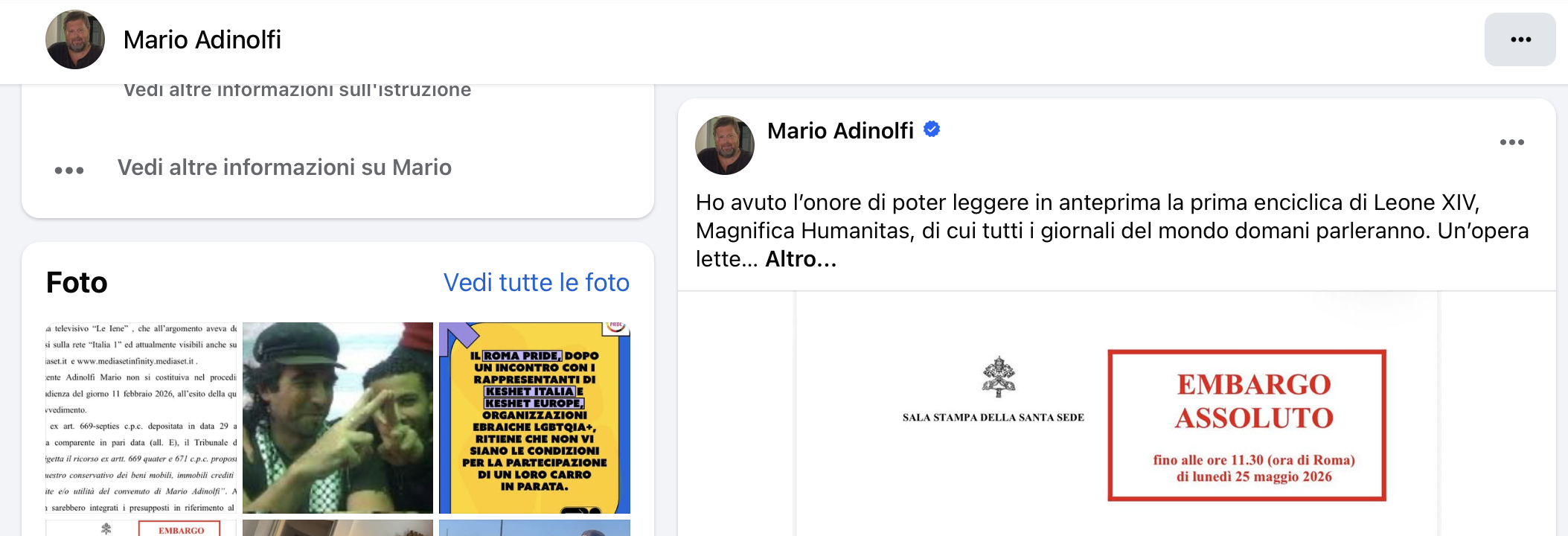
Mario Adinolfi - a figure sadly known for his life and his statements - even went so far as to publish on social media the screenshot of the first page sent by the Press Office to journalists, complete with the wording “Under absolute embargo”, declaring that he had had the privilege of reading it. Now, Adinolfi received that encyclical from an accredited journalist: he had no privilege of any kind. But, after all, we know this; we always return to the same point. These are the figures who move, officially and unofficially, around the world of Vatican information. We are talking about figures who are a contradiction in terms in their very existence: they speak of the traditional family after having scattered children with different wives; they speak of tradition when there is nothing traditional about them. These are the subjects who gravitate around Andrea Tornielli, Bruni, Monda, Ruffini. Those who live off politics and friendships, known for their embarrassing stories and militant allegiances. Meanwhile, Adinolfi’s screenshot made public, several hours before the embargo, part of the index. From Piazza Pia, no one said a word.
Double standards
Let us recall that, a few years ago, a well-known Vatican correspondent had his accreditation removed for a period because he had published the text of Laudato Si’ as an exclusive. They removed it even though it had not been the Press Office that had given it to him, and even though he had published it before the Press Office had distributed it under embargo. An absurd practice, which makes very clear how accreditation is more of a problem than a privilege: they have you by the throat and prevent you from publishing. “If you publish, I will remove your accreditation” is the permanent subtext. But this, of course, always and only applies to some people. Only to those without the right friends and contacts. Otherwise Matteo Bruni would have to concern himself with all those Vatican correspondents who, as soon as they received the text of the encyclical, immediately began forwarding it to colleagues, friends, relatives, priests, bishops. Always for the same reason: “I matter, I have the text!”
The distance between the Pope’s words and the actions of his collaborators
This is the world of Vatican communication, and many know it well. Some wallow in it; others suffer it in silence. None of this has anything to do with what Pope Leo XIV has been preaching for months: good communication, disarming words, the healthiness of environments, respect, friendship. If we want certain words truly to carry weight, we must ensure that those who put them into practice first are our own collaborators. And it is clear that these figures are not the right ones to be around the Pope.
d.L.V.
Silere non possum