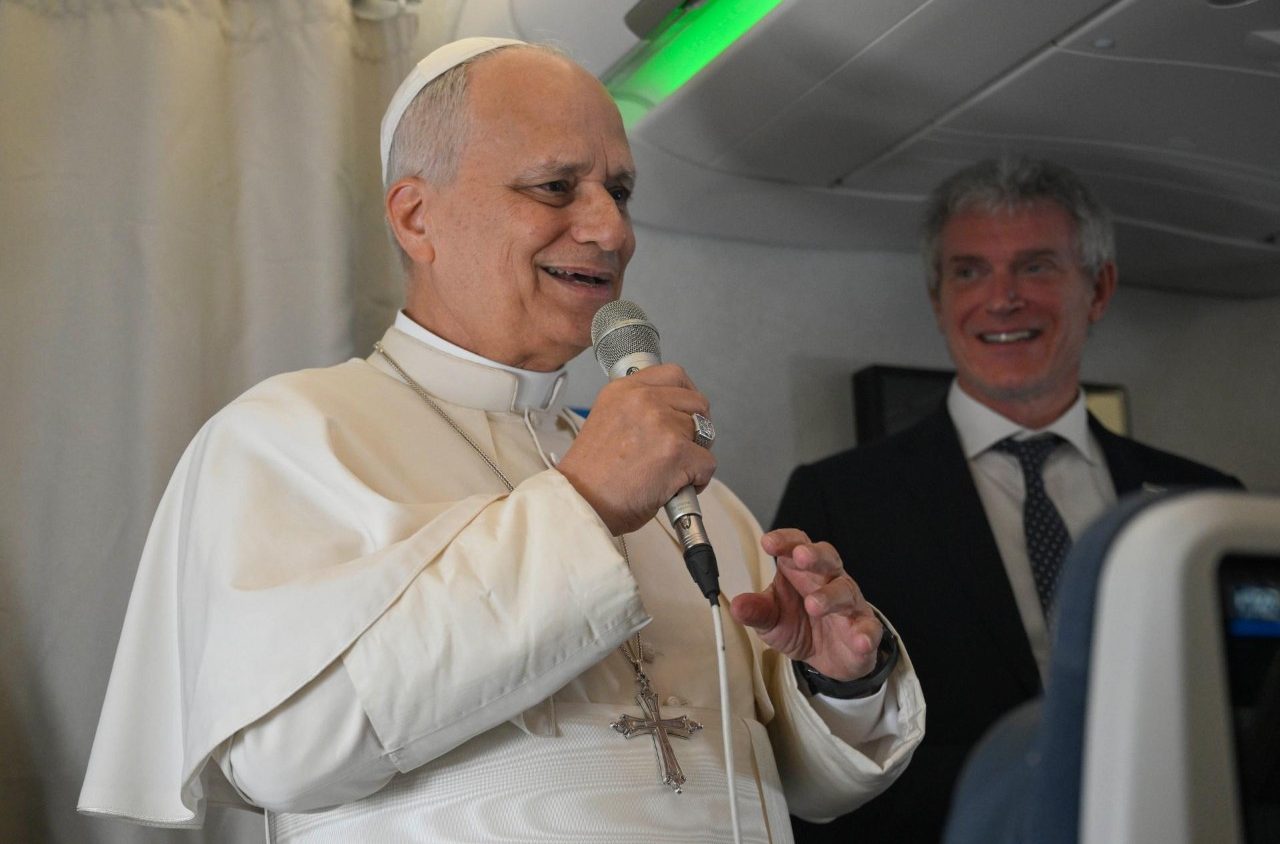
Vatican City - ‘Good morning, everyone. I hope you are well, and ready for another journey. With your batteries already recharged!’ With a tone that was both ironic and paternal, Leo XIV opened the traditional in-flight press conference at the end of his third international Apostolic Journey, which took him to Algeria, Cameroon, Angola and Equatorial Guinea. From the aircraft travelling from Malabo to Rome, the Pontiff answered questions from five of the roughly seventy journalists accompanying him, touching on some of the most sensitive issues in current international and ecclesial affairs: the war involving the United States, Israel and Iran, migration, the Holy See’s relationship with authoritarian regimes, the question of the blessing of same-sex couples raised by Cardinal Reinhard Marx in Munich, and the death penalty.
The key to understanding the journey
Before turning to the questions themselves, Leo wanted to offer a way of reading the journey that had just ended, distancing himself from what he implicitly described as an excessive political polarisation in the way papal trips are interpreted. ‘Very often the interest expressed is more political: “What does the Pope say about this or that issue? Why doesn’t he judge the government in one country or another?”’ he observed, acknowledging that there are indeed ‘many things to say’. But, he insisted, that is not the heart of the journey: it should be understood above all as ‘an expression of the desire to proclaim the Gospel, to announce the message of Jesus Christ’, a way ‘of drawing close to the people in their happiness, in the depth of their faith, but also in their suffering’. It is an approach that does not exclude comment, nor the encouragement of Heads of State ‘to take responsibility’, to embrace ‘a change of mindset’ and to ‘consider issues such as the distribution of a country’s resources’, but which finds its centre of gravity in walking alongside the People of God. Necessary words for a travelling press corps made up of Vatican correspondents who, even before departure, had already decided to say little about this journey because they had described it as ‘a pointless trip’. In other words, there is nothing new under the sun: the method is always the same - not to speak about what does not fit their framework. Leo, however, continues on his way without concern for this toxic modus agendi and, speaking in particular of Equatorial Guinea, recalled the blessed rain welcomed as a gift and ‘this sign of sharing with the universal Church what we celebrate in our faith’.
On Iran: ‘the issue is not regime change’
After such an introduction, Ignazio Ingrao naturally asked a political question. What surprise is there in that? The first question concerned the crisis triggered by the attacks of the United States and Israel on Iran, and the resulting chaos in negotiations, with Ingrao referring to the speech delivered in Bamenda, Cameroon, on the ‘handful of tyrants’ who risk destroying the planet. Asked about the prospect of regime change in Tehran, Leo rejected the very framing of the question: ‘The issue is not whether there is regime change or not; the issue is how to promote the values we believe in without the death of so many innocent people.’ The Pope said he had read the letter from some of the families of children killed on the first day of the attacks, and he recalled the photograph of a Muslim child he had met during his visit to Lebanon, later killed in the final phase of the war, who had waited for him with a welcome sign: ‘There are many human situations, and I think we must be able to think in these terms.’
There was, then, no endorsement of the rhetoric of regime change, but rather an urgent appeal for ‘the continuation of dialogue for peace’, for respect for international law, and for the protection of the innocent. The clearest formulation came when he spoke of the Church’s position: ‘As a Church - I repeat - as a pastor, I cannot be in favour of war.’ It is a sentence bound to weigh heavily in the internal Catholic debate, especially among those currents which in recent months have claimed a moral justification for armed intervention against Tehran. It also calls for an examination of conscience among those who confuse geopolitical realism with the renunciation of the Gospel. ‘We must promote a new attitude and a culture of peace,’ the Pontiff insisted. ‘Very often, when we assess certain situations, the immediate response is that we must go in with violence, with war, with attacks.’
Migration: ‘a State has the right to regulate its borders, but they are human beings’
Ahead of the next journey to Spain, the issue of migration dominated another part of the press conference. Here Leoadopted a consciously balanced line, far removed both from irenicism and from security rhetoric, addressing a matter which, he acknowledged, divides Catholics as well. ‘Personally, I believe that a State has the right to regulate its borders,’ he said, noting that entry without order can at times create in destination countries ‘situations more unjust than those they left behind’.
But he immediately widened the discussion in structural terms, shifting responsibility to the global economic system: ‘What is the Global North doing to help the Global South, or those countries where young people today cannot find a future and therefore dream of moving north?’ The Pontiff pointed the finger at economic extractivism, recalling how Africa is still seen as ‘a place to extract minerals, to take its wealth for the benefit of other countries’, and he called into question both state aid and ‘the investments of large wealthy companies and multinationals’. Finally came the appeal to human dignity: ‘they are human beings, and we must treat human beings humanely, not treat them worse than animals, as often happens’. On future journeys to Latin America - Peru, Argentina, Uruguay, and his desire to greet Our Lady of Guadalupe - Leo closed with a cautious formula: ‘So far, nothing is confirmed; we will wait and see.’
Diplomacy with regimes: ‘an awful lot of work goes on behind the scenes’
Asked about the risk of lending a veneer of moral legitimacy to authoritarian leaders encountered during the journey, the Pope firmly defended the traditional diplomatic line of the Holy See. He acknowledged that the papal presence ‘can be interpreted - and has been interpreted by some - as “Ah, the Pope or the Church is saying it’s okay that they live like that.”’ But he insisted on the value of maintaining diplomatic relations, ‘at times with great sacrifice’, stressing that results are often measured far from the spotlight: ‘there’s an awful lot of work that goes on behind the scenes to promote justice, to promote humanitarian causes, to look for, at times, situations where there may be political prisoners, and finding a way for them to be freed.’ It was a defence of the traditional grammar of Vatican diplomacy, in which formal neutrality does not coincide with substantive silence, and in which the application of the Gospel to concrete situations passes through channels that rarely make the headlines.
The Marx question and blessings
The most delicate moment, also from the point of view of the governance of the Church, concerned the decision of Cardinal Reinhard Marx, Archbishop of Munich and Freising, to authorise the blessing of same-sex couples in his diocese. Leo chose not to enter into open confrontation, but he drew a line that leaves no room for ambiguity. He recalled that the Holy See ‘has already spoken to the German bishops’ and made clear that there is no agreement ‘with the formalized blessing of couples - in this case, homosexual couples, as you asked - or couples in irregular situations, beyond what was specifically, if you will, allowed for by Pope Francis in saying all people receive blessings’.
The Pontiff was careful to distinguish precisely between the blessing given at the end of Mass, addressed indiscriminately to all those present, and a blessing that in effect formally ratifies a union. In this he claimed continuity with Francis’‘Tutti, tutti, tutti’, but read in a vocational sense: ‘all are welcome; all are invited; all are invited to follow Jesus, and all are invited to look for conversion in their lives’. To go beyond that framework today, he warned, ‘the topic can cause more disunity than unity’. He then added a methodological observation that sounds like part of the programme of this pontificate: ‘First of all, I think it’s very important to understand that the unity or division of the Church should not revolve around sexual matters. We tend to think that when the Church is talking about morality, that the only issue of morality is sexual. And in reality, I believe there are much greater, more important issues, such as justice, equality, freedom of men and women, freedom of religion, that would all take priority before that particular issue.’ The answer, predictable in substance, contains a clear methodological position: a refusal to allow the geometry of ecclesial debate to be dictated by sexual morality.
The condemnation of the death penalty
The final question brought the Pope back to Iran, this time on the issue of the public executions of opponents and dissidents put to death by the regime. His reply was unequivocal, in continuity with recent magisterium: ‘I condemn all actions that are unjust. I condemn the taking of people’s lives. I condemn capital punishment.’ He then reaffirmed the principle on which contemporary Catholic doctrine in this area has been built: ‘I believe that human life is to be respected and that all people - from conception to natural birth - their lives should be respected and protected’-
It is a fixed point that links his positions on war, migration and capital punishment within a single coherence: human life as a non-negotiable criterion. That, in outline, is the mark Leo XIV wished to leave with journalists before landing at Fiumicino. A pontificate which, in this first year, is stitching unity back together in the Church along a line that rejects both restoration and drift, and which chooses to engage with its own time without surrendering its own language.
L.B.
Silere non possum
CONFERENZA STAMPA
Pope Leo XIV: When I travel, I speak for myself, but today as Pope, Bishop of Rome, it is above all a pastoral Apostolic Journey to meet, accompany, and get to know the People of God. Very often the interest expressed is more political: ‘What does the Pope say about this or that issue? Why doesn’t he judge the government in one country or another?’ And there are certainly many things to say. I have spoken about justice, and those issues are there. But that is not the first word: the journey should be understood above all as an expression of the desire to proclaim the Gospel, to announce the message of Jesus Christ, which is a way of drawing close to the people in their happiness, in the depth of their faith, but also in their suffering.
There, it is clear that very often it is necessary to make comments or to look for ways to encourage people themselves to take responsibility for their lives. It is also important to speak with Heads of State, to encourage a change of mindset or greater openness to thinking about the common good, and to consider issues such as the distribution of a country’s resources. In the talks we had, we did a bit of everything, but above all we saw and met the people with this enthusiasm. I am very happy with the whole journey, but living, accompanying, and walking with the people of Equatorial Guinea was truly a blessing, with the rain… They were happy with the rain the other day, but above all it was a sign of sharing with the universal Church what we celebrate in our faith.
Your Holiness, thank you for this journey rich in encounters, stories, and faces. At the peace meeting in Bamenda, Cameroon, you described an upside-down world where a handful of tyrants risk destroying the planet. Peace, you said, must not be invented but welcomed. Negotiations over the Iran conflict are in chaos, with heavy effects on the global economy. Do you hope for regime change in Iran, given that civil society and students also took to the streets in recent months, and there is global concern about the nuclear race? What appeal do you make to the United States, Iran, and Israel to break the deadlock and stop the escalation? And should NATO and Europe be more involved?
Pope Leo XIV: I would like to begin by saying that we must promote a new attitude and a culture of peace. Very often, when we assess certain situations, the immediate response is that we must go in with violence, with war, with attacks. What we have seen is that many innocent people have died. I have just seen a letter from families of children who were killed on the first day of the attack. They speak about how they have lost their children, who died in that event. The issue is not whether there is regime change or not; the issue is how to promote the values we believe in without the death of so many innocent people. The situation in Iran is clearly very complex. Even the negotiations themselves—one day Iran says yes and the United States says no, and vice versa—and we do not know where things are heading. This chaotic, critical situation for the global economy has been created, but there is also an entire population in Iran of innocent people suffering because of this war. So, on regime change, yes or no: it is not even clear what regime currently exists after the first days of attacks by Israel and the United States on Iran. Rather, I would encourage the continuation of dialogue for peace, that all sides make every effort to promote peace, remove the threat of war, and respect international law. It is very important that innocent people are protected, as has not happened in several places. I carry with me a photo of a Muslim child who, during the visit to Lebanon, was waiting there with a sign saying “Welcome Pope Leo.” He has been killed in this final phase of the war. There are many human situations, and I think we must be able to think in these terms. As a Church—I repeat—as a pastor, I cannot be in favor of war. And I would like to encourage everyone to make efforts to seek answers that come from a culture of peace, not hatred and division.
We are leaving a continent where many people desire and dream of traveling to Europe. Your next trip will be to Spain, where the migration issue is very important, especially in the Canary Islands. You know that migration in Spain generates great debate and polarization; even among Catholics there is no clear position. What can we say to Spaniards, and in particular to Catholics, about immigration? And, if you’ll allow me: the next trip will be to Spain, but we know you also wish to travel to Peru, and perhaps to Argentina and Uruguay, and perhaps also to greet Our Lady of Guadalupe?
Pope Leo XIV: The issue of migration is very complex and affects many countries, not only Spain, not only Europe, not only the United States; it is a global phenomenon.
So, my answer begins with a question: what is the Global North doing to help the Global South, or those countries where young people today cannot find a future and therefore dream of moving north? Everyone wants to go north, but often the North has no answers on how to offer them opportunities. Many suffer… The issue of human trafficking is also part of migration. Personally, I believe that a State has the right to regulate its borders. I am not saying that everyone must be allowed to enter without order, sometimes creating in destination countries situations more unjust than those they left behind. But that said, I ask myself: what are we doing in richer countries to change the situation in poorer countries? Why can we not try, both through state aid and through the investments of large wealthy companies and multinationals, to change the situation in countries like those we visited on this visit? Africa is often seen by many as a place to extract minerals, to take its wealth for the benefit of other countries. Perhaps globally we should work more to promote greater justice, equality, and development in these African countries so that people do not need to emigrate to other countries, including Spain, and so on. And another point I would like to make is that, in any case, they are human beings, and we must treat human beings humanely, not treat them worse than animals, as often happens. It is a very big challenge: a country can say it cannot receive more than a certain number of people, but when people arrive, they are human beings and deserve the respect that belongs to every human being because of their dignity.
And the next journeys?
Pope Leo XIV: I have a strong desire to visit several countries in Latin America. So far, nothing is confirmed; we will wait and see.
Holy Father, thank you very much in the name of all my French colleagues for that amazing trip. It was wonderful. Holy Father, during this trip, you met leaders among the most authoritarian in the world, right? How can you prevent your presence from lending moral authority to these regimes? Isn't it a kind of let's say, ‘pope-washing’?
Pope Leo XIV: Thank you for the question. Certainly, the presence of a Pope with any Head of State can be interpreted in different ways. It can be interpreted and has been interpreted by some as, “Ah, the Pope or the Church is saying it’s okay that they live like that.” And others may say things differently.
I would go back to something I said in my initial remarks about the importance of understanding the primary purpose of the travel that I do, that the Pope does, to visit the people, and of the great value that the system, that the Holy See continues with, at times, great sacrifice, to maintain diplomatic relations with countries throughout the world. And sometimes we have diplomatic relationships with countries that have authoritarian leaders.
We have the opportunity to speak with them on a diplomatic level, on a formal level. We don't always make great proclamations—criticizing, judging, or condemning. But there’s an awful lot of work that goes on behind the scenes to promote justice, to promote humanitarian causes, to look for, at times, situations where there may be political prisoners, and finding a way for them to be freed. Situations of hunger, of sickness, etc. So the Holy See, by maintaining, if you will, a neutrality and looking for ways to continue our positive diplomatic relationship with so many different countries, we’re actually trying to find a way to apply the Gospel to concrete situations so that the lives of people can be improved. People will interpret the rest of it as they will, but I think it’s important for us to look for the best way that we can to try and help the people of any given country.
Holy Father, congratulations on your first papal trip to the Global South. We saw a lot of enthusiasm and even euphoria; I can imagine that was very moving for you as well. I would like to know how you assess the decision of Cardinal Reinhardt Marx, Archbishop of Munich and Freising, that he gave permission to the blessing of same-sex couples in his diocese, and in light of different cultural and theological perspectives, especially in Africa, how do you intend to preserve the unity of the global Church on that particular matter?
Pope Leo XIV: First of all, I think it’s very important to understand that the unity or division of the Church should not revolve around sexual matters. We tend to think that when the Church is talking about morality, that the only issue of morality is sexual. And in reality, I believe there are much greater, more important issues, such as justice, equality, freedom of men and women, freedom of religion, that would all take priority before that particular issue. The Holy See has already spoken to the German bishops. The Holy See has made it clear that we do not agree with the formalized blessing of couples, in this case, homosexual couples, as you asked, or couples in irregular situations, beyond what was specifically, if you will, allowed for by Pope Francis in saying all people receive blessings. When a priest gives a blessing at the end of Mass, when the Pope gives a blessing at the end of a large celebration like the one we had today, they are blessings for all people. Francis’ well-known expression ‘Tutti, tutti, tutti’ is an expression of the Church’s belief that all are welcome; all are invited; all are invited to follow Jesus, and all are invited to look for conversion in their lives. To go beyond that today, I think that the topic can cause more disunity than unity, and that we should look for ways to build our unity upon Jesus Christ and what Jesus Christ teaches. So that’s how I would respond to that question.
Holy Father, thank you very much. You have spoken on this trip about how people hunger and thirst for justice. It was just reported this morning that Iran has executed yet another one of the members of the opposition, and this comes as it has been said that the regime has also publicly hanged multiple other people, as well as murdered thousands of its own people. Do you condemn these actions, and do you have any message to the Iranian regime?
Pope Leo XIV: I condemn all actions that are unjust. I condemn the taking of people’s lives. I condemn capital punishment. I believe that human life is to be respected and that all people—from conception to natural birth—their lives should be respected and protected.
So when a regime, when a country takes decisions which takes away the lives of other people unjustly, then obviously that is something that should be condemned.