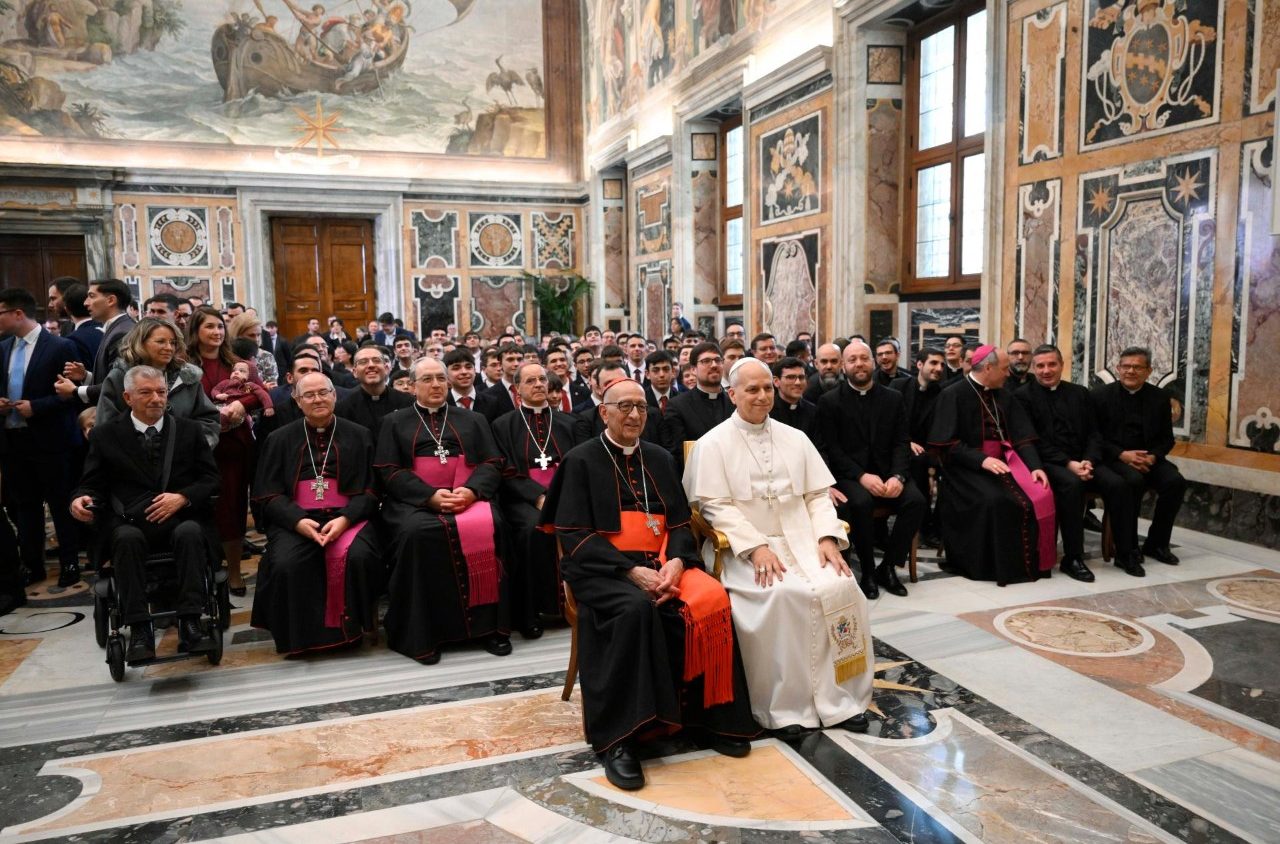
Vatican City - This morning, Saturday, 28 February 2026, Pope Leo XIV resumed private audiences after spending a week of spiritual exercises in the Apostolic Palace, led by Bishop Erik Varden. The Pontiff chose to devote his first meeting to seminarians from four Spanish seminaries.
In his address, the Pope issued a strong and incisive appeal, drawing attention to the heart of priestly formation: developing a supernatural view of reality. He also warned against a subtle but dangerous trap that threatens all Christians, and in particular those preparing for the priesthood: the risk of spiritual emptiness, which he described with the evocative image of “dying standing”.
Removing the supernatural and finding the unnatural
At the centre of the Holy Father’s address was a striking quotation from G.K. Chesterton: “Take away the supernatural, and what remains is the unnatural” (cf. Heretics, VI). Pope Leo XIV used this line as a key to his entire message, explaining that when the living relationship with God is obscured or weakened, life itself begins to fall into disorder from within. This “unnatural” state concerns not only scandalous sin, but the silent, daily decision to live as though God were merely a concept, pushed to the margins of one’s thoughts and choices.
For a seminarian or a priest, this danger is heightened. What could be more unnatural, the Pope asked, than speaking of God with familiarity while living as if He did not truly exist in the fabric of one’s life? He warned that nothing is more dangerous than becoming accustomed to the things of God without truly living from God. Everything, then, begins - and always returns - to a living and concrete relationship with the One who has chosen us.
Deep roots against sterile appearance
To prevent this spiritual decline, the Pope stressed that a supernatural view is not an escape from the world. Rather, it is the learned capacity to recognise God’s action in the concrete events of each day. This is the principle that gives unity to every other aspect of formation. Without it, even good practices such as study, prayer, and community life can hollow out and become merely external and empty actions. To cultivate this outlook, the Pope recommended a simple and proven path: practising the presence of God, an exercise that keeps the heart awake and life constantly oriented towards Him.
Pope Leo XIV used two powerful biblical images to illustrate the point. The first, drawn from Psalm 1, describes the righteous as “a tree planted by streams of water, that yields its fruit in its season, and its leaf does not wither” (v. 3). This tree is fruitful not because it avoids difficulties, but because its foundation is secure. Storms and drought are part of its growth, yet they cannot destroy it because it is connected to its source of life.
In sharp contrast stands the paradox of the barren fig tree in the Gospel of Luke (cf. Lk 13:6–9). Though it receives care, it produces no fruit. The Pope used this image to introduce the idea of trees that “die standing”. Outwardly they may still look tall and alive, yet inwardly they are already dry and dead. In short, a forceful warning to those who stake everything on appearance, presenting themselves in television interviews, podcasts, reels, TikTok or YouTube, or arriving in parish life well put together and full of themselves, projecting the image of someone prepared and ready. The Pope also cautions those who think they can revolutionise the Church through their own presence and choices. The warning is clear: sometimes what appears is not what is real. This, he said, is what can happen to a seminarian or a priest who confuses spiritual fruitfulness with intense activity or with a merely external observance of religious forms. When the deep root of a personal relationship with God is neglected, everything dries up from within until, silently, the person is spiritually dead while still maintaining an appearance of life.
The foundation of everything: “being with the Master”
Ultimately, the Pope returned to the simplest and most decisive aspect of vocation: being with the Master. Jesus called his disciples first “to be with him” (Mk 3:14). This, Leo XIV emphasised, is the foundation of all priestly formation. It means remaining with the Lord and allowing oneself to be formed from within by the Holy Spirit. Although human instruments and psychological insights are valuable, they can never replace this central relationship.
The Holy Father concluded with words of thanks and encouragement, reminding seminarians, their formators and their families that they do not walk alone on this path. Christ goes before them, the Virgin Mary accompanies them, and the whole Church supports them with prayer.
His message stands as a vital call for everyone - lay faithful and priests alike: an authentic life of faith is one rooted deeply in a living relationship, moment by moment, with God, a relationship that protects us from the silent tragedy of dying while remaining standing.
Fr.L.V.
Silere non possum