If I had to name a national pastime in which, to varying degrees, many Italian Catholics online have taken part over recent months, it would certainly be the habit of filling their timelines with hateful comments after Alberto Ravagnani announced that he intended to leave the ministry. After all, waiting for someone to stumble - according to one’s own perspective, of course - so that one can point the finger and laugh is a discipline at which we, disciples of Jesus of Nazareth, are becoming increasingly skilled.
When Ravagnani announced his decision, a crowd of self-styled Catholics poured into the comments under his posts - and, far more meanly, under those of Fraternità, the community of young people he had founded - driven by one motive alone: finally having a target.
This is nothing new. Yet each time it becomes more embarrassing. The arrogance with which certain figures felt obliged to hand down lessons - from Fortunato Di Noto to Mario Adinolfi, all the way to those profiles that inhabit social media in ways so grotesque that they have now become a laughing stock for anyone watching - reached heights of self-assurance that nevertheless deserve to be analysed. Because they say far more about those who utter them than about those forced to endure them.
Alongside the declared aggressors came another category, perhaps the most insidious among those that populate our sacristies: the falsely concerned. Those who, with the contrite air of people who can summon emotion on demand - just long enough to extract a little gossip from it - wondered aloud about the fate of “these poor young people”. What will become of them now, poor things? Fr Ravagnani has “left” them, they said; they will lose their way, everything will fall apart, it is the end of an illusion. And down came the verdicts, the prophecies of doom, the premature condolences for a funeral that existed only in their imagination. Compassion brandished like a club: a classic. As usual, one only has to look at the stories posted by these “kindly country parish priests” to despair. Yet projecting onto others is merely the other side of the same Olympic discipline in which we are always on the podium
The answer has arrived. And it was not the one they were hoping for
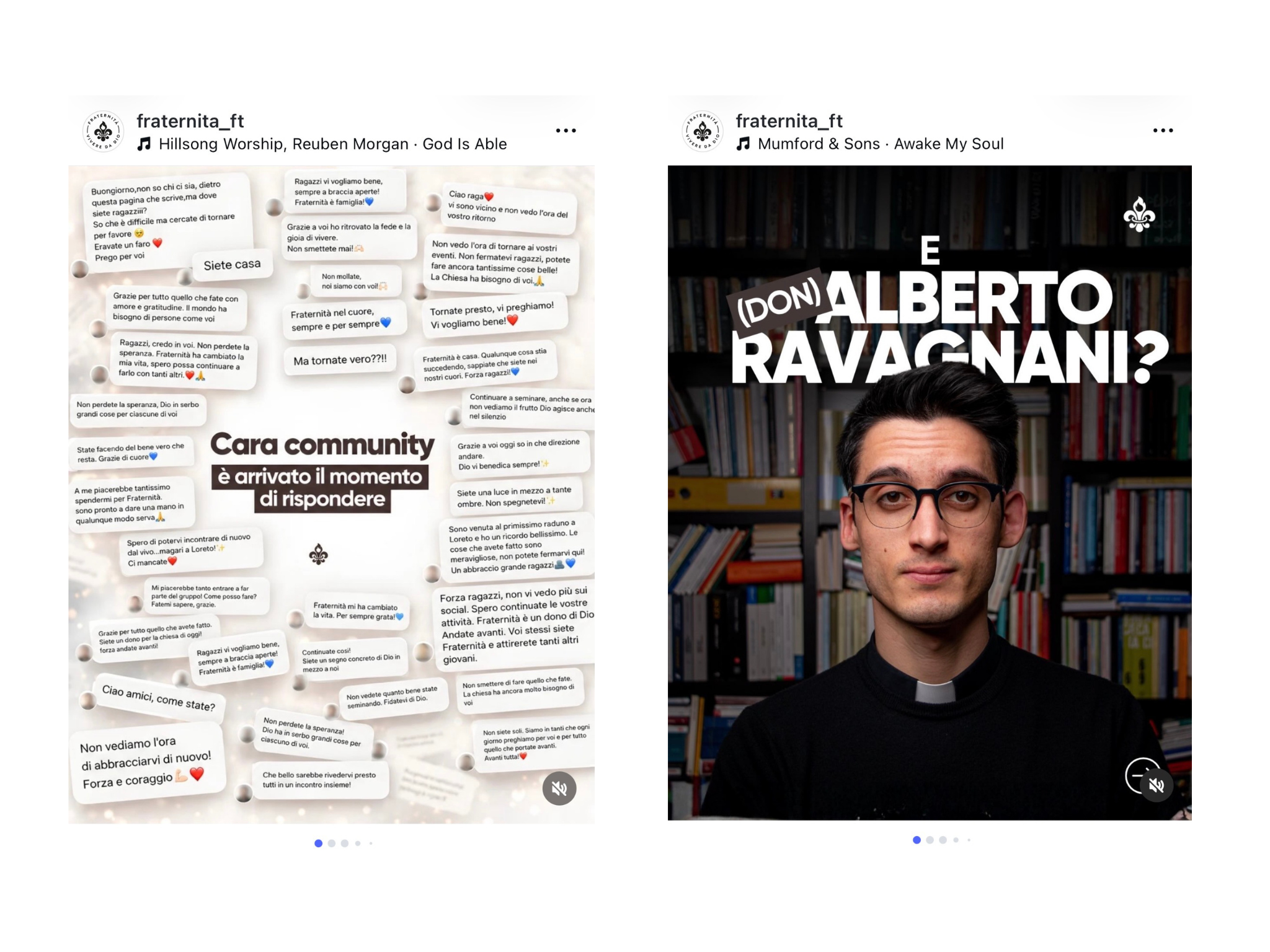
In these hours Fraternità has published two posts, two carousels. And those who were waiting for tears, resentment, rupture, the latest material for gossip chats, have been left empty-handed.
 Associazione LabOratorium APS
In the first, the community addresses those who, in recent months, had written, prayed and asked: “Where are you, guys?”, “But you are coming back, aren’t you?”. It explains that it has not dissolved, but has “held the experience of these months in the silence of prayer”, continuing to meet in local communities, to take part in adoration, to look one another in the face and to share - in their own words - “dreams and fears”. With disarming honesty, it admits that some became angry, that others experienced everything as a test of faith, and that they will probably “limp on for a little while yet”. But it closes with a sentence worth more than a thousand smug comments from the usual online boomers: none of them believes that everything is over.
In the second, the young people directly address the question many had been putting to them - “and Fr Alberto?” - and they do so “clearly”, without hypocrisy and without the hysterics that instead mark those who used this affair to wrest a minimum of attention from the online world.
They acknowledge that Ravagnani was for them “a faithful friend”, a father, a brother, and that it was he who accompanied many of them to an encounter with Jesus. They state, without ambiguity, that today their paths are taking different directions and that they do not share many of his current positions. And this is the most instructive part, the part that embarrasses certain cardinals, bishops, priests and the “ever-so-committed” lay faithful, accustomed to thinking in boxes - small and cramped ones at that - and to seeing the world only in black and white. The young people of Fraternità, by contrast, offer many a small lesson in how to live in the world: “this does not mean that we are taking sides against him: we choose mutual respect for different ideas and thoughts”.
They state clearly that Alberto will no longer have any role within Fraternità - no ambiguity, no organised nostalgia — and yet they give thanks: “Thank you, Alberto. For believing in this and for walking with us this far”, entrusting him to the Lord with the words of the Psalmist: “The Lord will watch over your coming and going”.
In short, the young people are teaching the keyboard haters that not everything is black or white. There are shades. There is gratitude for what has been, and there is the freedom no longer to recognise oneself in certain choices. There is the explicit refusal to turn dissent into condemnation. Above all, there is the idea - profoundly mature and deeply Christian - that one can “hold what has been without clinging to it, let it go without erasing it, continue the journey without forgetting where we set out from”.
These young people have understood Leo XIV better than many others…
It is worth saying plainly: these young people - lay people, mostly young - have done precisely what Leo XIV has for some time been asking, insistently, of Churchmen.
From the first days of his pontificate, speaking to those working in communications, the Pope rejected a “strong and muscular communication” and pointed instead to the path of a disarming language, setting against attitudes of aggression, partisanship, prejudice, resentment and fanaticism the search for truth in love, humility, dialogue and the listening that comes before speech. On 30 May, while praying the Rosary at the Lourdes Grotto in the Vatican Gardens, he asked everyone to refrain “from every form of verbal or physical violence”, explicitly mentioning social media. And in the Message for the 2026 World Communications Day, dedicated to safeguarding human voices and faces, he recalled that the face and voice of every person are sacred, because they reveal an unrepeatable identity.
Here, then: the young people of Fraternità neither insulted nor erased Fr Alberto’s face and voice. They safeguarded them, even in disagreement. They “repaired the nets”, to use another image dear to Leo, instead of tearing them apart.
The same, unfortunately, cannot be said of a far from negligible part of the laity, and sadly also of the clergy, who frequent social platforms. While people in their twenties offer a lesson in charity and balance, there are those - wearing a clerical collar or a mitre - who use the same tools for the exact opposite. One example among many: Bishop Ricchiuti, who thinks nothing of spending the small hours commenting on posts, reserving contemptuous words even for his confrères. It is the perfect reversal of the paradigm indicated by the Pope: not the listening that comes before the word, but the word that humiliates; not meekness, but irritation; not the face safeguarded, but the finger pointed.
We need witnesses
There is an uncomfortable truth in this whole affair, and we might as well say it: in our dioceses we do not know how to communicate and, consequently, we do not teach others to do so. We ought to be masters in transmitting the Gospel and the faith, and instead we move around the web with clumsiness and embarrassment. Sobriety, gratitude, the ability to say “no” without contempt, the conviction that faith does not need an enemy in order to exist: everything that emerges from Fraternità’s communication should be a warning to us all.
Because this, in the end, is the dividing line. Those figures who feed on indignation do not exist unless they can take aim at someone: without a scapegoat they collapse, because their identity is entirely reactive. At a conference on digital communication in which I took part a few weeks ago, we reflected precisely on this: online there are those who put content into circulation and there are those who, instead, try to carve out a place for themselves in society by positioning themselves against it, living off the mockery of that content. There are those who produce and those who reuse other people’s material in order to strike. The para-Catholic world is full of this mechanism, and social media rewards it, because it generates engagement, indignation, reaction and therefore traffic.
The young people of Fraternità, by contrast, have always communicated well - competently, I would even say - and have always told the beauty of their activities and of their faith. These young people exist regardless - they exist in prayer, in friendship, in adoration, in local communities - and for this reason they have been able to afford the rarest luxury in contemporary Christianity: responding to a wound with a thank you.
“Without fraternity,” they write, “even beautiful things become empty.” It is true. And it also applies to those who have turned faith into a perpetual courtroom: without charity, even the truth they believe they are defending becomes empty. Noise. Another late-night post. We are well, the young people say. It shows. And it is the most edifying thing the Italian Church on social media has produced in months - signed, what is more, by people with no pulpit of their own.
fr.P.B.
Silere non possum