Jerusalem - A long and carefully considered letter, which Cardinal Pierbattista Pizzaballa chose to send to the Church in the Holy Land, signing it symbolically on 25 April 2026, the feast of Saint Mark the Evangelist. The Latin Patriarch of Jerusalem addresses the faithful of his diocese, which extends across Israel, Palestine, Jordan and Cyprus, to offer a “more articulate” word after years marked by war. The title, taken from Luke’s Gospel, is already a programme: “They returned to Jerusalem with great joy”. A proposal for living the vocation of the Church in the Holy Land.
A letter born of the pain of war
From the first pages, Pizzaballa explains why he felt the need to write such a substantial text. Recent years, marked by the “latest and tragic war”, have forced him to rethink the times and methods of pastoral ministry. The Letter, the cardinal warns, “is not meant to be read quickly or in part, nor is it to be used as a text of political analysis”. It is intended instead as a tool for discernment, to be read “little by little”, in order to promote dialogue in communities, monasteries and families.
The question running through the whole text is a single one: how can Christians, as an ecclesial assembly, remain within this situation of conflict, political, military and spiritual, which we know will continue for many years?
Reading reality
The first section of this long missive deals with the present situation without filters. Pizzaballa speaks of a real “watershed”: 7 October 2023 and the war in Gaza closed one era and opened another “in the worst possible way”. His Beatitude denounces the return of force as an instrument regarded as decisive, leading to a worrying cultural drift: “War has become the object of a kind of idolatrous cult: we no longer sit down at tables to avoid conflicts at all costs, but rather consider war a possible or even inevitable outcome”. Particularly strong is the passage on civilians, who, Pizzaballa writes, “are no longer simply considered collateral damage, rather this damage is blamed on the enemy’s failure to surrender”. The Patriarch also touches on an ethically new issue: the use of artificial intelligence in military operations. He asks, in dramatic terms: “how many people in these recent wars in our region have died because of ‘the decision of an algorithm’?”
The analysis offered by the religious leader, like a meditation before the Crucified One, is structured around five “nuclei”: the dissolution of bonds between people, pain, hatred and mistrust; fragmentation and the temptation of social “enclaves” reinforced by social media algorithms; the loss of meaning of words such as “coexistence”, “dialogue”, “justice”, “human rights”, “two peoples and two states”, which today appear “worn-out and devoid of meaning”; the crisis of interreligious dialogue, where “the Holy Places, which should be spaces for prayer, are becoming battlegrounds about identity”; and finally the suffering face of the local Church, from Gaza, where “the parish of the Holy Family and Caritas have been and remain the Face of Christ amid the horrors”, to Palestine, Israel, migrants and Hebrew-speaking Catholics, who “experience a particular solitude within the Church”. Pizzaballa does not spare himself a courageous self-criticism: “in this period so hard, have we at times also been overly cautious, refraining from speaking out with courage, fearing to lose something, thus betraying our prophetic witness?”
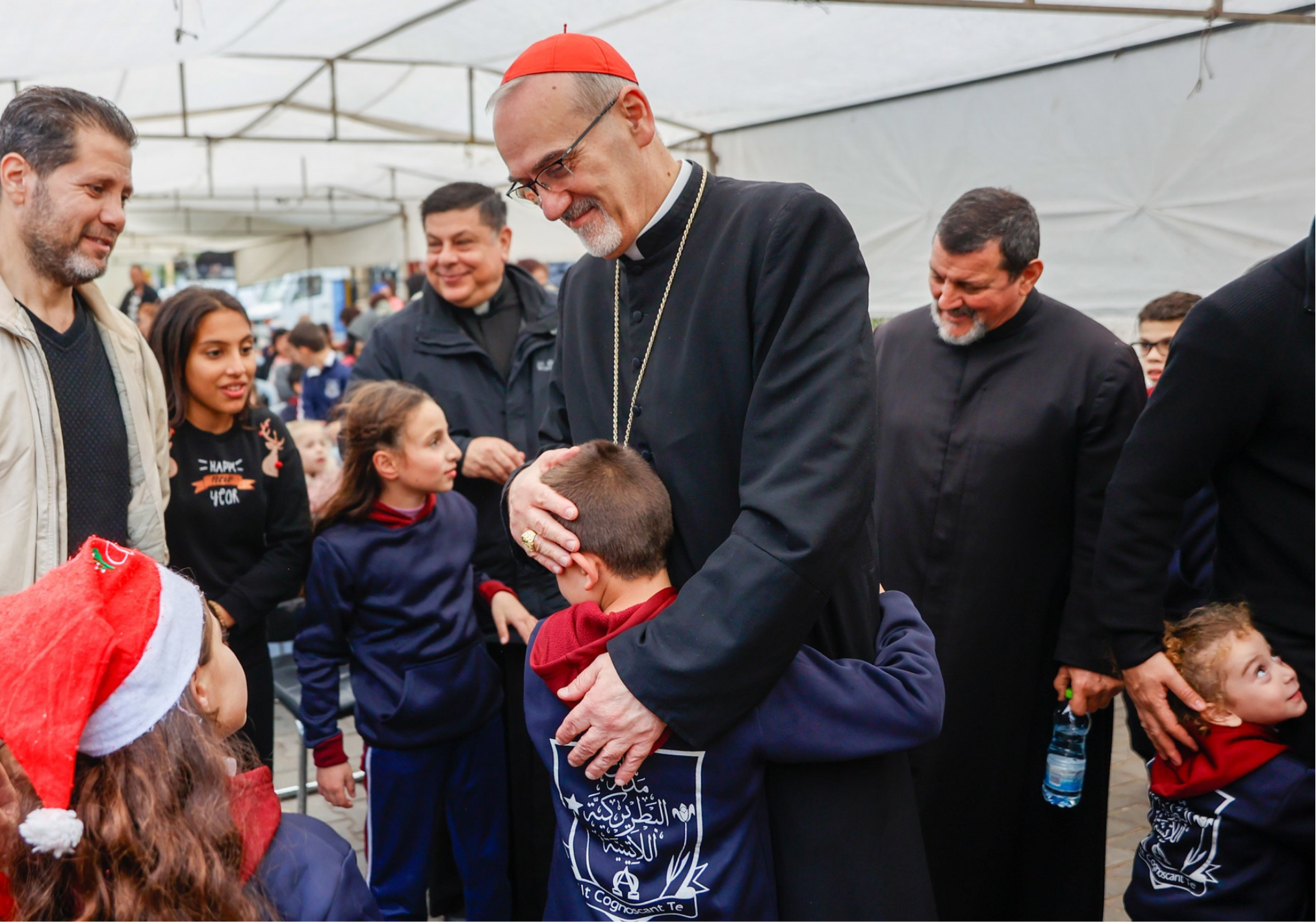 © Patriarchate of Jerusalem
God’s dream for His city
The second part of the letter is built around the biblical image of Jerusalem as it appears in the final chapters of the Book of Revelation. The Franciscan offers ten images describing the identity of the Holy City and, by reflection, the vocation of the local Church. There is the new Jerusalem that “comes down out of heaven” as a gift: it is not conquered, it is received. There is the absent Temple: “I saw no temple in it”, John writes, because God no longer dwells in a building “but in relationship”. There is the lamp of the Lamb, which sheds Easter light even where “our physical eyes see only death, defeat, or devastation”. Above all, there are the gates, always open: “There is nothing to defend, only a way to be adopted”.
The political and spiritual message is explicit: “The historical character of Jerusalem makes us understand that the city is the homeland of both Israelis and Palestinians, and is claimed by both as their capital. However, exclusive claims are in conflict with Jerusalem’s vocation. It is rather a city to be shared, a place of encounter”.
Within this vision there is also a crucial reference to the “purification of memory”, a concept dear to Saint John Paul II and reaffirmed during the Jubilee of 2000: not denying the facts of the past, but “verifying their interpretations so that these do not violently determine today’s choices”. Christians in the Holy Land, Pizzaballa specifies, “are not a third party, nor a neutral buffer between Israelis and Palestinians”: they are an integral part of society, “salt and leaven” from within.
Pastoral implications
The final part translates the vision into thirteen concrete areas. The primacy of liturgy and prayer: “not a means to obtain something else”, not even peace, but “a moment of love and encounter with God”. Families as “domestic churches” and “laboratories of reconciliation”, where parents are “the first storytellers of history”: the way they recount the past, “with poison or with honesty, with resentment or with trust, marks their children for life”. Schools, described as “workshops of a new humanity”, are today also facing the concrete problem of permits for teachers from Bethlehem, which puts their Christian identity at risk. Hospitals and social works are “the leaves that heal” of which Revelation speaks: “in a land where everything divides, you build unity”.
Pizzaballa devotes warm words to the elderly, “living memory”, to young people, “do not believe those who tell you that there is no future here”, to priests and religious, and addresses ecumenical dialogue with realism, including concrete difficulties such as the different date of Easter among the various Churches. He also deals with interreligious dialogue, which today “is not a whim of the few, nor an option among others: it is a vital necessity”. There is also a strong warning against the “culture of violence”, including verbal violence: “We live as though immersed in a sea of violent words, which have become common language. And we Christians too risk falling into this trap”. And there is the appeal to welcome: “The love Jesus teaches us knows no boundaries”.
They returned to Jerusalem
The letter closes by returning to its title. Pizzaballa recognises that the risk, in reading thirty-two dense pages of analysis and proposals, is “to feel overwhelmed, to think: ‘how can we do all this?’” The answer, he writes, “is simple: we cannot. Alone, we cannot. But we are not alone”. The final image is that of the disciples after the Ascension of Jesus, described in Luke’s Gospel: “They returned to Jerusalem with great joy”. “They had been shaken, they had been afraid, they had doubted. And yet, in the end, they returned full of joy”. The Church in the Holy Land too, the Patriarch concludes, is called to return to its “daily Jerusalem” with that same Easter joy, which does not ignore hardship but knows “that light overcomes darkness, that life conquers death, that love disarms hatred”.
A letter that offers no political solutions and no shortcuts, but a direction: to contemplate, as the cardinal writes, “God’s dream for His city”
m.V.P.
Silere non possum