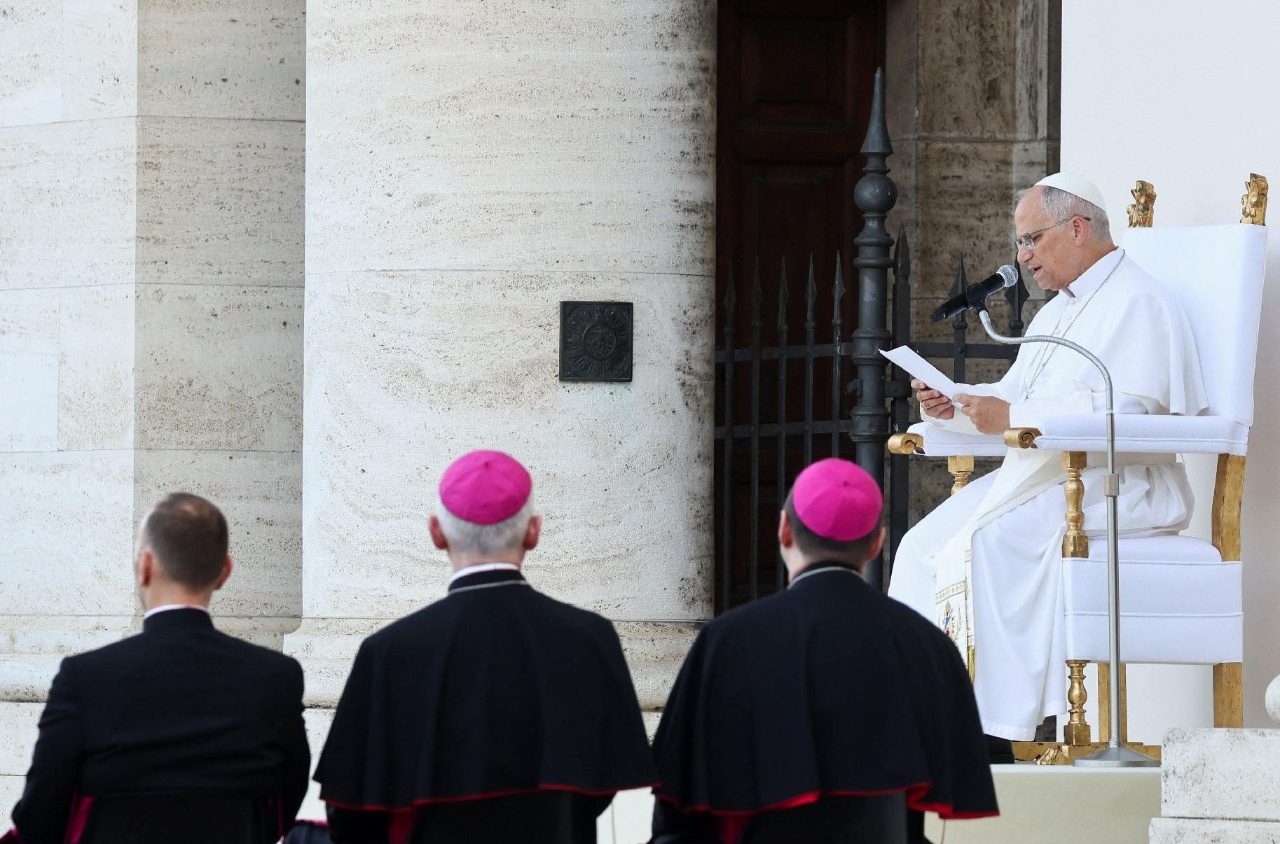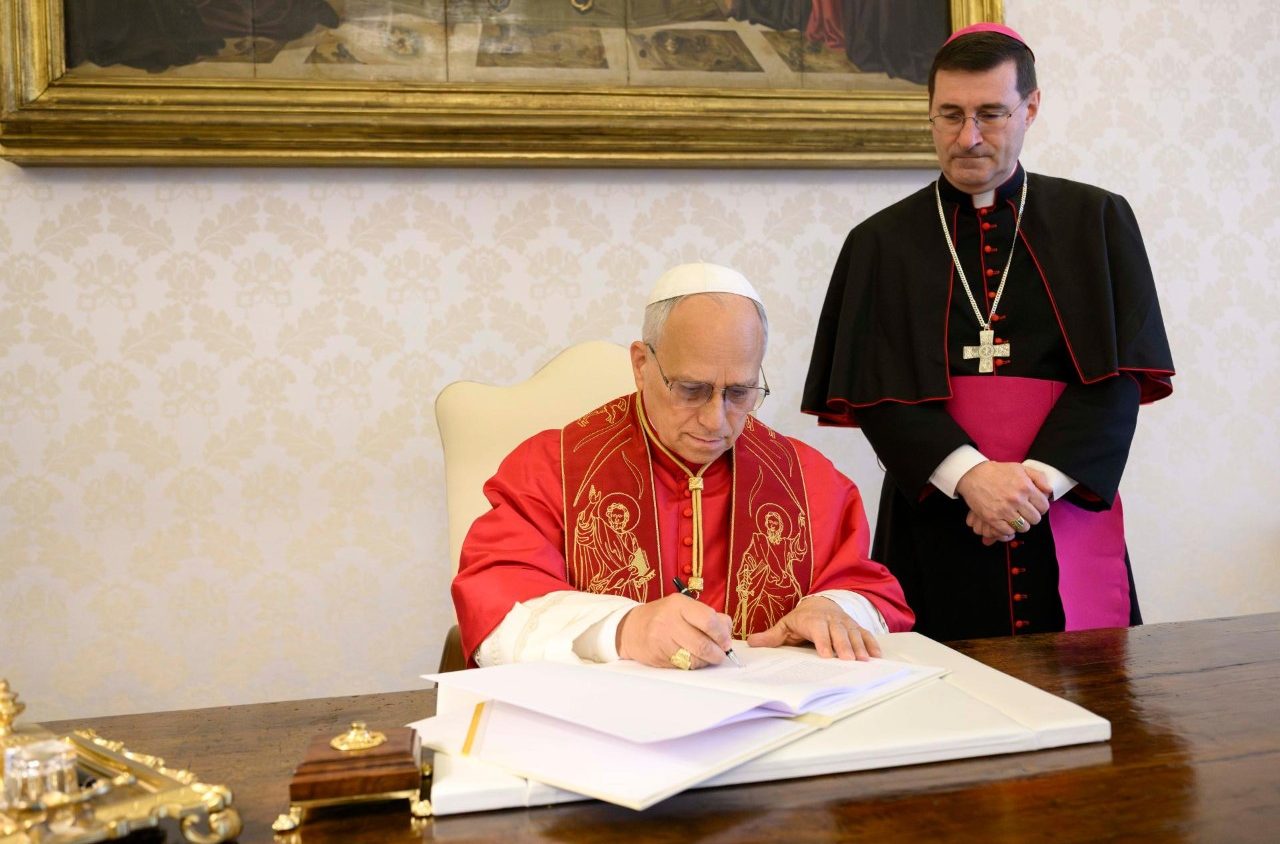
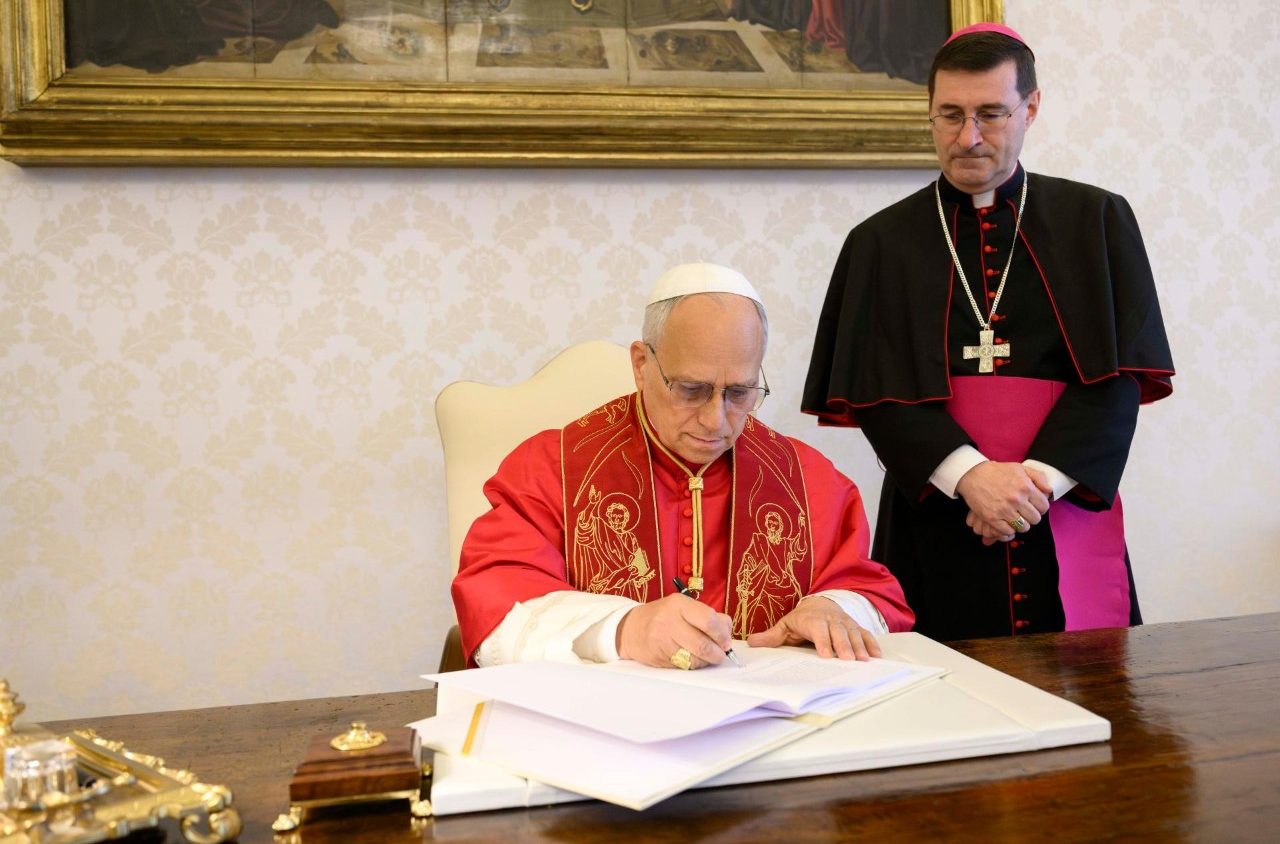
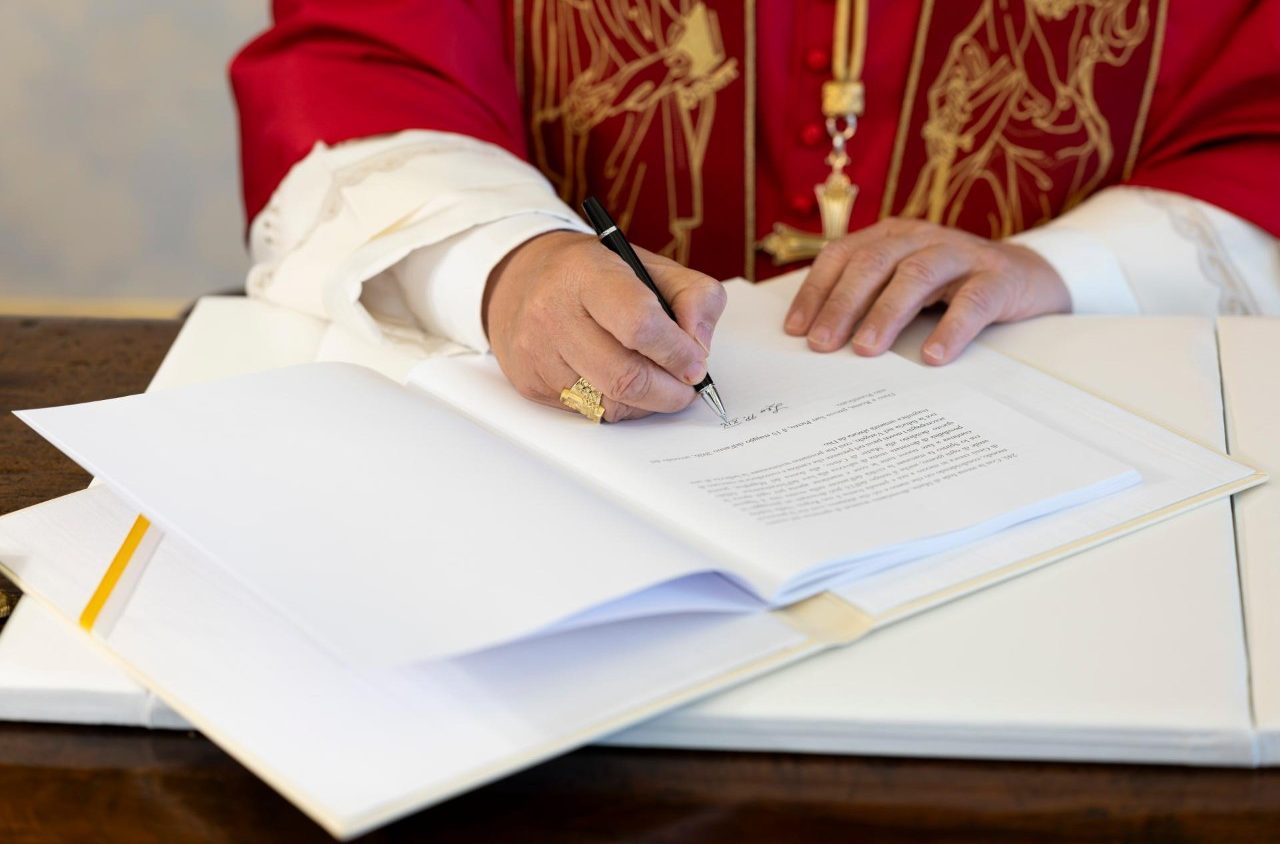
“Humanity, created by God in all its grandeur, is today facing a pivotal choice: either to construct a new Tower of Babel or to build the city in which God and humanity dwell together.” With these words begins Magnifica humanitas, the first encyclical of Leo XIV, signed on 15 May 2026 and devoted to “safeguarding the human person in the time of artificial intelligence”.
These words are a programme in themselves and immediately place the document within a fundamental anthropological and spiritual choice: between domination and communion, between technocratic pride and shared responsibility.
The document, structured in five chapters and 245 paragraphs, explicitly follows in the path of Leo XIII’s Rerum novarum, whose 135th anniversary falls this year. The continuity is not accidental: the choice of the name Leo, made by Robert Francis Prevost immediately after his election on 8 May 2025, now takes on its programmatic meaning. Just as in 1891 his “beloved predecessor” confronted the “new things” of the industrial revolution, today Leo XIV seeks to be the pontiff of a second Rerum novarum, that of the digital revolution.
Two biblical icons: Babel and Nehemiah
The symbolic heart of the encyclical lies in the introduction, where Leo XIV proposes two biblical images: the Tower of Babel and the rebuilding of the walls of Jerusalem under Nehemiah. It is a theological and pastoral insight of considerable force. Babel represents “a project conceived without reference to God, supported by a uniformity that eliminated diversity and that chose homogenization over communion”. Nehemiah, by contrast, embodies a patient and shared reconstruction, in which “the city is reborn, not through the initiative of one man, but through the shared responsibility of all”. The sentence that sums up the choice placed before contemporary humanity has an almost prophetic force: “the primary choice is not between a ‘yes’ or ‘no’ to technology, but rather between constructing Babel or rebuilding Jerusalem; between a power that claims to dominate the heavens and a people who work together in the presence of God to rebuild the walls of fraternal coexistence”.
Particularly significant is the denunciation of the “Babel syndrome”: “the idolatry of profit that sacrifices the weak, a uniformity that neutralizes differences, and the pretense that a single language - even a digital one - can translate everything, including the mystery of the person, into data and performance”.
The core of the encyclical: who holds power today?
One of the most explicit and politically courageous passages in the entire text is found in number 5, where Leo XIV addresses directly the question of private technological power. Taking up the words of his predecessor, the Holy Father writes: “In the past, it was largely up to the State to guide and direct innovation. Today, however, the main drivers of development are private, often transnational, parties that are endowed with resources and the capacity to intervene that surpass those of many Governments. Technological power thus takes on an unprecedented, predominantly ‘private’ aspect, which makes it even more challenging to discern, govern and direct such power toward the common good.”
This is the point at which the encyclical moves beyond analysis and becomes an indictment. The great digital platforms and the giants of AI are directly called into question, even though they are never explicitly named. The reference is unmistakable.
“Disarming” artificial intelligence
Among the most powerful expressions in the whole document is the use of the verb “to disarm” in relation to artificial intelligence (n. 110). The Pope writes: “Disarming AI means freeing it from the mentality of ‘armed’ competition, which today is not limited simply to the military context, but is also an economic and cognitive phenomenon. This entails a race for ever more powerful algorithms and larger datasets, driven by the desire to secure geopolitical or commercial dominance. To disarm means discrediting the assumption that technical power automatically confers the right to govern.”
The expression recalls the celebrated “unarmed and disarming peace” spoken of by Leo XIV on the day of his election, and constitutes a programmatic development of it. The Pope is asking not for technology to be renounced, but for it to be prevented from “dominating humanity. It means freeing technology from monopolistic control and opening it to discussion and debate, therefore making it human-friendly”.
The “new forms of slavery”: the invisible face of the digital economy
One of the harshest chapters of the encyclical is devoted to the “new forms of slavery” generated by the digital economy. Leo XIV exposes, with stark realism, what lies behind the apparent magic of AI: “Nothing in the world of AI is immaterial or magical. Every seemingly immediate and flawless response is the result of a long chain of mediation, involving vast networks of natural resources, energy infrastructure and, above all, people.”
The Pope explicitly denounces the exploited labour of “millions of people engaged in essential yet largely unseen activities, such as data labeling, model training and content moderation, often involving disturbing material”. He then adds, in dramatic terms: “In some regions of the world, children and adolescents work in dangerous conditions, crushing the materials from which rare earth elements are extracted. The bodies of these people are scarred, injured and worn down so that computational flow may continue uninterruptedly.”
In this context, at number 176, Leo XIV performs an act of considerable moral weight: he sincerely asks pardon, in the name of the Church, for the historic delay with which she came to condemn slavery in an absolute and universal way, recognising “a wound in Christian memory, one from which we cannot consider ourselves detached”.
“Data colonialism” and the betrayal of the Incarnation
At number 178 the Pope introduces a concept destined to enter public debate: the new colonialism of data. “Even today, colonialism assumes new forms. It no longer dominates only bodies, but appropriates data, transforming personal lives into exploitable information.” And again: “These have become the new ‘rare earths’ of power: vital data which, once aggregated and analyzed, can be used to train predictive models, guide investment strategies, anticipate crises and, above all, determine who and what is deemed to matter.” The conclusion of the passage is striking: “Otherwise, the digital age will not be post-colonial, but colonial in another form.”
To understand the scale of this denunciation, it is illuminating to read it in the light of Leo XIV’s homily at the Chrism Mass on Holy Thursday, the first of his pontificate. On that occasion, the Pope stated forcefully that “throughout history mission has not infrequently been distorted by logics of domination, wholly foreign to the way of Jesus Christ”, recalling, with Saint John Paul II, the weight of “the errors and faults of those who came before us”. He added: “neither in the pastoral sphere nor in the social and political sphere can good come from domination.” True missionaries, he said, are “witnesses to approaches made on tiptoe, whose method is the sharing of life, disinterested service, the renunciation of every strategy of calculation, dialogue and respect”. And again, in a passage destined to resonate today with renewed force: “Even those places where secularisation seems most advanced are not lands of conquest, or reconquest.”
The data colonialism denounced by the encyclical is precisely this: a new logic of domination that repeats the structure of the old one. It presents itself as aid, research and innovation, just as historical mission presented itself as evangelisation, yet in reality it extracts, possesses and decides in the place of the other. Entire territories, especially those “marked by structural fragility and limited geopolitical relevance”, are traversed by “a new mindset of extraction: that of health data, epidemiological profiles, genetic maps and demographic information”. They have become, Leo XIV writes, digital “lands of conquest”.
Here the profound coherence of Leo XIV’s thought becomes clear: his missionary theology and his social anthropology draw from the same source. In his Holy Thursday homily, the Pope pointed to “the path of the Incarnation, which again and again takes the form of inculturation”, and stated that in order to welcome others one must first “learn to be welcomed”. This is the logic of receiving, rather than taking; of becoming flesh alongside the other, rather than extracting value from them. Data colonialism is the precise reverse of this logic: it is a dis-incarnation, because it turns the flesh of the other into exploitable data, reducing persons and peoples to raw material for calculation. It is no accident that the encyclical closes precisely on the mystery of the Incarnation, with the chapter entitled “The Word became flesh”: Magnifica humanitas explicitly sets the assumed flesh of the Son of God against the extracted data of the new digital empires. In this perspective, the request for pardon that Leo XIV makes at number 176 for the Church’s historical delay in condemning slavery takes on a further meaning: it is not only a penitential remembrance of the past, but an urgent warning for the present. “If we want to avoid the need to ask for pardon again in the future for having failed to respect the treasure of human dignity that is required by our faith,” the Pope writes, “it falls to us today to denounce, clearly and firmly, trafficking in its many forms.” The logic is clear: what the Church has already had to confess as sin - having tolerated for centuries the reduction of human bodies to merchandise - must not be repeated today in the subtler and more pervasive form of domination over data, over digital bodies, over lives turned into algorithms.
The centrality of the person: against transhumanism and posthumanism
The third chapter is entirely devoted to dismantling transhumanist and posthumanist narratives, described as “the ideological background present in some centers of technological power” which colonise the collective imagination. Leo XIV writes: “If the human being is treated as something to be perfected or surpassed, it becomes easier to accept that some lives are less useful, less desirable or less worthy. In the name of progress, ‘necessary sacrifices’ may begin to be justified.” One of the most beautiful pages of the encyclical is the one devoted to limitation as a place of humanity (nn. 118-120). Citing Viktor Frankl, the Pope writes that the human being “flourishes not despite limitations, but often through them”. And again: “To eliminate suffering entirely would mean, in the end, extinguishing love and desire as well.”
War, military AI and the crisis of multilateralism
The fifth chapter, devoted to the “culture of power”, contains some of the sternest pages of the Leonine pontificate. The Pope denounces “a real paradigm shift in public discourse and in decisions regarding rearmament, with a troubling revival of war as an instrument of international politics”. He also reiterates that the “just war” theory, “which has all too often been used to justify any kind of war, is now outdated”. On AI applied to weapons, Leo XIV is categorical: “it is not permissible to entrust lethal or otherwise irreversible decisions to artificial systems. No algorithm can make war morally acceptable.”
The three watchwords offered to humanity are simple and disarming: “Let us meet, let us talk, let us negotiate!”, repeated explicitly at number 222 as a citation from the first address of the pontificate.
The Magnificat as the song of hope
The encyclical closes with a theological image of extraordinary beauty. Mary’s Magnificat becomes the interpretative key to the entire document: “Before Elizabeth who announces to her that she has become the mother of the Lord, Mary bursts into a hymn of praise and joy… Nothing has changed around her… Yet, everything has changed within her, and this allows her to see what is invisible.” The Pope thus entrusts to the Virgin of the Magnificat the task of preserving “true faith in the Gospel, so that we may bear witness to the grandeur of humanity, in which God has made his dwelling”.
The deeper meaning of this text
Magnifica humanitas is not only the first encyclical of Leo XIV: it is the programmatic manifesto of his pontificate. The Pope seeks to offer the Church and the world a theological key for passing through this change of era without losing sight of the human person. The encyclical gathers up and relaunches the social magisterium of his predecessors - from Leo XIII to Francis, through the Second Vatican Council - yet it does so with unmistakable originality, showing how the principles of Social Doctrine, namely dignity, the common good, the universal destination of goods, subsidiarity, solidarity and justice, constitute the indispensable grammar for governing the digital age.
The merits of the document are multiple and are woven together in an organic vision. Magnifica humanitas does not demonise technology, but asks that it be “disarmed”, that is, restored to the service of the human person and removed from the monopolies that currently govern its development. At the same time, the encyclical calls the great global private actors to account, indicating without ambiguity that the real power of our time no longer resides in states but in a small number of transnational companies capable of shaping imaginations, markets and decision-making processes on a planetary scale. It does so by relocating the human person within the perspective of limitation, relationship and the wounded flesh of the incarnate Christ, against every temptation towards Promethean surpassing: against the illusion, in other words, that the fullness of life can be attained by eliminating fragility rather than inhabiting it.
In a world rushing towards Babel, Leo XIV invites us to rebuild Jerusalem. Not alone, not through power, but “stone by stone”, in the co-responsibility of the People of God and of all humanity of good will. Magnifica humanitas is, at heart, an act of trust: trust in the possibility that the human being, despite everything, remains capable of choosing the good. And that the magnificent humanity created by God will not allow itself to be replaced by any machine, however intelligent.
fr.I.C.
Silere non possum