Vatican City - In recent hours the Holy Father Leo XIV appointed Maria Montserrat Alvarado, President and Chief Operating Officer of EWTN News, as Prefect of the Dicastery for Communication. The new Prefect will take up her post on 1 November.
She is a professional woman who will turn forty in November. Young, formed in the Anglo-American world, with solid experience in communications, in the management of international media platforms and in the public defence of religious freedom. The Pope has drawn from a pool that the Piazza Pia clique could simply never have imagined. Not someone raised in the Roman salons, not a product of the Italian coteries, not a pawn bred in the corridors where, for years, appointments have been handed out according to friendships, affiliations and protection networks. Leo XIV has gone elsewhere. And that is precisely what makes this appointment politically and ecclesially significant.
Leo XIV breaks a system
Around Via della Conciliazione there moves, every day, a small cast of “Vatican correspondents”, or self-styled ones, who go in and out of the Holy See Press Office with a single aim: to eavesdrop, observe, collect half-sentences and feed the gossip mill. In and out, out and in, in a constant coming and going of people hunting for a stolen word, a whispered item of news, a piece of gossip to turn into some alleged inside story.
Some are looking for information. Others, more banally, are looking for someone to lean on. Someone to be seen with, a prelate to parade, a contact to trade on, an acquaintance to boast about. There are characters who are not even journalists and who spend their days with a phone in their hand looking for “that bishop’s number” or “that cardinal’s contact”. They spend hours fiddling and scrolling on social media, constructing a persona, repeating grotesque formulas: “my cardinal friend”, “my bishop friend”, “my Pope friend”. Then they publish the photograph snatched at an event, the greeting received in passing, the image beside this person or that one, and in this way consume a poor life, made up of exhibitionism and dependence on the recognition of others.
It is a real and bleak picture of a world that also feeds on the loneliness of certain clerics, who end up placing such figures beside themselves, convinced they have found companionship, support or even protection. Often, instead, they find their worst sentence: people who gather confidences, distort them, circulate them and, at the first opportunity, expose them to ridicule and compromise them publicly.
Andrea Tornielli and his magical world
A rather elderly prelate, commenting on the news, observed: “It would be interesting to pick up again a book Andrea Tornielli wrote with his little sidekick Gianni Valente as soon as the Viganò affair broke out.” Indeed, in 2018, when the former nuncio to the United States released a dossier on Pope Francis, the usual vultures pounced on the story in order to sell a few books. “A book unknown to most people, moreover, Your Eminence,” I had occasion to say to the elderly cardinal. “Ah, but you know, I always have plenty of time, and I read that one too.”
The book in question is The Day of Judgement. Conflicts, power struggles, abuses and scandals. What is really happening in the Church, published by Andrea Tornielli and Gianni Valente in 2018, shortly before Tornielli was appointed editorial director of the Vatican media. A title perfectly consistent with the way this man has chosen to narrate the Church: always and only through scandals, backstage manoeuvres, plots, power struggles, dossiers and insinuations. The living Church, the real Church, the Church that prays, proclaims, educates and serves, struggles to find room in that narrative. For years Silere non possum has written this clearly: these people are incapable of narrating the Church in her beauty and variety.
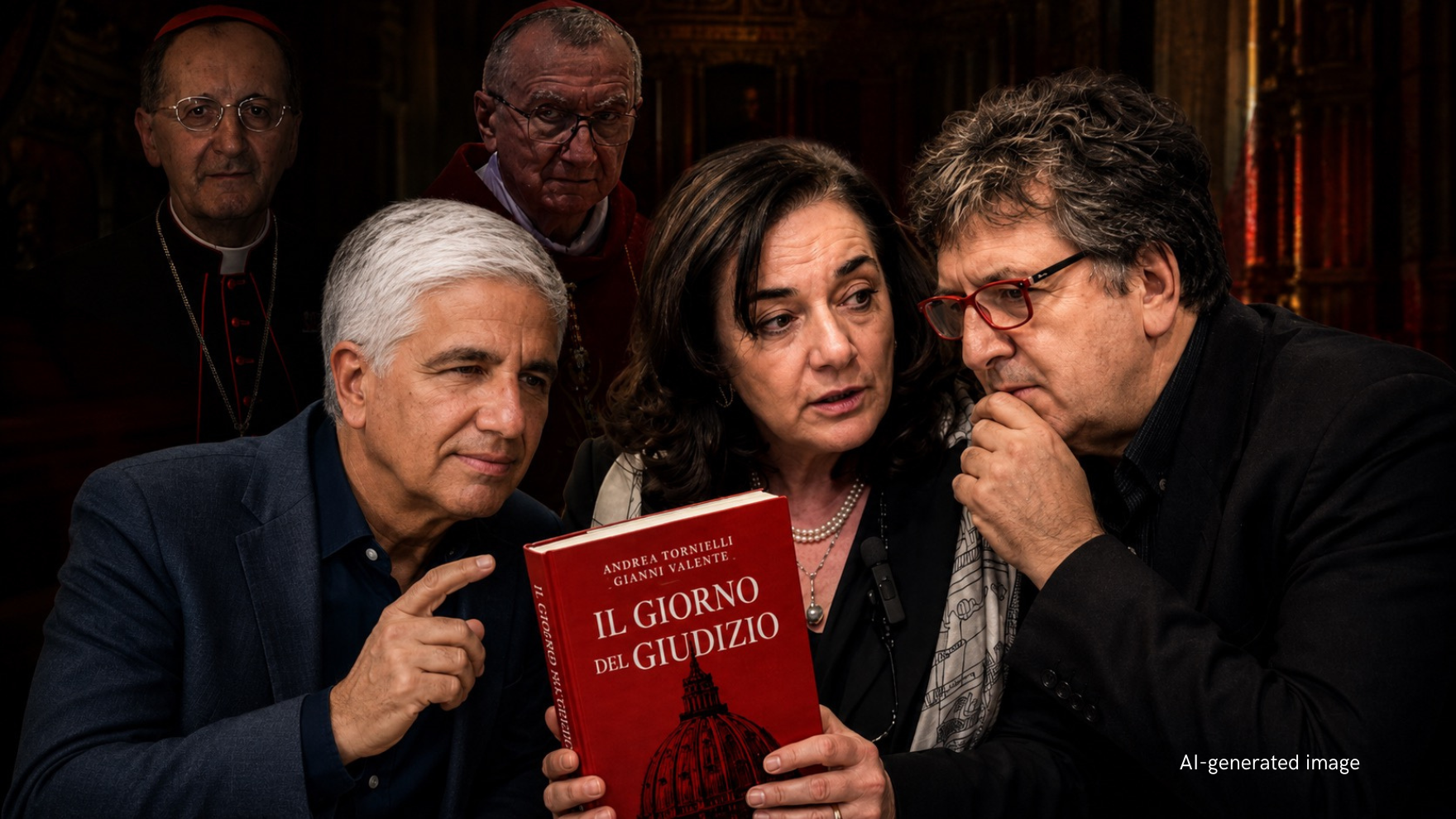
The clique in the service of Francis
Gianni Valente is a faithful friend of Andrea Tornielli and, together with his wife Stefania Falasca, belongs to that circle which brought Jorge Mario Bergoglio into every newsroom. It was they, together with the little group of cardinals and bishops who have always used them for their own purposes, who made Jorge Mario Bergoglio appreciated by television networks even before he was elected Pope. We also spoke about this in an episode of the investigation into Communion and Liberation.
The relationship between Tornielli, Valente and Bergoglio, moreover, was not always a bed of roses. In the final years of Francis’ pontificate, Valente realised that that “friendship” had become his own condemnation, to the point that Bergoglio himself created problems over his appointment to lead the Fides Agency.
In 2018, shortly after the Viganò scandal broke out - scandalous not because it stated true things, but because of the role held by the person stating them - Andrea Tornielli immediately set to work to get the saleable little book into print. After all, Piemme has always looked kindly on its “Vatican writer”. Recently it was Tornielli himself who arranged for his protégé Salvatore Cernuzio’s book of Pope Francis’ memoirs to be published. First he brought him into the Vatican from La Stampa, where he had worked with him; then he opened the publishing route for him through his publishing house of reference. This is the Italian system of intrigues and family ties, nothing new under the sun. And it is precisely this system that Leo XIV wants to dismantle with the appointment of a competent American journalist of Mexican origin.
Welcome for “everyone” except…
In these hours the keyboard haters have already hurled themselves against Maria Montserrat Alvarado. One example is the former employee of the Dicastery for Communication and former spokesman for Vincenzo Paglia, Fabrizio Mastrofini.
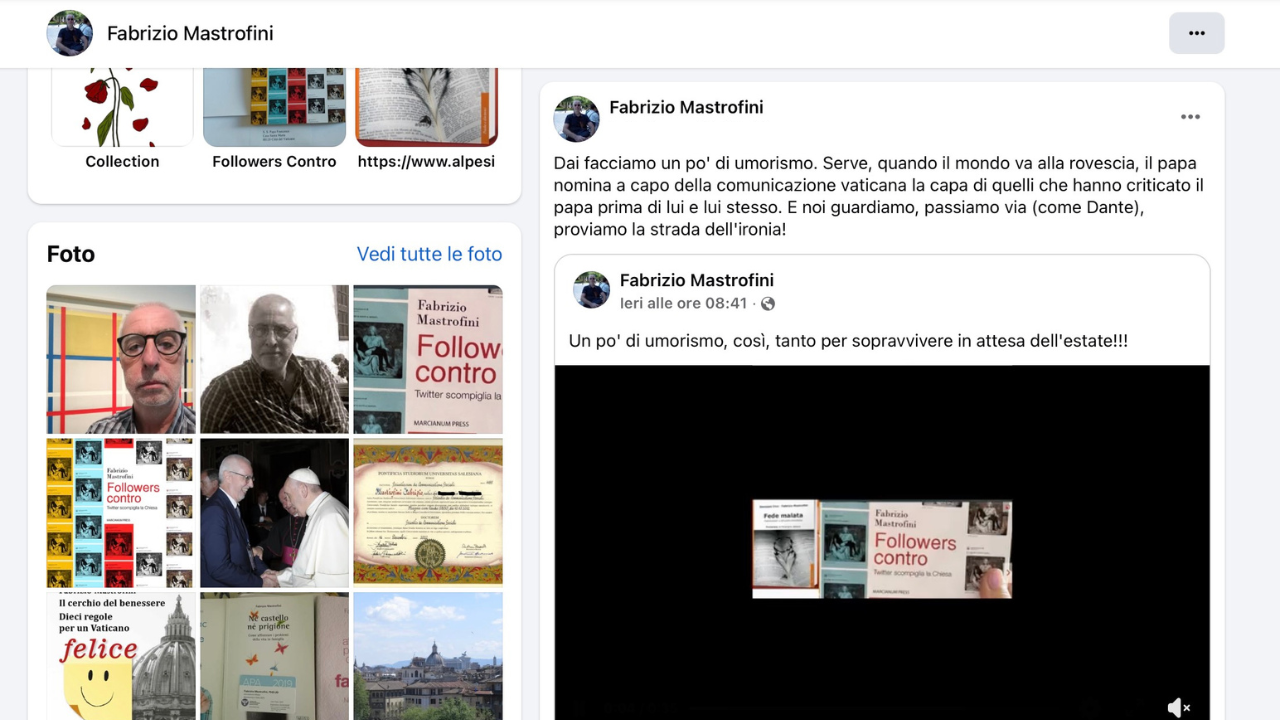
Leo XIV, however, has given all these people a lesson, making it clear that in the Church there are no first-class Christians and second-class Christians. The Pope wants everyone to have a voice, especially when they are competent. The fact that for years Andrea Tornielli and his clique sought to demonise certain realities - EWTN is only one among many - is a revealing test of a Catholicism badly lived. Very badly.
Andrea Tornielli grew up at the feet of Fr. Giacomo Tantardini, in an environment that had a particular vision of the Church: sex, scandals, gossip, backstage manoeuvres, dossiers, corridors, half-collected confidences and then their use in constructing narratives. A Chioggia-flavoured Dan Brown. And it is against this mindset that Leo XIV breaks the mould.
The Viganò scandal and the vultures
Archbishop Carlo Maria Viganò published his dossier during the night between 25 and 26 August 2018. EWTN, like other newspapers and blogs, did its job: it republished a news item. That is what journalists do. What Tornielli has never understood in sixty years of life is precisely this: journalism is not having a cardinal ring you to find out who probably wrote an article, or who might be the source of a particular journalist, and then starting to contact everyone in search of that source. Journalism is not calling newsrooms and saying: “No, you wrote this like that, but actually it is not so, you had better correct it.” All of this, of course, in order to obtain a single, managed narrative, desired by those who hold power.
At last year’s Rimini Meeting, Tornielli told the director of Silere non possum that he quotes and publishes whatever he pleases. Not the news, not the truth, not the sources according to the professional code of ethics: whatever he pleases. That is how he has governed the Dicastery in recent years, including in appointments: friends and acquaintances.
That is before one even mentions the management of the editorial direction of the Vatican media, conducted according to the logic of amoral familism. We are talking about money that did not enter the coffers of the Holy See because of friendships and favours; all matters for which there is documentation and which have already reached the proper authorities. We will speak about them publicly and in depth in the second episode of the investigation The Dirty Pact. It is only a matter of time.
The book that sells with a clickbait title
A few months after that enormous scandal, Tornielli delivered to Piemme a book written jointly with Gianni Valente precisely on the Viganò dossier. That book, however, is not an analysis of what the former nuncio wrote. It is, above all, an invective against EWTN - through the National Catholic Register, which belongs to the EWTN network - and against all the sites and blogs that republished the news.
Already in the introduction, Tornielli and Valente speak of the multiplication of “media pulpits” which set themselves up “as judges of everything and everyone” after assigning themselves the task of guardians of doctrine. They speak of the “unscrupulous, instrumental and selective” use of the crimes and sins committed by men of the Church in order to fight “dirty power battles”. And they add that their book intends to help the reader distinguish between “truth, half-truths and interested disinformation propagated also by various self-styled ‘Catholic media’”. Tornielli helping you distinguish between truth and disinformation! Just think about it. It sounds like a joke. It is the usual vocabulary of those who cannot bear the existence of free voices: anyone who does not fall into line is turned into an ecclesial problem, a suspect figure, a danger to communion. And it is once again the emblem of projection: what he has always done himself, he projects onto EWTN.
The passage on EWTN is even clearer. The authors write that, at 4.30 in the morning on 26 August 2018, the journalists accompanying Francis read on their phones a news item disseminated “simultaneously by a media network connected with the conservative galaxy of the pope’s opponents”: in the United States, the National Catholic Register “of the EWTN group”; in Italy, others. Thus the EWTN publication is immediately placed within the “conservative galaxy of the pope’s opponents”. Not within the circuit of journalism reporting a relevant news item. Within the camp of the opponents.
Further on, Tornielli and Valente make the interpretation even heavier. The Viganò dossier is described as “a document written by a Catholic archbishop with the intention of inflicting the greatest possible damage on the pope and on the trust of the baptised in him”. The operation is described as having been launched “simultaneously throughout the world with a carefully planned global media strategy”. The support expressed by some American bishops is compared to the tactics of “financial syndicates in corporate raids”, with the lead party launching the offer and the stakeholders rushing to express their support. Ecclesial life, according to them, had been remodelled according to the “predatory mechanisms of speculative finance”, with the Pope treated as a chief executive to be “outvoted” in order to force him to let go.
Then comes the attack on the American network. The authors write that the “logistical-media network of the Viganò operation”, while using branches scattered around the world, supposedly had “its strategic and economic bases in the United States”, represented by “groups and foundations that finance the media used to launch the dossier and accompany its reception”. Immediately afterwards they specify that the National Catholic Register, that is, the web publication that first disseminated the English version of the dossier, “is part of the EWTN media network”, founded by Mother Angelica and recognised as “the most influential Catholic multimedia hub in the world”, capable of reaching two hundred and fifty million people in one hundred and forty countries.
That is not enough. Tornielli and Valente recall that Michael P. Warsaw, chief executive officer of EWTN, was a consultor of the Vatican Dicastery for Communication. They then introduce Timothy Busch, a millionaire lawyer and member of EWTN’s board of governors, attributing to him “a not insignificant role” in the Viganò operation. According to the book, Busch supposedly provided “an essential contribution in outlining the contours and aims of the entire operation”.
In short, an invective against the most imposing and widespread Catholic television network in the world, guilty only of having done what a journalistic outlet is called to do: report a news item.
That Archbishop Viganò later took paths that cannot be shared, going so far as to attack Pope Francis unjustly on matters that had nothing to do with it and today associating himself with a circle of embarrassing figures, is another matter. None of this means that the Catholic media which in 2018 reported on his dossier were sharing its content or endorsing its approach. They were simply reporting a fact. And that fact was, objectively, news: disconcerting, grave, destined to have consequences, because it came from a former senior figure of the Holy See.
The deformation of journalism
Tornielli belongs to that category of journalists convinced they can decide who should or should not “have visibility”. “Do not give visibility to this”, “do not give visibility to that”: the old obsession of the gatekeepers of the enclosure. This is why he never cites the sources for what he talks about, because he draws from them, uses them, reworks them, but then cites only those who are his friends and those he likes.
Tornielli belongs to that category of figures who move in the shadows, talk about one person and another, suggest, insinuate, steer, but rarely put their own face to anything. They prefer to send others forward, often figures who are already fragile, exposed, compromised or burdened with personal and institutional problems, in the hope that they will strike those perceived as enemies.
It has also happened with a priest removed from his own diocese because by then he was considered embarrassing and problematic, whom Tornielli continues to feed with arguments, suggestions and targets, then leaving him with the task of attacking and insulting. The game is always the same: someone throws mud, someone else watches from a distance, and when the people targeted choose not to give weight to certain characters, Tornielli at the Meeting even asks the provocative question: “Why do you not take him into consideration?” A childish dynamic, like children tickling someone to get attention and then asking why nobody is looking at them. The results, inevitably, are embarrassing. These embarrassing characters are called to pay for what they write and say, while he steps aside to keep himself clean.
He knows very well how to dance to the boss’s tune
After this book, Pope Francis decided to appoint Andrea Tornielli as editorial director of the Vatican media. The volume was published at the beginning of November; the appointment came in December. This is no minor detail. During Benedict XVI’s pontificate, Tornielli had been a staunch defender of Ratzinger, even attacking Enzo Bianchi over him, as the founder of Bose himself recently recalled. He then began to do the same with Francis. Wherever power is to be found, Tornielli knows how to dance to the boss’s tune. That is how, in a short space of time, he went from defending Summorum Pontificum to fiercely attacking that world, all the way to his defence of Traditionis Custodes.
The bolt from the blue
With the election of Leo XIV, the system suffered an evident blow. His sponsor Pietro Parolin was not elected; only some peddler of titles and Tornielli himself believed in that election, together with the entire media network that thought it could shape public opinion and perhaps influence the cardinals. The cardinals, however, were well aware of what had happened in 2013 and of how Parolin had reached the position he reached. They were also well aware of what Parolin has done in these years: nothing. It did not even occur to them to let such an operation happen again.
In the period immediately after the election, Tornielli piled up one gaffe after another. Evidently weighing on him, too, was the image of Leo XIV who, on 8 May 2025, appeared at the Loggia wearing mozzetta and stole: a scene that shattered years of narrative and produced more than one short circuit among those who thought they still held the keys to the ecclesial story. From Leo XVI to Pius XIV, down to the numerous mistaken posts, the sequence of errors gave a vivid picture of the bewilderment of a system that had not foreseen that Pope, that language and that change of pace. Then came the appeal trial in the Sloane Avenue case.
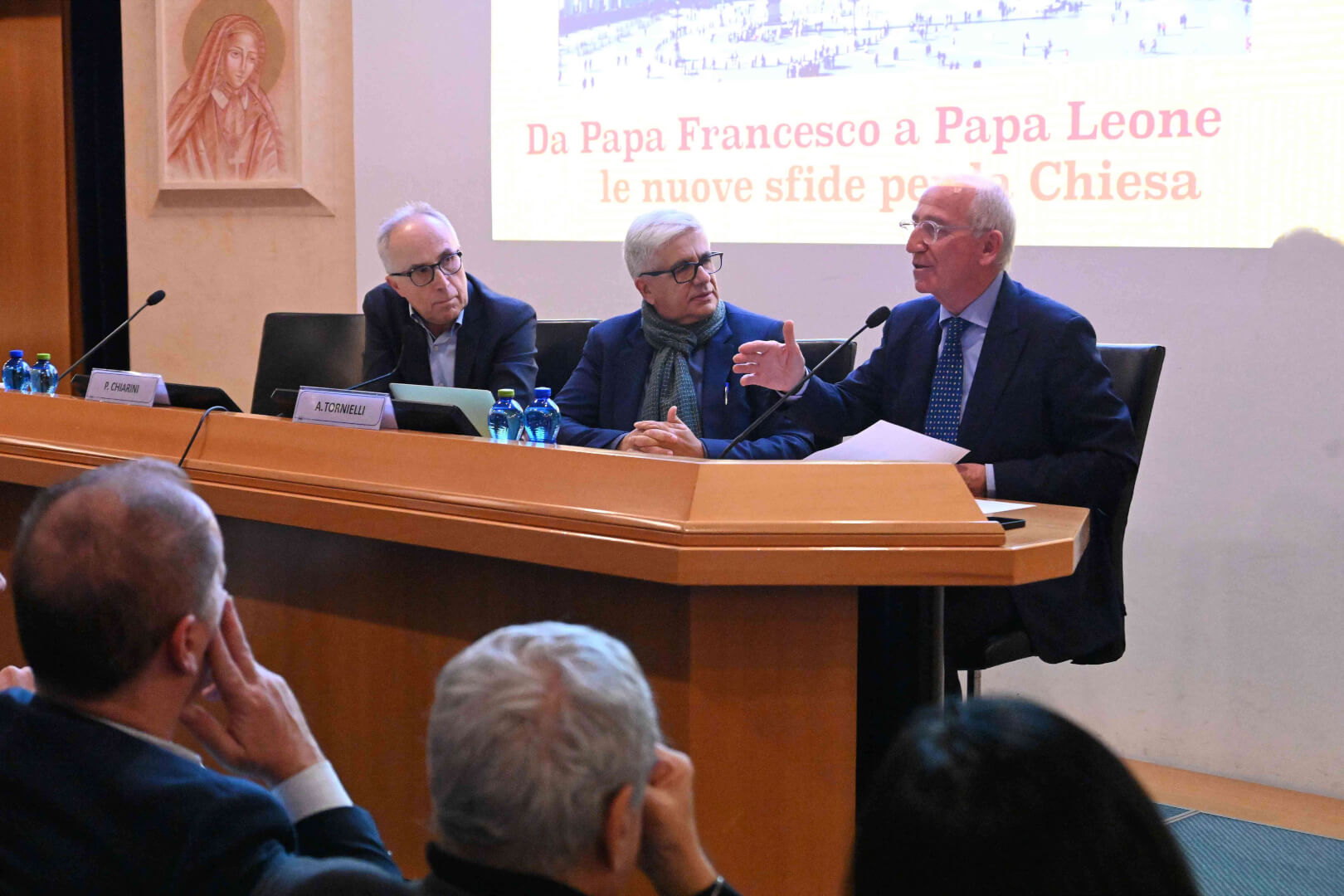
A castle in ruins
Tornielli had written, during Francis’ pontificate, an editorial in defence of the first-instance trial; he, who used to perform magic shows in Chioggia, started talking about law in a deranged editorial. The Court of Appeal then dismantled that judgment, striking precisely at the points Tornielli had defended. That is how, little by little, the sandcastle began to crumble.
Francis is no longer here and those whom Tornielli attacked for years, and whom in 2018 he had even pointed to as responsible for the circulation of the Viganò dossier, are today being promoted by Leo XIV. The appointment of Maria Montserrat Alvarado, President and Chief Operating Officer of EWTN News, is not merely an administrative choice. It is a message. The Pope looks to competence, freedom and the ability to communicate outside the para-Vatican confines. And, above all, he does not accept that a part of the Church should be treated as suspect simply because it is unwelcome to the apparatuses that have managed communications in recent years.
“If there were any dignity, the resignations would already have been submitted”, someone at Palazzo Pio commented in these hours. And yet that dignity seems to be precisely the one concern missing from certain crowd agitators. For years they claimed the right to decide who was a reliable Catholic and who was not, which publication deserved to be heard and which had to be demonised, who could speak and who had to be silenced. Leo XIV, with a single appointment, has overturned the table. With his gentle and silent style.
The attempt to redraw reality
And while Matteo Bruni and Andrea Tornielli are rushing from newsroom to newsroom, trying to convince journalists that “this is not a sacking, but a retirement”, the facts tell another story. Leo XIV did not receive Paolo Ruffini even for a formal farewell, and not a single word of thanks came from the Holy See for the eight years he spent at the head of the Dicastery for Communication.
The only words were those of Ruffini himself, entrusted to an ungrammatical letter signed simply “Paolo”, in which he thanks everyone for these eight years and speaks of his experience as a race, almost as though he had been an athlete. Pity that, in these eight years, the Dicastery has done very little running. More often, it has run for cover. As for efficiency, results and any real capacity to make an impact, the balance sheet remains poor.
This is also confirmed by certain meetings Ruffini continues to hold, such as the one that took place in recent hours with those responsible for communications in dioceses and associations. More than one person, listening to him, asked: “Was this man really at the head of the Pope’s media?” Because the problem is not only the season that is coming to an end, but what that season has left behind: weak communications, devoid of vision, incapable of offering serious tools, useful insights and a real professional culture to those who, in the dioceses, are supposed to communicate the life of the Church.
Time will tell the Truth
EWTN, which in 2018 was placed within the “conservative galaxy of the pope’s opponents”, today enters through the front door into the governance of the Holy See’s communications. The new Prefect does not come from the Roman courtyard, does not owe her career to friends of friends, does not belong to the system that turned the Dicastery into a place of relationships, favours and protections. She comes from an international, solid, professional reality, debated as much as one likes, but alive. A reality that has spoken and continues to speak to millions of Catholics when others preferred to speak only to themselves.
This is Leo XIV’s lesson. The Church is not the property of a clique. The communications of the Holy See cannot remain hostage to those who confuse service to the Pope with the defence of their own power. And Catholic journalism cannot be reduced to a network of phone calls, pressure, omissions and selective citations.
With Maria Montserrat Alvarado, Leo XIV sends a direct message to Palazzo Pio: the season of courtyard-style Vatican communications is over. Now begins the time of responsibility.
fr.N.I. e s.F.V.
Silere non possum