In biology, there is a process which we, as the Church and above all as priests, would do well to observe carefully: a healthy body knows how to let die what is killing it. It is called cellular apoptosis, and it is one of the most extraordinary mechanisms in our organism. It is defined as “programmed cell death”: when a cell is damaged, corrupted or ceases to work for the good of the whole, the body itself recognises it and eliminates it. It does not hide it, it does not transfer it to another tissue, it does not cover it up hoping it will heal on its own. It expels it. It is the body saying to that cell: “You must go, because you are becoming a danger to me”. When this mechanism breaks down, and damaged cells remain where they are and begin to multiply, a tumour develops. A healthy organism does not protect what makes it ill: it lets it go. This is how, and only how, the life of the whole is preserved.
An analogy for the Church
The same thing should happen within the Church and within our presbyterate. Let us be clear: here we are not speaking about those who experience difficulties and can be helped. There is no doubt about them: as the Church, we must welcome and integrate them, and everyone, through us, must be able to reach salvation. The point we wish to dwell on today is another: those individuals who are not only deeply problematic, but fail to recognise it, and indeed cause real damage to the Body of the Church, particularly to the presbyterate or to religious, monastic and seminary communities. People who, if left in place, risk poisoning the entire organism.

The failure of formation
The presbyterate must be able, by its very nature, to defend itself from those divisive and problematic ministers who unfortunately inhabit it. In reality, they should not even reach ordination: it is the seminary that should do its work, identify in good time those capable of poisoning the presbyterate, and remove them. Yet we know very well that formation today presents several serious problems, and on two fronts.
On the one hand, there are bishops who do not even send certain candidates to seminary, because they know perfectly well that such an institution might bring to light the problems of the individuals they are determined to ordain at all costs. So they decide to ordain them and insert them directly into the presbyterate, deliberately poisoning it. On the other hand, there is the issue of the seminaries themselves no longer functioning properly; by now they are no longer places of formation, but places of selection. And it is here that the first short circuit occurs: selection no longer takes place according to the criteria that should matter, namely prayer, faith, human and affective maturity, and cultural preparation. These are inconvenient criteria, because they require discernment, effort, and above all the ability to say no. For this reason, they have been replaced by a more convenient, and infinitely more dangerous, criterion: the rector’s favour. Today, in the seminary, one progresses only if one is in his good graces. Indeed, the more problematic one is, the more the rector — especially when he improvises as a psychologist — will push the candidate forward, because he will enjoy playing with him. The fragility of the seminarian thus becomes the raw material of the formator’s petty power. “You see, I healed him. You see, I improved him”, he goes around telling priests. Only for one then to look at these individuals and realise that it would be necessary to hospitalise not only them, but the rector himself.
The common root: an affective and relational incapacity
The tragedy, however, is infinitely more serious than many imagine. Many focus on cases of sexual abuse, which are indeed the fruit of a formation that failed, and have exactly the same root as what we are discussing. The point, however, is that the tragedy begins much earlier, and is perfectly recognisable, provided one is willing to see it. Who, after all, is the paedophile? He is someone who cannot relate to his peers, to adult people, and who for this reason directs his attentions and desires towards a minor, or towards a vulnerable person, because that person cannot say no to him.
Yet there are very many critical issues of the same nature. Everything begins with an affective, sexual and relational incapacity. The question, then, is inevitable: how many of those who enter the good graces of formators carry precisely these problems within themselves? Does the morbid taste for gossip not have the same root, that gossip which always revolves around the same themes: sex, relations between confreres, feminine forms of address used for superiors, confreres and collaborators? Does the inability to relate to those who do not think as you do, whether confrere or layperson, and the habit of attributing to others what you in fact live, or would like to live, not have the same root? Does the frantic search for attention from that confrere who is not interested in you not have the same root? Does the persecution that these characters carry out against those whom they label as “enemies” when they are “rejected” not have the same root? The list would be very long.
Food as an ignored symptom
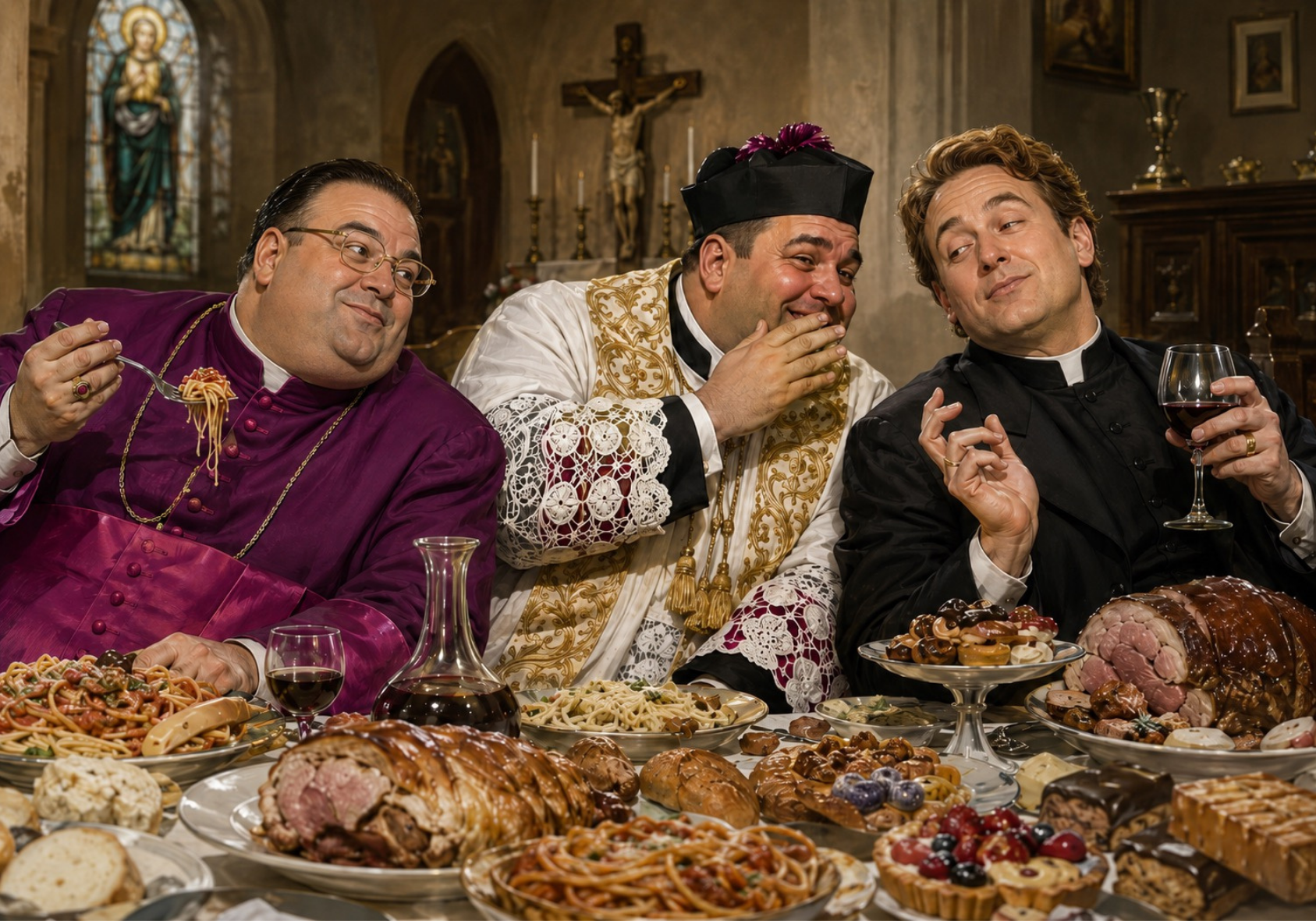
Addictions and disorders are, moreover, very numerous. But let us think even only of those priests who drown all their repression and dissatisfaction in food: in some dioceses they can no longer be counted. Often these are not matters of constitution, but psychological and behavioural issues which someone stubbornly refuses to see. Food, in the seminary, is one of the most visible symptoms and at the same time one of the least addressed. Instead of beginning a serious assessment of why that seminarian or priest throws himself voraciously on food, addressing the psychological problems and eating disorders that lie behind it, in the refectory the rector laughs and jokes: “Give him something to eat, hahaha!”
How many seminarians have suddenly lost weight immediately after ordination? And how many, on the contrary, have gained weight just as rapidly? How many are there who, during communal lunches or dinners, drown their dissatisfaction in food? These are warning signs we should be able to notice, though not through the purely judgemental lens that dominates seminary life today. They should be read for what they are: signs to be gathered in order truly to help people, because very often even those living in such conditions are not fully aware of them.
When distress becomes a joke
And yet, there is no real concern to be seen for human formation, nor for the concrete resolution of these problems. Distress is turned into a joke, gluttony into house folklore. Clearly ridiculous figures become the pretext for laughter within the community, without anyone realising something very simple: those same people, one day, will not only be part of the presbyterate, they will be sent to govern a community. And people do not mince their words over such matters: they can be ruthless when necessary. And they are right to be so.
We have reached the point where some rectors think, and at times say openly: “So much the better; if they are like that, they will not cause us problems with chastity”. Chastity, from being an evangelical virtue requiring mature affective integration, is reduced to a cynical calculation: fewer attentions, fewer troubles. Something embarrassing and disturbing at the same time. Not least because that dissatisfaction will set the tongue in motion, and there are very many such cases.
Repression in disguise
It is usually these individuals who then create problems in the seminary and in the presbyterate, if they are unfortunately ordained. It is not an accident; it is a consequence. That dose of repression, never named and never treated, does not disappear with ordination: it simply disguises itself. It disguises itself as rigour towards others, as implacable judgement upon confreres, as poisonous gossip that needs to strike someone every day. They are the ones who label everyone, who are always speaking ill of others, who reduce priestly fraternity to a courtyard of suspicion. And often they are also the ones who play with sashes — which, incidentally, are on the verge of bursting - with lace, with priestly coats of arms complete with mottos and purple trimmings, and so on: the external apparatus becomes the armour holding together an identity that has never truly been built.
Beginning apoptosis
This is why, a few days ago, an elderly prelate who was for many years a seminary formator wisely said: we should function exactly like our organism and begin a genuine cellular apoptosis. We should throw these people out, in order to prevent the whole presbyterate from being contaminated. This is not a matter of harshness; it is a matter of health. Covering up, moving around, justifying, tolerating: this is not mercy. It is precisely how an illness becomes systemic.
This is exactly what happens when the bishop changes: all these problematic characters, full of ambition, gather around the newly elected bishop, and the idea that takes hold is always the same, namely: “Let us give him a role, so at least he will keep quiet”. This is how the entire presbyterate is destroyed, piece by piece. Then, when priests, even young ones, take their own lives, we are ready to weep with false tears and fill our social media pages with tear-jerking posts, set between a piece of lace and a candlestick. In the meantime, however, nothing changes, and the problems are not addressed at their root at all.
It is the broken mechanism which, from the cells, allows the tumour to develop. A Church that no longer knows how to expel what is poisoning her is not a gentler Church; she is a sicker Church.
Whom do we spend our time with?
And here the matter also becomes personal, because a presbyterate is not an abstract entity: it is made up of concrete relationships, of daily choices about whom one speaks with, whom one has dinner with, whom one goes on holiday with. At La Sapienza, in recent days, Leo XIV said: “We are our relationships, our language, our culture: all the more so, it is vital that the university years be a time of great encounters”. This applies to university students, but it applies infinitely more to us. We must therefore ask ourselves: whom do we spend our time with? If we surround ourselves with the chattering friar, the one who hops here and there, always speaks ill of his confreres and inserts references to sex into every conversation; if we surround ourselves with the friar who takes unresolved young lads around the Vatican because “he feels lonely”, even placing the Pope’s security at risk, then it is evident that we are not doing well. If we are part of those little circles made up of problematic priests, who quarrel with every confrere, pour their dissatisfaction into food, preen themselves with tricorn hats with purple pompoms, mozzettas and sashes, and spend the clergy retreat speaking ill of other priests or of the neighbouring parish priest, then perhaps we are not doing well. If we surround ourselves with confreres who spend their days speaking ill of the bishop and of priests, we are not building anything good. If anything, we are feeding the diseased tissue that a healthy organism should have the courage and the strength to let go. But these, as we know, are not subjects anyone has the courage to address, because “otherwise, who will say Mass in the little village?”
fr.E.B. e fr.T.F.
Silere non possum