VATICAN CITY - The Extraordinary Consistory convened by Leo XIV on 26 and 27 June came to a close on Saturday 27 June with the Te Deum and dinner with the Holy Father in the Paul VI Hall. The second and final day was divided into two sessions - the third in the morning and the fourth in the afternoon - and ended with a long and wide-ranging address by the Pope, who revisited the work of the previous two days and set out its deeper significance for the cardinals. The day had begun at 7.30am with Holy Mass in St Peter’s Basilica, presided over by Cardinal Giovanni Battista Re, Dean of the College of Cardinals.
The third session: building for the common good
At 9.30am, in the Paul VI Hall, the third session - Building for the common good: the work before us - was introduced by Cardinal Stephen Brislin, Metropolitan Archbishop of Johannesburg, with a reflection on the introduction and conclusion of the encyclical Magnifica humanitas. At the heart of his address was a question: whether technological progress is accompanied by a growth in responsibility, or whether it exposes humanity to new forms of exclusion and reductionism.
The South African cardinal returned to an image central to Leo XIV’s text: the two contrasting projects of Babel and Jerusalem. In the first, human intelligence is an “act of self-sufficiency”, and unity pursued “without God” ends in disintegration. In the second, human capacity is “placed at the service of God” and allows the dignity of every person to flourish. On this basis, Brislin set out a four-part framework for building: the human desire for happiness, which must be protected in its truth against the temptation to reduce it to “performance or control”; limitation, which reminds us that life is a gift received; “courageous co-responsibility”, which makes subsidiarity “an ordered form of participation”; and, finally, the criteria for discernment offered by Catholic social teaching. This framework, he added, finds its fulfilment in the theological virtues: faith, which forms the gaze; charity, which creates communion by drawing on the Eucharist; and hope, which “sustains the building of the civilisation of love”.
After the introductory address, eleven groups reported back to the assembly, focusing on the divisions running through the contemporary world. It was observed that the loss of identity can foster “a tribal attitude”, while widespread individualism feeds “the illusion that others exist for our success”. The cardinals considered how artificial intelligence can be directed towards the good of humanity without reducing the person to “numbers and statistics”, and reaffirmed the role of politics in applying Catholic social teaching as an antidote to division. Cardinal Protase Rugambwa, Metropolitan Archbishop of Tabora and moderator of the session, thanked the cardinals on the Pope’s behalf for their support of his appeals for peace, urging them to make those appeals “even more effective” in their dioceses. Leo XIV, who had been present at the beginning of the session, left before the groups’ reports and led the Angelus at 12.45pm.
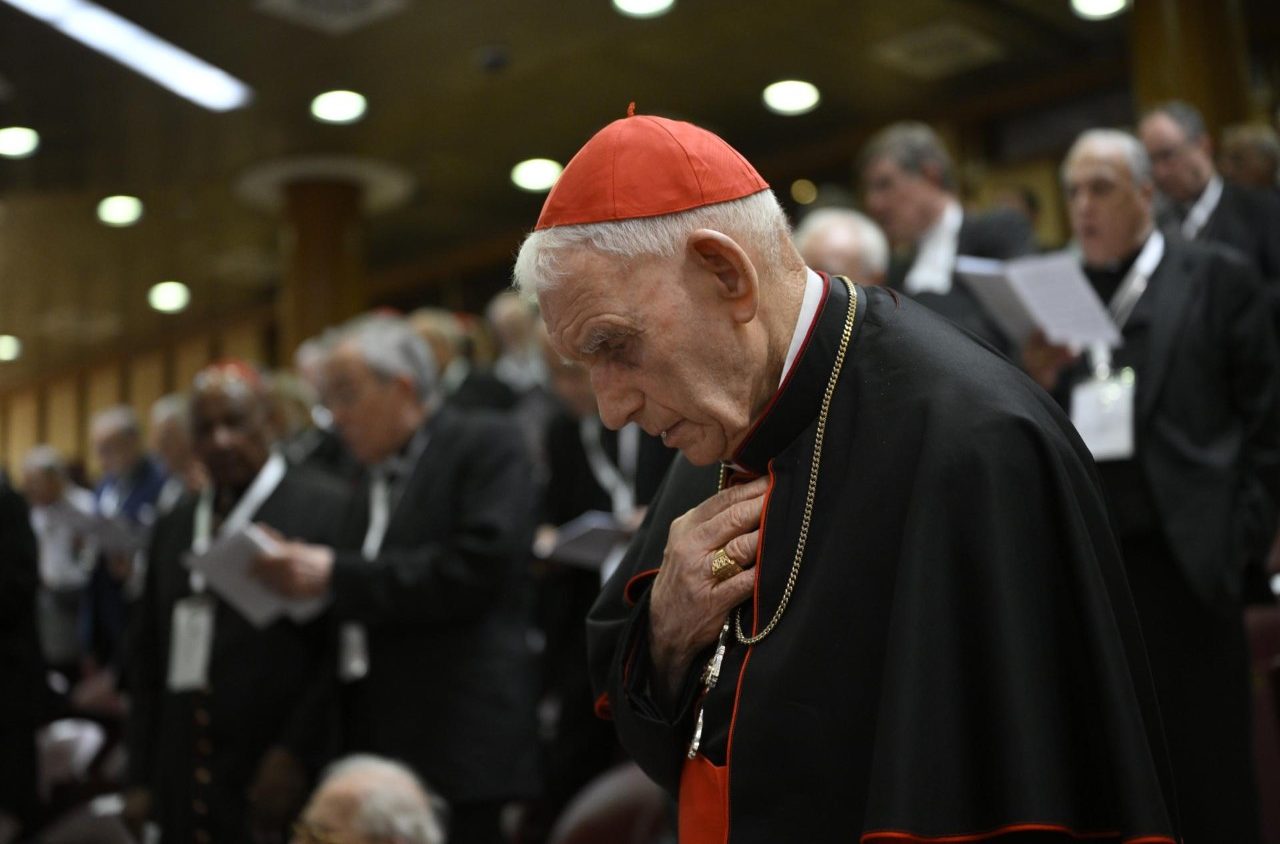 Vatican Media
The fourth session: implementing the Synod
In the afternoon, at 4.00pm, the work moved to the New Synod Hall for the fourth and final session, devoted to the implementation of the Synod. Introducing the subject, beginning with the document Towards the 2027–2028 Synodal Assemblies, was Cardinal Mario Grech, Secretary General of the Synod.
The Maltese cardinal recalled that, when the Synod on Synodality began in 2021, “few could have imagined the scale of participation” it would generate. He stressed the substantial difference between a merely “thematic” spiritual conversation and a genuine “conversation in the Spirit”. The implementation phase, he explained, is not about applying decisions already taken, but about allowing the insights that emerged along the way to mature in the life of local communities, through a process leading to the ecclesial assembly planned for October 2028. The journey is shaped by four verbs - “remember”, “interpret”, “give direction” and “celebrate” - in which the ministry of the bishop remains fundamental alongside synodal teams and participatory bodies. The Consistory and synodal assemblies, Grech concluded, are “two practical expressions of the same communion”, and for this reason the contribution of the College of Cardinals to the implementation phase will be “particularly important”.
Cardinal Grech’s remarks, however, appear not to reckon with what is actually happening in dioceses. Numerous pastors have observed, and continue to observe, that the synodal process has failed to generate genuine interest among the faithful and has produced no significant developments, leaving uncertainty and confusion in its wake. It was therefore no coincidence that the cardinal’s address was followed by interventions from several cardinals and bishops present, who sought clarification. After the break, the discussion continued with the Holy Father, with open-floor interventions of no more than three minutes each.
The concluding address: ‘The question is not who has the power to decide’
It was in his concluding address that Leo XIV provided the key to understanding the entire Consistory. The Pope began with a thought for the people of Venezuela, “harshly affected by the violent earthquake of recent days”, assuring them of the College’s prayers for the victims and for all those engaged in rescue efforts.
He then thanked the cardinals “for the freedom, fraternity and ecclesial spirit” with which they had taken part in the work, saying that he would carry with him “not only the content” of their reflections, “but also the experience that made them possible”. If the first day had opened under the image of the Good Samaritan, the Pope chose to close the assembly with the Gospel scene of the disciples on the road to Emmaus: men walking “marked by sadness and disappointment”, to whom the Lord makes himself a travelling companion until their hearts begin to burn once more.
The central passage concerned synodality. The decisive question, Leo XIV said, “is not primarily: ‘Who has the power to decide?’, but rather: ‘How do we together safeguard the gift that the Lord has entrusted to his Church?’” Only when this becomes the centre of discernment, he continued, do questions of authority and co-responsibility “find their proper place”. Returning to Cardinal Grech’s words, the Pope reaffirmed that synodality “is not a series of meetings, nor a working method”: it is “a spiritual style” born of encounter, growing through listening and maturing in discernment. “The real question,” he added, “is not how many conversations we are able to organise, but what Gospel quality our encounters will have.”
Reviewing the sessions, the Pope reflected on the way in which the cardinals had “contemplated the world” on the first day. Behind wars, poverty and injustice, he observed, they had identified “an even deeper suffering”, made up of loneliness, a crisis of relationships and the loss of hope. He spoke particularly movingly about young people, in whose suffering - “at times reaching the extreme despair of taking their own lives” - he recognised “one of the deepest wounds of our time”, but also “the work of the Spirit”. He returned to the subject of the family, anticipating the October meeting with the heads of the Eastern Churches and the presidents of episcopal conferences to assess the progress made since Amoris laetitia. Returning to the themes of the second session, Leo XIV pointed to one of the insights of Magnifica humanitas: “war is not merely a conflict between states”, but arises “from a culture of power” that shapes ways of thinking, relationships, the use of the economy and technology, “and even religion”. The response, he said, is to “rebuild a culture of cooperation and dialogue”, capable of giving new strength to multilateralism, with the essential contribution of lay faithful engaged in public life and their “political charity”. He described the non-violent response as “profoundly evangelical”: one that does not avoid conflict or remain silent in the face of evil, but “begins by disarming oneself”. He also noted the opportunity, raised by several groups, to continue “with the necessary theological and pastoral rigour” the examination of legitimate defence “in the light of the profound changes that have taken place in the nature of contemporary conflicts”.
The Pope also took up the request to make Catholic social teaching “a living part” of local communities and insisted on the common good as “a reality to be rediscovered together”, recalling that the poor are not merely recipients of the Church’s care “but protagonists of hope”. In a time marked by polarisation, he stressed, “the very way in which the Church listens and engages in dialogue becomes part of her proclamation”.
This led to a reflection of institutional significance on the meaning of the Consistory itself: “the gathering of the College of Cardinals around the Successor of Peter” so that the Holy Spirit may help the Pope to guide the Church. “Not a parliament, not a congress in which opinions or interests prevail,” Leo XIV made clear, “but an experience of communion at the service of mission.” The Pope then confirmed his intention to make the meeting an annual event “beginning next year”, although no date has yet been set; he expects to announce it “towards the end of this year”. Before concluding, the Pope took up the “unanimous” appeal that had emerged from the Consistory, inviting the cardinals to proclaim it together: “God desires peace for every nation and every people. For this reason, we must not resign ourselves to violence. Violence will not have the last word.” He finally thanked the speakers, moderators and all those who had made the working days possible, entrusting the fruits of the Consistory “to the intercession of the Virgin Mary, Mother of the Church”.
The work concluded with the singing of the Te Deum and dinner with the Holy Father in the Paul VI Hall at 7.45pm. The next event is scheduled for Monday 29 June, the Solemnity of Saints Peter and Paul, when metropolitan archbishops will receive the pallium from Leo XIV in St Peter’s Basilica.
fr.G.V.
Silere non possum