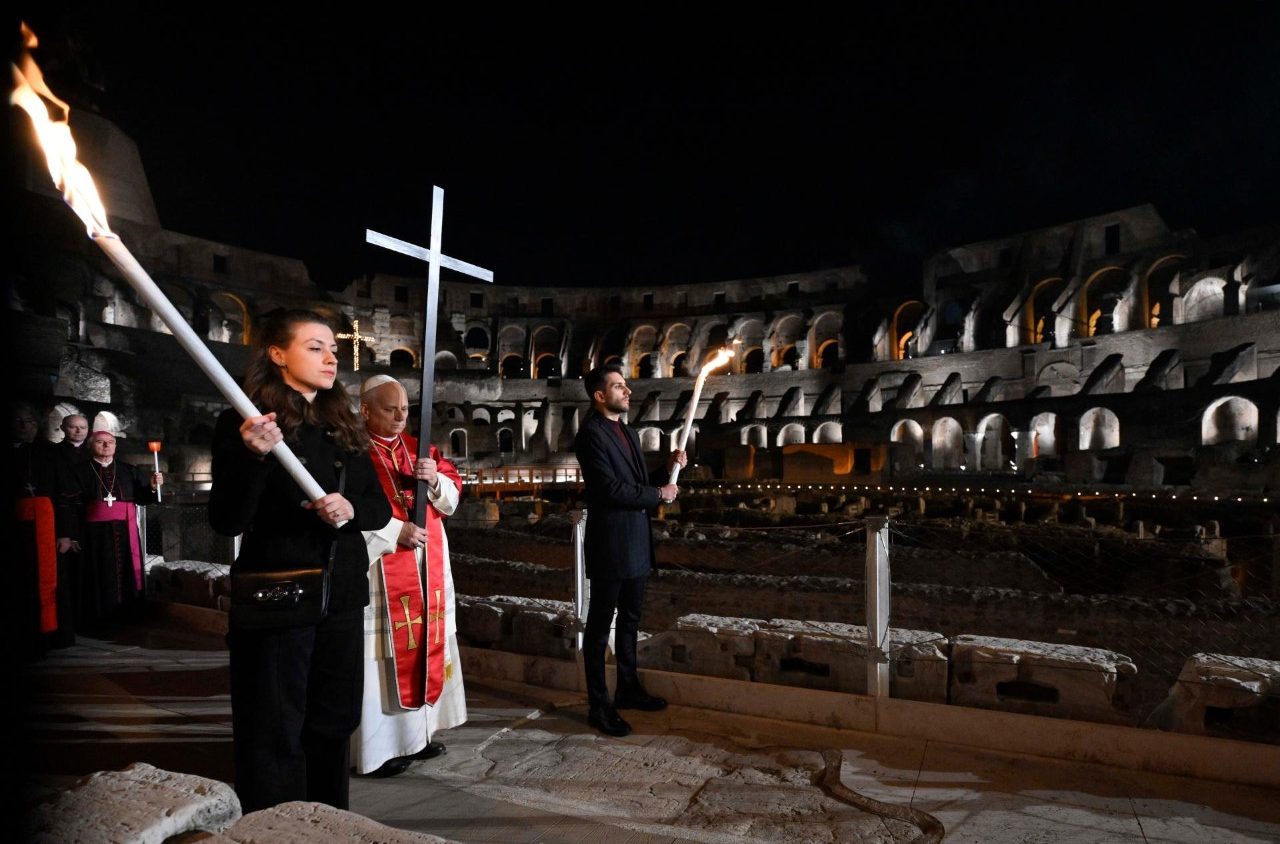
Rome - There was the gentle darkness of a Roman spring night, the flickering glow of torches, the Colosseum transformed for one evening into a place of prayer and remembrance. There were thirty thousand faithful gathered around the Flavian Amphitheatre: families with children, young people, priests, women religious, pilgrims from various countries. And there was, above all, the cross. Held in the hands of Leo XIV through all fourteen stations of the Good Friday Way of the Cross, presided over by the Pope at 9.15 pm and broadcast worldwide.
It was an intense celebration, marked by a rare recollection, capable of holding together popular devotion, the drama of the Passion and the wounds of the present time. Five stations within the Colosseum, nine outside, along a route marked by the chants of the Sistine Chapel Choir conducted by Monsignor Marcos Pavan, the voices of the readers and the slow pace of the Pontiff, flanked by two young people carrying torches. Leo XIV moved forward with his gaze often fixed on the wood he held in his hands, as though that gesture were gathering within itself the suffering of many, the prayer of all, the weight of a humanity that continues to seek redemption at the heart of its contradictions.
This year, the meditations and prayers for the stations were entrusted to Father Francesco Patton, O.F.M., former Custos of the Holy Land. His texts, marked by the spiritual breath of Saint Francis of Assisi in the eighth centenary of his death, accompanied the faithful into the Via Dolorosa of Jerusalem and, at the same time, into the streets of today’s world. It was not an abstract devotion, removed from history, but a journey immersed in noise, injustice and the wounds of real life. This was one of the strongest features to emerge from the celebration: the Passion of Christ did not remain confined to liturgical remembrance, but returned to question the present with words both severe and merciful. Station after station, the Way of the Cross brought to the surface the great knots of our age. In the condemnation of Jesus there resounded the denunciation of every abuse of power, of every authority that forgets it is received and not possessed. In the disfigured face of the Lord, wiped by Veronica, appeared the features of those who today are humiliated, exploited, despised and stripped of their dignity. In the meeting with the Mother were gathered the tears of women mourning sons arrested, killed, disappeared, swept away by wars and violence. In Simon of Cyrene took shape the volunteers, humanitarian workers and all those who bend over the suffering of others without clamour, sometimes without even realising that they are serving Christ precisely there, in the wounded body of their brother.
The strength of Father Patton’s texts also lay in the decision to look upon the cross without softening it. The falls of Jesus spoke of our own falls, of frailty, depression, addictions and despair. The stripping of his garments evoked torture, abuse and humiliations inflicted on bodies, but also that subtler violence which exposes people to public judgement and tramples upon modesty and intimacy. The crucifixion brought back to the centre the kingship of Christ, who does not dominate but gives himself over, does not crush but forgives, does not use force to impose himself but takes evil upon himself in order to overcome it with love.
 © Vatican Media
Around the Colosseum, as the crowd followed in silence and the choir intoned Adoramus te, Christe, et benedicimus tibi, the decision of Leo XIV to carry the cross personally along the entire route became especially clear. It was a gesture the Pope had presented in recent days as an “important sign”, to remind the world that Christ continues to suffer in the sorrows of humanity. At the Colosseum that sign took on a tangible depth. The Pontiff walked on without allowing himself to be distracted by those present. His slow, absorbed pace gave the celebration an almost penitential tone, as though the Bishop of Rome wished to take upon his own shoulders, at least symbolically, the weight of the wounds that the Church and the world carry within this Good Friday. Present were Cardinal Baldassare Reina, Vicar General for the Diocese of Rome, the Vicegerent, Auxiliary Bishop Di Tolve and the other elected auxiliary bishops whom Leo XIV will ordain in May for the Diocese of Rome: a discreet presence, yet one full of meaning, almost as if also to place before them, from this moment, the image of a ministry born at the foot of the cross and shaped by service, closeness and the sharing of the people’s suffering.
At the end of the fourteenth station, the Pope made his own the prayer with which Saint Francis of Assisi closes the Letter to the Entire Order: the Omnipotens, an invocation asking God to purify, enlighten and inflame the human person inwardly, so that he may follow in the footsteps of Christ and come, by grace, to encounter him. Then came the final blessing, that ancient biblical blessing which Saint Francis loved to give to the friars and to the people: “May the Lord bless you and keep you… may he turn his face towards you and grant you his peace.” When Leo XIV pronounced those words, the Colosseum remained suspended in an almost palpable silence. Only afterwards did the applause break out. It was restrained applause, which did not break the atmosphere of prayer, but almost prolonged it in the form of gratitude. Perhaps this is what remains most impressed from this first Good Friday Way of the Cross presided over by Leo XIV at the Colosseum: the ability to hold together the weight of history and the horizon of hope. Wars, wounded mothers, the poor, prisoners, migrants, victims of trafficking, the humiliated, those who fall and those who are left alone did not remain at the margins of prayer. They entered into the stations, into the invocations, into the wood of the cross carried by the Pope.
At the heart of the Triduum, as the Church enters into the atmosphere of the great silence of Holy Saturday, the Way of the Cross at the Colosseum recalled that the Christian faith passes through the world without withdrawing from its harshness. It walks among the stones of the city and among the wounds of men and women. It looks death in the face, but does not stop there. For this reason, on this Roman night, the garden of the tomb evoked in the final station did not appear as the place of the end, but as the threshold of waiting. And within that waiting, this evening, Rome prayed with its Bishop.
fr.E.R.
Silere non possum