Cologne - In Cologne Cathedral, on Monday 30 March 2026, Cardinal Rainer Maria Woelki, Archbishop of Cologne, presided at the Chrism Mass and delivered to clergy and faithful alike a homily of particular significance, built entirely around the relationship between priestly ministry and the Eucharist. From his opening words, the cardinal situated the priests’ renewed “yes” within the logic of the Church’s tradition and fidelity to the mysteries of Christ celebrated in the liturgy.
The central point of his address was the sacred liturgy as the heart of the priesthood. Woelki recalled that, if the liturgy is, as the Second Vatican Council teaches, the summit and source of the Church’s life, then it is so also for the life of the priest. For that reason he said: “Although our work is by no means exhausted in the celebration of divine worship, the celebration of the sacred liturgy is nonetheless the very centre of our priestly ministry.” He added that it is at once summit and source, because the whole of priestly action is ordered towards communion with Christ and must continually receive renewal from that communion. To express this reality, the archbishop returned to an image used by John XXIII, that of the “village well”, from which every generation draws the same living and fresh water.
A concern: preaching
From this theological framework there also follows a very precise pastoral indication on preaching. Woelki insisted that the homily cannot be regarded as something separable from presiding at the Eucharist. He recalled that, from ancient times, the one who presides at the Eucharist also carries out the service of proclaiming the Word of God in the homily during Holy Mass. For this reason he warned “in view of present attempts to detach the proclamation of the Word of God in the homily from presiding at Mass”, urging priests to safeguard “this important theological connection” and not to surrender to a “purely functionalist” way of thinking. The point is clear: preaching at Mass is not something to be lightly delegated to one who does not preside at the Eucharist, because it belongs to the very structure of the liturgical action and of priestly ministry.
Celebrating the divine mysteries each day
The other major passage in the homily concerned the daily celebration of Holy Mass. For Woelki, this is not an optional custom, nor a private devotion left to the sensibility of the individual presbyter. After recalling that in the Eucharist the work of redemption is continually accomplished, the cardinal reaffirmed that the Church “earnestly commends - especially to us priests - the daily celebration of Holy Mass”. He then expressed himself in very clear and deeply felt words: “Even if only a few faithful, or indeed none at all, should be present, its daily celebration remains meaningful for us priests and, spiritually speaking, almost a matter of survival.” Nor did he stop there. He added: “The daily celebration of Holy Mass is not simply a pious exercise for us priests. On the contrary: it is constitutive of our priestly being and action.”
The cardinal then explained that the Eucharist is not simply one practice among others, but the place in which the Church herself takes shape. Woelki expresses this in a particularly dense formula: “The Church does not simply celebrate the Eucharist. She also comes forth from it.”
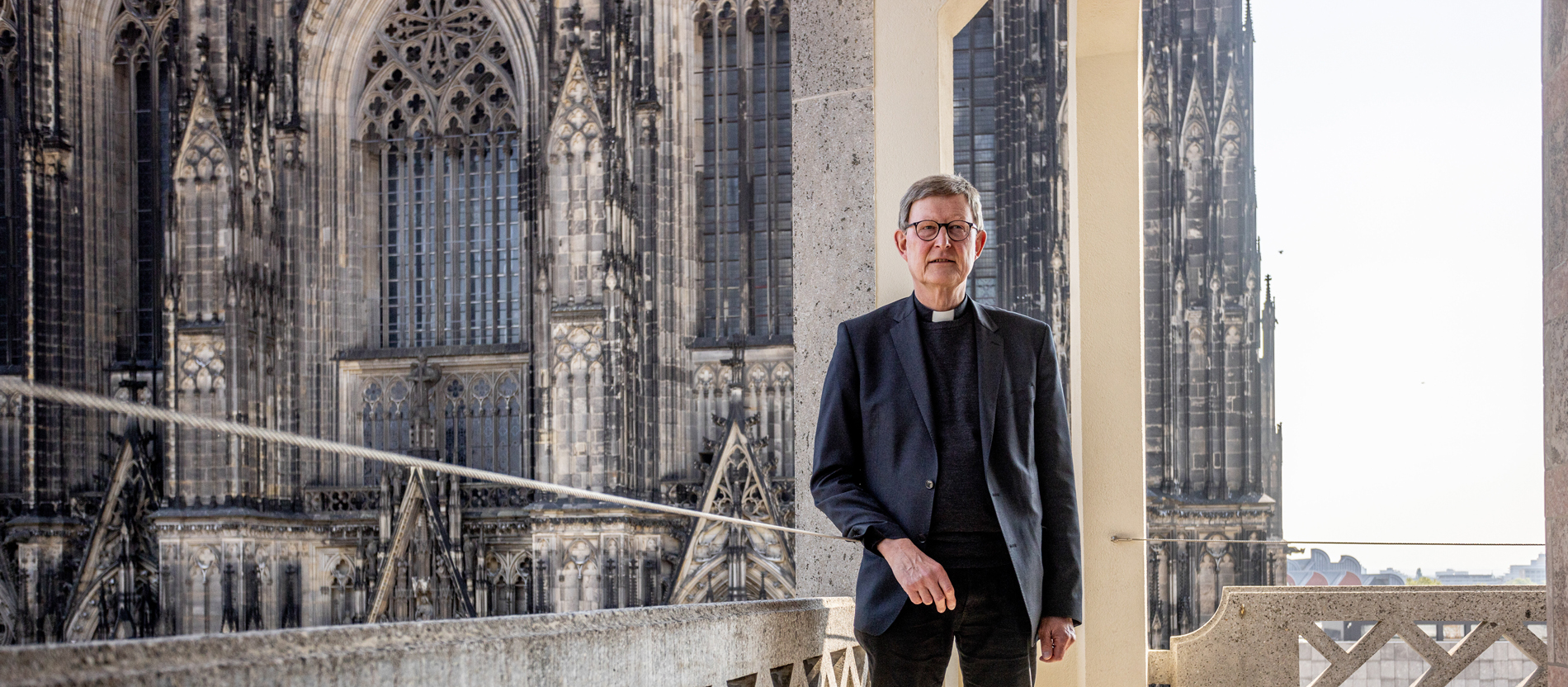 © KNA/Theo Barth
Woelki warns the clergy
The archbishop also reaffirmed that the Sunday Eucharistic celebration “cannot be replaced or exchanged for anything else”, and he voiced his concern over the growing spread of celebrations of the Word which, in some places, are taking the place of Mass, at times even with the distribution of Holy Communion. “Through such a practice we are gradually losing our Catholic identity,” the cardinal told the priests in a tone of evident suffering. He then described the concrete consequences of this drift: some of the faithful travel to places where Holy Mass is celebrated, others remain at home, while still others end up considering a celebration of the Word sufficient. The sharpest passage comes when he denounces the existence of settings in which people openly say that they wish to do everything possible to make themselves independent of the priest and of his ministry. His conclusion on this point leaves no room for ambiguity: “That, dear brother priests, is no longer Catholic, and I urge you most earnestly to resist it from the outset.”
Woelki also indicated a possible path of renewal, recalling an ancient Christian practice, still alive in the Eastern Churches and present in the West until the nineteenth century: a single Sunday Eucharist as the gathering of the whole assembly. According to the archbishop, the Eucharistic celebration on Sunday must serve to gather the community, not to scatter it, “as it were, into a kind of diaspora”. For that reason he suggested reflecting on the recovery of this approach in large pastoral units and parishes, seeing in it a possible path towards the spiritual and Eucharistic renewal of the archdiocese. The homily delivered before the presbyterate of Cologne represents a passage of unusual clarity from a pastor called to confirm faithful and priests alike in the faith within a context, such as that of Germany, marked by ecclesial tensions, pastoral experimentation and pressures tending to redefine the relationship between ordained ministry, community and liturgy. In this setting, the words of Cardinal Rainer Maria Woelki stand as a clear summons back to Catholic doctrine and to the Church’s practice. Such an explicitly faithful stance towards tradition and Rome has cost him, over the years, growing hostility, campaigns of delegitimisation and attempts to secure his removal from the governance of the archdiocese through disgraceful accusations that proved to be without foundation. For that very reason, for many priests and faithful who continue to ask for clarity, the centrality of the Eucharist and ecclesial fidelity, this text sounds like fresh water.
fr.P.H.
Silere non possum