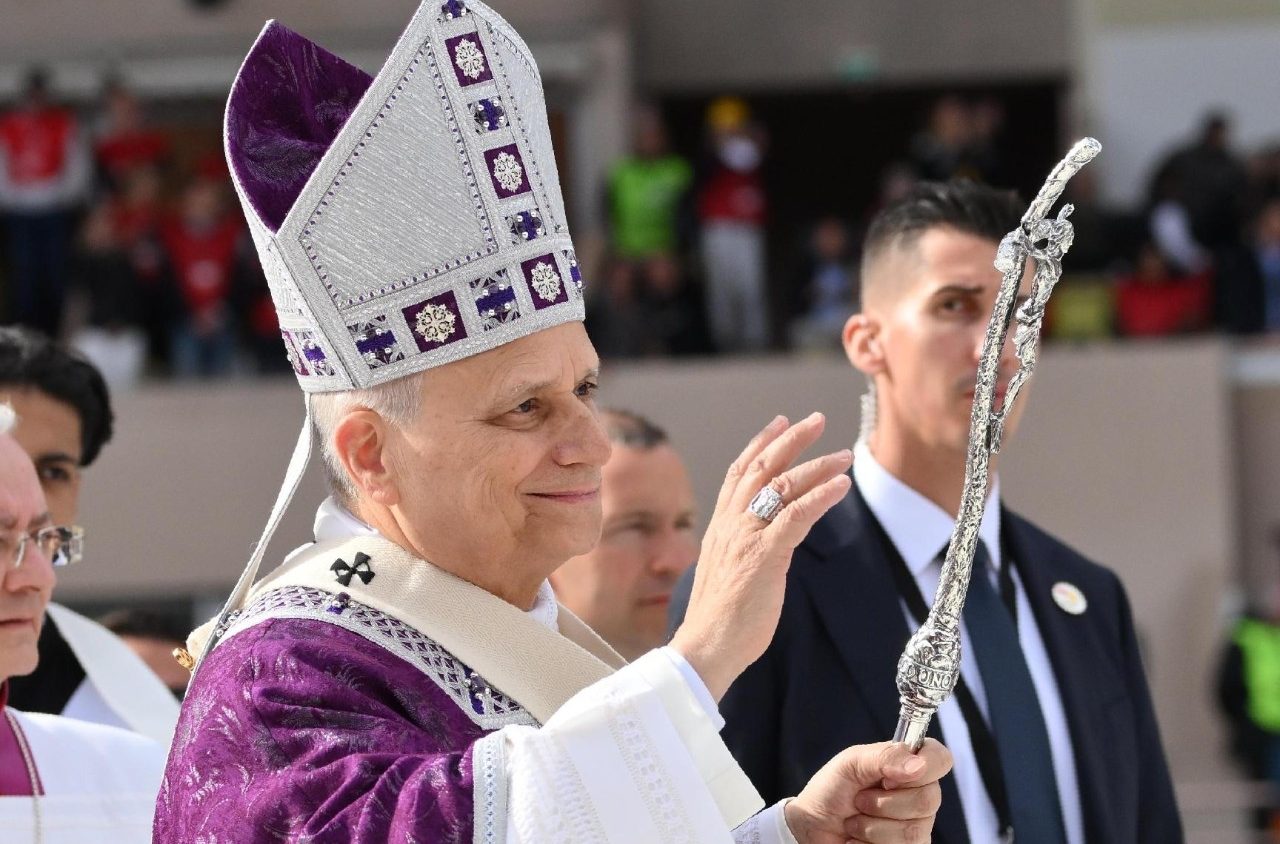
Principality of Monaco - In the afternoon, as the light settles once more over the Principality and the sun intermittently breaks above the stands, Leo XIV’s visit reaches its most expansive and visible moment. After meeting young people and catechumens, at 2:45 pm the Pontiff moves to the Stade Louis II. On arrival, he passes among the faithful in a golf cart, greeting at close quarters the crowd gathered for Mass.
In a land the Pope himself has described as called to safeguard social friendship and responsibility for the common good, that passage among the people gives the celebration a precise tone: not the distance of a formal event, but the closeness of a pastor. The white and yellow flags of the Vatican and the red and white of the Principality move in the light afternoon breeze. At around 3:30 pm, the Eucharistic Celebration begins, the liturgical and spiritual centre of a day dense with glances and emotion.
Leo XIV’s homily takes its starting point from the Gospel of John, from the moment when the Sanhedrin decides to put Jesus to death after the resurrection of Lazarus. The Pope does not soften the Gospel account, nor does he reduce it to a distant page. He takes it in its starkness. Jesus is condemned precisely because he has restored life, precisely because he has given back hope, precisely because he has shown himself capable of entering human suffering, even to the point of weeping at his friend’s tomb.
The point on which Leo XIV insists is the deliberate nature of that decision. Not an accident, nor a tragic chain of circumstances, but a choice matured in fear. Caiaphas and the Sanhedrin do not recognise in Jesus the expected Messiah; they see someone who disrupts balances, who moves the people, who opens a hope that cannot be controlled. The Pope speaks of a “political calculation”, a phrase that alone gives the entire homily particular force. The issue does not concern religious misunderstanding alone. It concerns power when it feels threatened. It concerns men and women who, in order to preserve order, influence and position, choose to strike the innocent. We see it even today, in daily life, when in darkness and in the shadows plots are devised against a common enemy.
In the Gospel account, Leo XIV observes, there is already much of what continues to mark human history. On the one hand stands the work of God, who frees and saves; on the other, authorities prepared to suppress without scruple. The Pope does not turn this contrast into an abstract scheme. He allows it to act within the conscience of his listeners. The death of Jesus does not appear as the triumph of evil over a defenceless righteous man, but as the point where human hatred and God’s saving plan intersect in a dramatic way. Even Caiaphas, at the moment he pronounces his verdict, ends up saying more than he intends: without knowing it, he prophesies that Jesus must die for the people. In this reading, Lazarus is not only the man called out of the tomb. He becomes the sign that anticipates Easter. He becomes the announcement of a life that enters death and is not held captive by it. Leo XIV looks at that miracle as a threshold: before the tomb of Bethany, one already begins to glimpse Christ’s destiny - his passion, his death, his resurrection - and with it the destiny of redeemed humanity. The Christian faith, in essence, is born here: not in a consoling theory, but in the certainty that God does not leave man under the dominion of death.
From this point the discourse quickly opens to the present. Leo XIV speaks of the innocent who are still struck down today, of the many apparent reasons used to justify their elimination, of the calculations that continue to decide who may be sacrificed. There is no need to add more to understand how the homily looks to wars, violence, the powerful, hidden dealings, wounded peoples, and the least who pay the price of others’ ambitions. The Pope does not dwell on geopolitical analysis; he chooses a more radical word. Each time the innocent is crushed, each time human life is treated as an obstacle or refuse, the Gospel story presents itself again before humanity.
Against this background, one of the most significant terms of the homily emerges: mercy. Leo XIV presents it as the true name of God’s omnipotence. Not a sentimental mercy, nor a vague disposition of mind, but the force by which God draws man out of his tomb, raises him up and restores him to life. Mercy, the Pope says, cares for human existence in every season: when it begins in the womb, when it grows, when it weakens, when it encounters illness and solitude. The first reading, taken from Ezekiel, allows Leo XIV to dwell on the theme of liberation. Not an individual, almost private liberation, but a work that touches a people, its relationships, its way of standing before God and before others. Ezekiel speaks of purification from idols. The Pope devotes some of the most striking images of the homily to this point. An idol, he explains, is what narrows the gaze. It is a reduced vision of reality. It is whatever captures the heart to the point of enslaving it. Thus even goods that are in themselves great and good can become instruments of corruption: power when it degenerates into domination, wealth when it turns into greed, beauty when it bends to vanity.
The target is not possession in itself, but the heart that allows itself to be bought. Leo XIV describes idolaters as people of narrow vision, incapable of going beyond what dazzles. It is biblical language, yet it resonates with particular clarity in a context such as Monaco, marked by the coexistence of great wealth, international finance, tourism, social privilege and service work. In the Pope’s words there is no polemical complacency, but a clear call that every good received be understood according to a broader purpose, not held as closed property, not separated from justice. The reference to Saint Augustine adds theological depth without interrupting the rhythm of the homily. Man is freed from the dominion of idols when he believes in the one who raises him through humility. Christ, therefore, does not defeat evil by crushing it from without, but by passing through it with love. He does not impose himself by punishment; he saves by drawing humanity back to himself. The promise of God - “they shall be my people, and I will be their God” - thus returns as the centre of a restored covenant, of a reopened history, of a life rescued from the sterility of fear.
In the final part, Leo XIV links idolatry to the wars that stain the present. He speaks of the idolatry of power and money as a concrete root of conflict. He states that every life cut short wounds the Body of Christ. He calls for resistance to becoming accustomed to the noise of weapons or even to images of war, as though repetition could render acceptable what remains a scandal. Peace, he adds, does not coincide with a provisional balance between opposing forces. It is born rather of purified hearts, capable of seeing the other not as an enemy to be defeated but as a brother or sister to be protected. To the Church in Monaco, the Pope entrusts a very concrete task: to bear witness to this vision of life within peace and within God’s blessing. Christian joy, he recalls, is not achieved like a wager won; it is shared through charity. And charity has concrete faces, situations and ages: life at its beginning and in need, to be welcomed and protected; young and elderly life, to be sustained in trials; healthy and sick life, often alone, always in need of accompaniment. It is a passage that holds together social doctrine, defence of life, pastoral care of fragility and ecclesial responsibility, without dispersing into a list. As the homily draws to a close, it returns once more to the image of the world’s Lent. Evil continues to rage, hearts risk indifference, and yet the Lord prepares his Easter. The sign of this passage, Leo XIV says, is the human being himself: Lazarus called from the tomb, the forgiven sinner, the Risen Crucified One who opens the way of salvation. Christ is “the way, the truth and the life”, and the mission of the Church consists in giving the world the life of God. No task appears higher. No task, the Pope suggests, can be fulfilled without the gift of self to others.
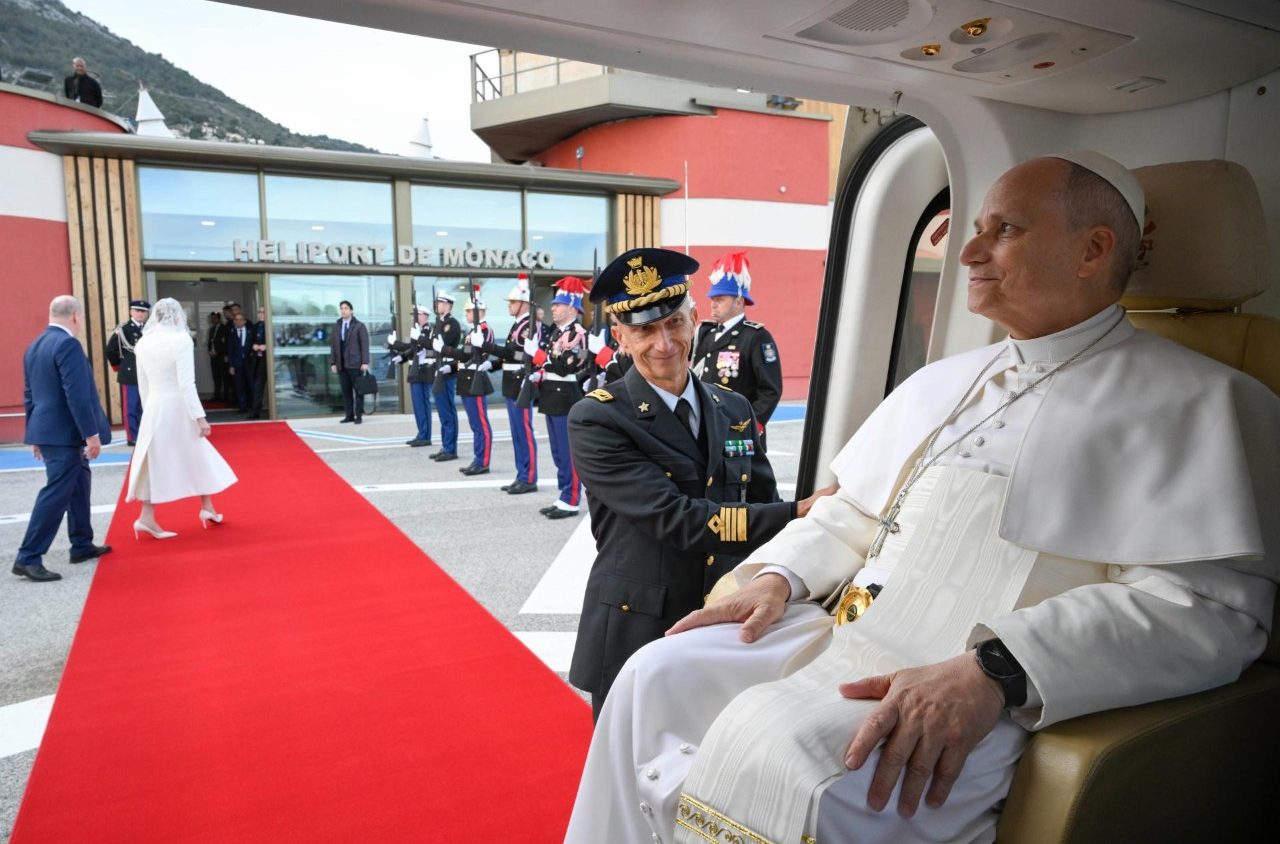
At the end of the celebration, the Archbishop of Monaco, Dominique-Marie David, addresses words of thanks to the Pontiff. Before leaving the stadium, Leo XIV meets several people assisted by ecclesial and lay associations. It is an almost final note coherent with what he has just preached: concrete life, fragility, the singular face of those who need to be seen not from afar but at close range. At 5:15 pm the Pope leaves the Stade Louis II and heads to the heliport. The farewell ceremony follows, the greeting to Prince Albert II and Princess Charlène, and the passage before the Guard of Honour. At 5:30 pm the helicopter departs for the Vatican City. Landing takes place at 6:57 pm. Shortly after departure, Leo XIV sends a telegram to the Sovereign of the Principality, expressing gratitude for the welcome received and invoking for Monaco the gift of peace and strength.
What remains is the impression of a visit brief in time and contained in space, yet dense in substance. In the afternoon of the Principality, between the sea, shifting light and flags stirred by the wind, Leo XIV has brought the gaze back to what is essential: human life, its dignity, and the duty to defend it when threatened by power, bent by the idols of money and force, wounded by war. A visit destined to leave a mark on the history of the Principality, and a stage lived by the Pope with evident joy, touched by the beauty and the singular identity of this small corner of Europe.
fr.C.B.
Silere non possum