Vatican City – “Sisters and brothers, even today there are tombs to be opened, and often the stones sealing them are so heavy and so closely guarded that they seem to be immovable.”
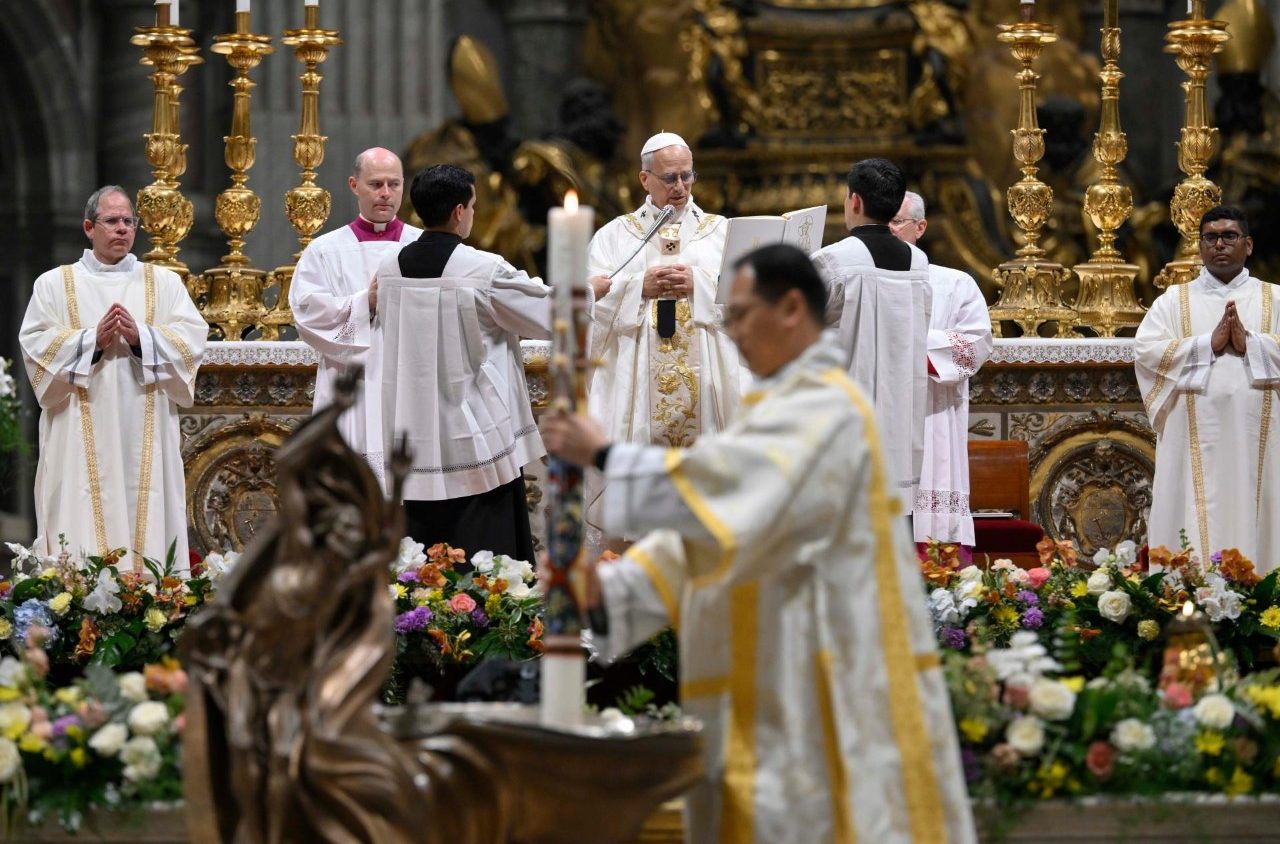
In these words, spoken by Leo XIV during his homily at the Easter Vigil, there is already the heart of this Holy Night: the weight of the stones, the weariness of man, the sense that some closures are final. Yet Easter enters precisely there, where everything seems still, sealed, watched over by sorrow and fear. At 9 p.m. this evening, in Saint Peter’s Basilica, the Pope presided over the solemn Easter Vigil in the Holy Night. The rite began in the atrium with the blessing of the fire and the preparation of the Paschal Candle. Then came the procession towards the altar, the slow spreading of the light, the great basilica little by little emerging from darkness. In that passing of flame from candle to candle, the truth guarded by the Church for centuries became visible once more: death does not have the last word. A single fire, a single light, and from that light a multitude of candles kindled. The Easter faith can also be contemplated in this way, in the simplicity of a sign that speaks of the superabundance of Christ: what comes from Him is shared, spread abroad, reaches other hearts and continues to overcome the darkness.
The singing of the Exsultet, intoned by the deacon, gave voice to that joy which, on the night of Easter, becomes real astonishment before the work of God. The ancient words of the Easter Proclamation filled Saint Peter’s with their undiminished force: Haec nox est. This is the night. The night in which the sea becomes a road, guilt is washed away, sorrow finds consolation, hatred retreats, and the powers of the world bend before a sovereignty that does not crush, but saves. Each year the Church returns to this proclamation, and each year seems to hear it as though for the first time, because every age knows its own darkness and every person carries within himself some region still waiting for light.
 © Vatican Media
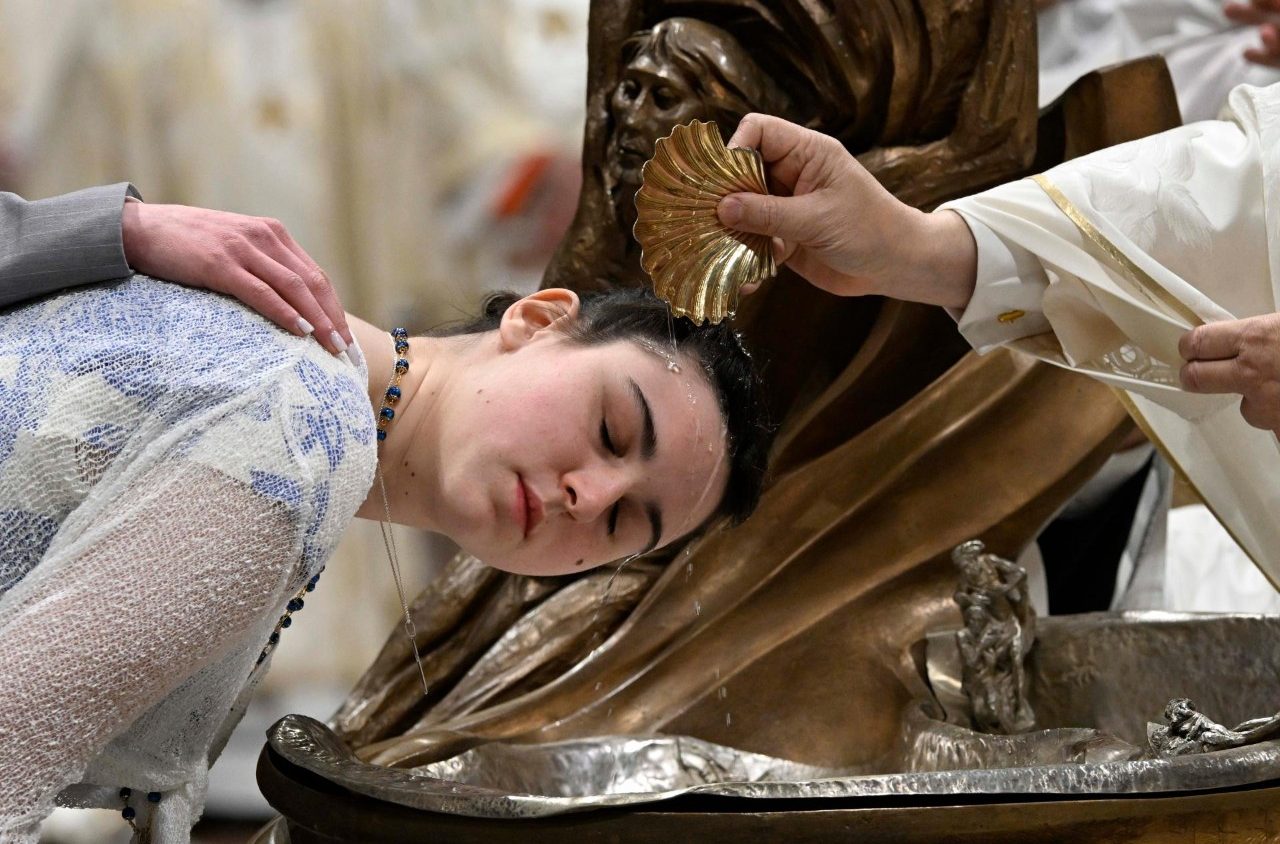
The Vigil continued with the Liturgy of the Word, the Baptismal Liturgy and the Liturgy of the Eucharist, concelebrated with cardinals, archbishops, bishops and priests. In the long weaving of the readings, the Church retraced the history of salvation as one passes through a living memory, not a collection of distant episodes. Creation, Abraham’s halted sacrifice, the passage through the Red Sea, the word of the prophets, the promise of a new heart: everything leads to this night, everything converges on the open tomb and on life restored. Easter is not an isolated fragment of the liturgical calendar. It is the point at which one understands that God has never ceased to pursue man, even when man had lost his way. At the heart of the celebration, the baptismal rite movingly showed that the Resurrection is not only a truth to be proclaimed, but a life to be received. Ten catechumens received Baptism on this Holy Night: five from the Diocese of Rome, one from Korea, two from Great Britain and two from Portugal.
From the Paschal Candle, godmothers and godfathers took the light to kindle the candles of the neophytes. In that scene, a simple and profound truth became visible: faith is never a private matter, nor an experience shut up in one’s inner life. It reaches the heart personally, but opens it to communion, binds it to concrete faces, grafts it into a history that comes before and accompanies it. No one crosses the threshold of the Church alone. Every birth into new life carries with it protection, nearness and a shared responsibility.
The water poured over the head, the white garment put on, the sign of the holy oil sealing the gift of the Spirit: each gesture had the force of a beginning. On those faces one could sense both the seriousness of the journey completed and the delicacy of a new beginning. To receive Baptism as an adult, on the night of Easter, means passing in almost visible form through that threshold which, for so many Christians, lies in the remote beginning of existence. For them, instead, the passage is impressed on the memory with the clear features of an event chosen, desired and awaited. When Leo XIVsaid, “Walk always as children of light,” those words were the handing on of a responsibility and, at the same time, the caress of an ecclesial fatherhood. Shortly afterwards, those same neophytes took part in the Offertory and approached the Eucharist for the first time. The Church saw them born and nourished in the same night.
In his homily, the Pope linked the light of the Paschal Candle to the mission of the baptised. From that single flame, he said, everyone had lit their candles, becoming in the Church “lights for the world”. The Christian faith is not entrusted in order to be kept as a private possession, but in order to give light. The Resurrection of Christ does not shut believers away in a space removed from the human drama; it sends them into history with a more demanding responsibility. For this reason Leo XIV spoke of tombs still to be opened: the inward tombs of mistrust, fear, selfishness and resentment; and those that wound relations between peoples, such as war, injustice and the isolation of peoples and nations. Easter asks us to look evil in the face without granting it the final definition of reality.
There was one passage in the homily that touched a deep nerve of the Christian experience: God, the Pope recalled, responds to the hardness of sin, which divides and kills, with the power of love, which unites and restores life. It is here that the Easter Vigil reveals its full scope. Faith is not born from naivety about the world, nor from a refusal to face sorrow. It is born from an encounter with a presence that passes through death and conquers it. The rites of Holy Weekaccompanied the faithful into the mystery of the Passion, showing the Son of God as a man of sorrows, despised, tortured, crucified. The night of Easter does not erase Good Friday; it brings it to fulfilment. The light that now fills the basilica is credible precisely because it comes after the blood, the silence, the humiliation, the stone rolled across the tomb.
 © Vatican Media
For this reason too, the Gospel of the women going to the tomb retains an inexhaustible force. Leo XIV recalled Mary Magdalene and the other Mary, their wounded yet courageous journey, their going towards a place that seemed definitively closed. They expected to find a sealed tomb, a heavy stone, soldiers standing guard. Instead, they found the sign of a different power, that of the love of God, stronger than evil and death. In that Gospel scene there is something that continues to concern every believer: one can go towards the tomb carrying grief and apparent defeat in the heart, and find oneself before a life beginning again where everything had seemed to be finished. Easter manifests itself in this way: it does not remove the weight of the real, but transfigures it with a force that surprises. Saint Peter’s, on this night, seemed to gather together all this tension between the weight of darkness and the irruption of light. There was the majesty of the liturgy, the precision of the rites, the solemnity of the chants, but above all there was something harder to describe: a sense of fulfilled expectation, of restrained relief, almost of breath recovered. The night of Easter also speaks to weary hearts, to those who have prayed without seeing, to those who have gone on hoping when everything seemed to contradict hope. This is why the Exsultet remains one of the most vertiginous texts of the Christian tradition: it dares to call this night blessed, even dares to bless the wound from which redemption came, because it knows that in Christ nothing is lost for ever.
In the Easter Vigil, the Church does not celebrate a mere anniversary. She returns to her source. She hears again the reason for her existence. She reminds the world, and herself, that Christianity is born from an empty tomb and from a living encounter. Everything this night repeated it with force: the fire lit outside, the candle carried in procession, the basilica illuminated by small flames, the singing of the deacon, the baptismal water, the white garment, the holy oil, the bread and wine offered upon the altar, the words of the Pope addressed to the neophytes and to the whole People of God. On this Holy Easter, the first celebrated by Leo XIV after his election, the liturgy set before the Church once again an essential question: what truly changes when one hears the proclamation of the Resurrection once more? The Popeoffered a demanding and concrete answer: to make of one’s life a lived Alleluia, allowing what is proclaimed with the lips to take shape in choices, words and deeds. Easter calls for Christians capable of bringing the light of the Risen Christ into the places where man remains crushed by the weight of fear, injustice and loneliness. It asks for people who know how to remove the stones that seal the heart, to speak in truth, to act with the strength that comes from God, and to sow the Gospel into the wounds of our time.
fr.V.B.
Silere non possum