Vatican City - “Is it possible to be friends in the Roman Curia? To have relationships of friendly fraternity?” In his first Christmas address to the Roman Curia, Leo XIV chose to place at the center a direct, almost disarming question that touches a raw nerve of this distinguished institution: the quality of relationships, trust, and everyday loyalty among people called to serve the Church. Over these years, Silere non possum has repeatedly highlighted the urgency of these themes, because they do not belong to the realm of abstract statements of principle: they touch the concrete lives of people and the real functioning of the institution. Living the Gospel within the Curia means embracing a style that precedes every practice and every reform: the Church, and in particular the institution that sustains its daily service, is called to offer witness before efficiency. Within this horizon, the question of relationships is not a merely “human” detail to be fixed on the sidelines. It is where credibility is measured: relationships that are healthy, free, not reduced to instruments of usefulness, belonging, or power. It is also here that the possibility of a good life - even a happy one - is at stake, because no community holds together if people are used, bypassed, or made functional to balances and careers.
The Pope returns to these points after also urging young people to safeguard authentic bonds: the message is clear. The request does not concern “others” or “the future”; it concerns us, today. If the Church is asked to educate, it must first show that what it proclaims is workable; if it asks young people for real relationships, it must know how to live them in its own homes and corridors. In other words: witness comes first, for them as for us. Leo XIV framed this important intervention in the light of Christmas, read as a “newness” that runs through history and restores the Church to its original horizon: Christ at the center, a mission that springs from God’s own movement toward humanity, and a communion that is not an organizational slogan but a work of conversion. From there comes the architecture of the address: two axes - mission and communion - which Leo XIV explicitly drew from Evangelii gaudium and applied to the operational heart of ecclesial governance: dicasteries, offices, procedures, and work styles.
Mission and the Curia: structures at the service of the Gospel
Leo XIV recalled a criterion: the Curia cannot live off administrative inertia, nor build procedures that “weigh down” the pace of proclamation. “Structures… must not weigh down or slow the course of the Gospel or hinder the dynamism of evangelization,” he said, relaunching the urgency of “ensuring that they all become more missionary.” Missionary conversion, for the Pope, is not an abstract program: it is a way of designing roles and offices while “looking to the great ecclesial, pastoral, and social challenges of today.” The theological accent is just as marked: mission begins “in the heart of the Most Holy Trinity,” in the “first great exodus” of God who goes out of himself and comes toward humanity. Christmas, in this perspective, becomes the grammar of a curial service that does not fold in on itself, but allows itself to be judged by God’s movement toward the world.

Communion: the hot spot of relationships
When Leo XIV moves to speak of communion, the address becomes sharper and, in many respects, more “internal.” The Pope does not idealize ecclesial life: he acknowledges that “at times, behind an apparent tranquility, the ghosts of division stir,” and he describes a typical temptation in complex environments: swinging “between two opposite extremes,” namely “flattening everything without valuing differences” or “exasperating differences” until they become opposition. It is a diagnosis that concerns “interpersonal relationships,” “internal office dynamics,” and even the way sensitive issues -faith, liturgy, morality - are handled, where rigidity and ideology generate fractures.
Here the Holy Father introduces a key passage: communion is not built primarily “with words and documents,” but “through concrete gestures and attitudes” that must emerge in daily life, including at work. And to make this concept understood, he cites the saint dearest to him: Saint Augustine. Leo quotes the line that frames the theme of relationships: “In all human affairs, nothing is dear to a person without a friend.” Immediately afterward, however, he brings in the bitterness of the Bishop of Hippo: “But how many can be found so faithful that we can trust them with confidence regarding their mind and conduct in this life?” It is a way of saying that fraternity is not automatic and that, in the Curia, the issue is measured on very concrete terrain: power, ambitions, interests. Leo XIV does not shy away from words when he recognizes that, after years of service, “certain dynamics linked to the exercise of power, to the craving to prevail, to the care of one’s own interests, struggle to change.” And from there he returns to the question that set the tone for the entire passage: can one truly be friends in the Curia?
The answer is not offered as a formula, but as a description of a method and a conversion: “it is beautiful when we find friends we can trust,” when “masks and subterfuges fall away,” when “people are not used and bypassed,” when one helps one another, recognizes competence and value, and avoids resentments and dissatisfaction. “There is a personal conversion we must desire and pursue, so that in our relationships the love of Christ that makes us brothers may shine through.”
“It is so ad intra, because communion in the Church always remains a challenge that calls us to conversion. At times, behind an apparent tranquility, the ghosts of division stir. And these make us fall into the temptation of oscillating between two opposite extremes: flattening everything without valuing differences or, on the contrary, exacerbating differences and viewpoints rather than seeking communion. Thus, in interpersonal relationships, in the internal dynamics of offices and roles, or in dealing with themes concerning faith, liturgy, morality, or anything else, there is the risk of becoming victims of rigidity or ideology, with the oppositions that follow,” the Pontiff said.
A sign “ad extra”: peace, social aggressiveness, and public responsibility
Internal relationships, for Leo XIV, have a public reflection. The Pope links the quality of communion to the Church’s credibility in a “wounded” world, where aggressiveness and anger grow, often amplified and instrumentalized “by the digital world as well as by politics.” In this framework, Christmas brings “the gift of peace” and calls the Church - and the Curia - to be a “prophetic sign” in a fragmented context. Hence an image that shifts the gaze beyond the palaces: “we are not small gardeners intent on tending our own patch,” but witnesses of a Kingdom that is asked to become “leaven of universal fraternity.”
The climate in the Curia: easing tensions and expectations
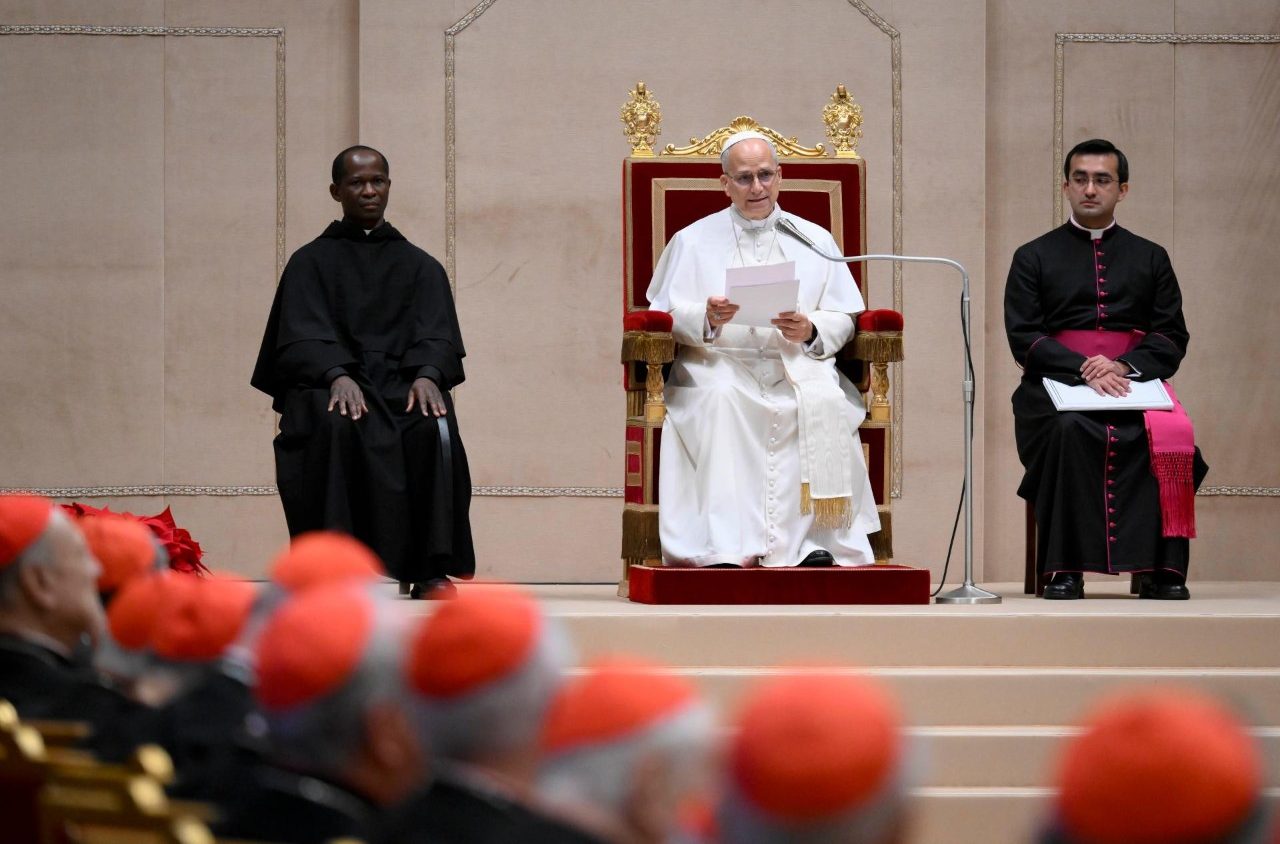
This year’s appointment - historically the only moment in which the Pope meets the Roman Curia gathered in its entirety for the exchange of Christmas greetings - took on particular significance because it marked Leo XIV’s first Christmas address to the Curia. After the initial meeting at the beginning of his pontificate, it was the first occasion on which the new Pope addressed the whole Curia again, and he did so in a climate noticeably more relaxed than in the previous thirteen years. Faces reappeared that in the past had progressively avoided this appointment, discouraged by a constantly conflictual environment marked by reprimand. In the corridors and on the stairways, moreover, there was no lack of explicit comments, voiced by cardinals and archbishops, that suggest a pontificate capable of calming spirits, reducing tensions, and reopening real spaces for dialogue, after a long season of rigidities and suspicions. This context also includes the increasingly explicit ожидание for the extraordinary Consistory in January, which will be a significant passage: there the Pope will engage with the College of Cardinals, and several cardinals look to that appointment with a concrete hope for the future of the Church.
A Christmas that calls for “condescension” and concreteness
Leo XIV concluded this moment with the wish of a “Holy Christmas” to the Curia, entrusting to a citation from Dietrich Bonhoeffer the final image: God who “enters into” the lowliness of humanity and loves what is lost, insignificant, marginalized. It is a closing that gathers the overall meaning of the address: mission and communion do not remain concepts, but become a discipline of the heart and a concrete criterion for assessing the quality of relationships. In the curial context, this translates into verifiable choices: the way people speak to one another, esteem one another, collaborate, renounce masks and subterfuges, and build sincere and loyal relationships. It is also an invitation to take distance from suspicion, gossip, and logics of division, often fueled by those who, from internal fracture, gain advantages of interest, influence, and power - sometimes even economic ones.
fr.L.B.
Silere non possum