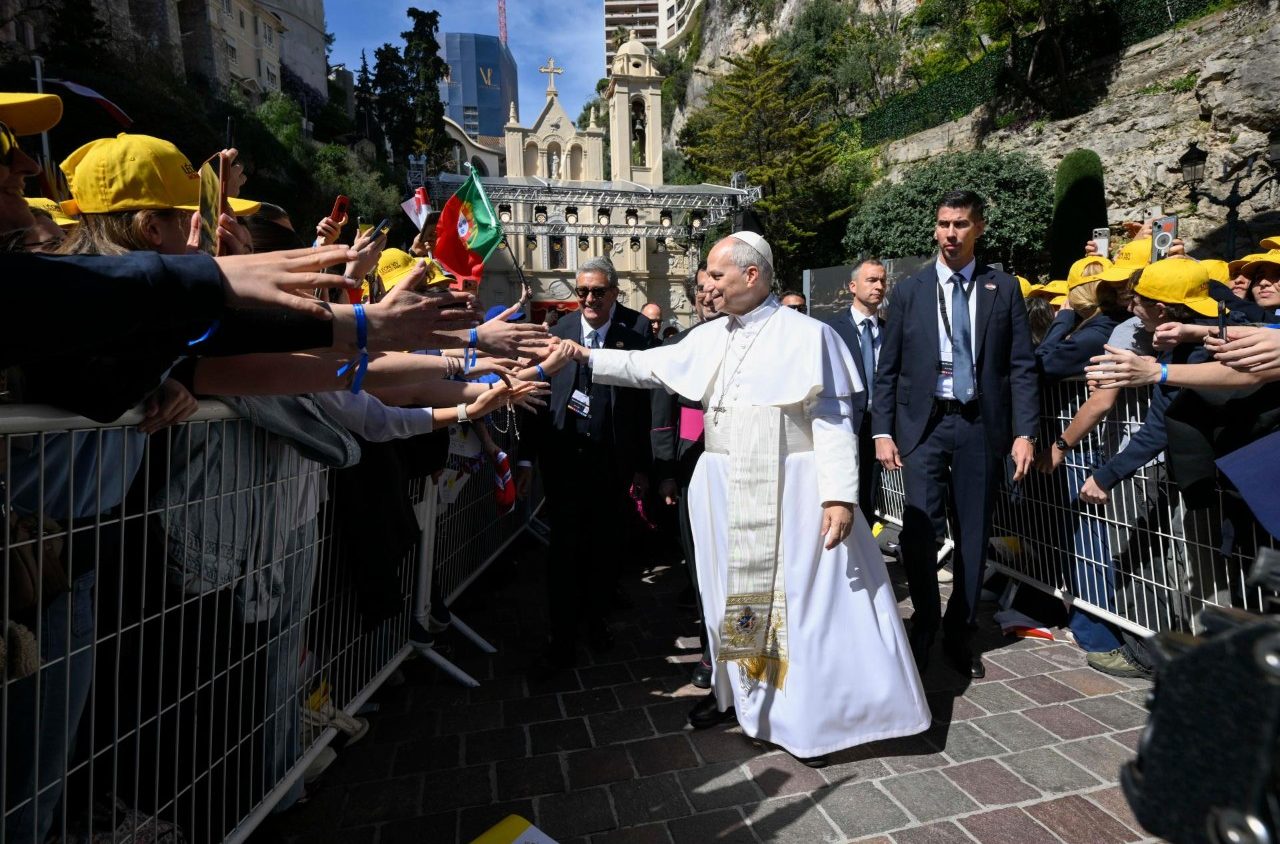
Principality of Monaco - It was a day of celebration for the Principality, accompanied by bright sunshine that rendered Monaco’s atmosphere even clearer. Distances here are short, and the Pope’s movements made that evident: a few minutes by car, a square, a church, an encounter. Within this compact setting, however, Leo XIV delivered a wide-ranging address, capable of weaving together the concrete lives of young people, their questions, and a careful reading of the time they are living through.
The meeting at the Church of Saint Devota took place around midday, in a simple format: the welcome by Archbishop Dominique-Marie David and the parish priest, a number of testimonies, followed by the Pope’s address and the final blessing. A linear structure, without spectacle, yet one that allowed space for a dense intervention, shaped more to be listened to than applauded. Leo XIV chose to begin with two figures: Saint Devota and Carlo Acutis. He presented them as two markedly different ways of living the faith. On the one hand, martyrdom; on the other, an everyday holiness, also expressed through the digital sphere. The point was not the distance between these experiences, but their continuity: in both cases, faith as something that is handed on, that reaches far, often beyond the intentions of the one who lives it.
This served to introduce the central theme of the encounter: interior stability in a context that tends to fragment it. The question posed by one of the young people - how not to be swept away by a constantly changing world - became the key to the address. Leo XIV did not reject modernity outright; indeed, he acknowledged its evident benefits in cultural, scientific and technological terms. Yet he identified a side effect: a kind of permanent instability, affecting not only habits but also personal identity. The Holy Father was keen to clarify that what gives solidity to life is love, understood first and foremost as the experience of God’s love, and then as a concrete relationship with others. This is not a generic spiritual formula, but one articulated in very concrete terms: fidelity, constancy, and daily sacrifice. Elements that are not particularly popular in a context dominated by speed and the continuous search for novelty.
The Pope insisted on a recurring point: the risk of filling emptiness with substitutes. He explicitly referred to “likes”, artificial forms of belonging, and dynamics that generate consensus without building real relationships. This was not a moralistic critique of the digital world, but a distinction between what gives substance to life and what merely occupies it. From this also stems the emphasis on prayer and silence. Leo XIV did not present them as isolated devotional practices, but as necessary conditions for resisting the constant saturation of stimuli. The reference to “messages, reels and chats”was among the most explicit passages: the issue is not their existence, but the fact that they tend to fill every space, making any form of interiority difficult.
When addressing the questions of the catechumens, Leo XIV moved away from general formulations and outlined a precise path. The eve of Baptism was presented as an opportunity to look truthfully at one’s own history, particularly within the context of Holy Week, where faith calls each person to confront both what they have been and what they are called to become. The same approach returned when he spoke of witness: not something self-constructed, nor a form of personal effectiveness. The Pope recalled the Gospel, emphasising that authentic speech arises when one allows God to act, and that the strength of witness does not depend on persuasive techniques but on a life inwardly inhabited by grace. One of the most significant passages concerned Saint Augustine: “Love and do what you will”. The Pope reinterpreted these words of the saint who inspires his Order: to love means to remain, not to walk away, even when everything cannot be resolved. It is a definition of love as permanence, rather than impulse.
In the final part of his address to young people, Leo XIV returned to the specific context of Monaco. He described it as a small country, yet capable of becoming a “laboratory of solidarity”. The implicit reference lies in the distance between the public image of the Principality - wealth, visibility, attractiveness - and the possibility of building relationships that are neither superficial nor selective. He asked something demanding of the young: not to be afraid to “give everything” - time, energy, skills. Not as an extraordinary gesture, but as an ordinary orientation of life. It is the point at which the address closes, coherently with its beginning: faith as something lived in the concrete, whose effects become visible only over time.
At around 12:55, the Pope left Saint Devota to proceed to the Archbishop’s Residence, where he paused for lunch.
fr.C.B.
Silere non possum