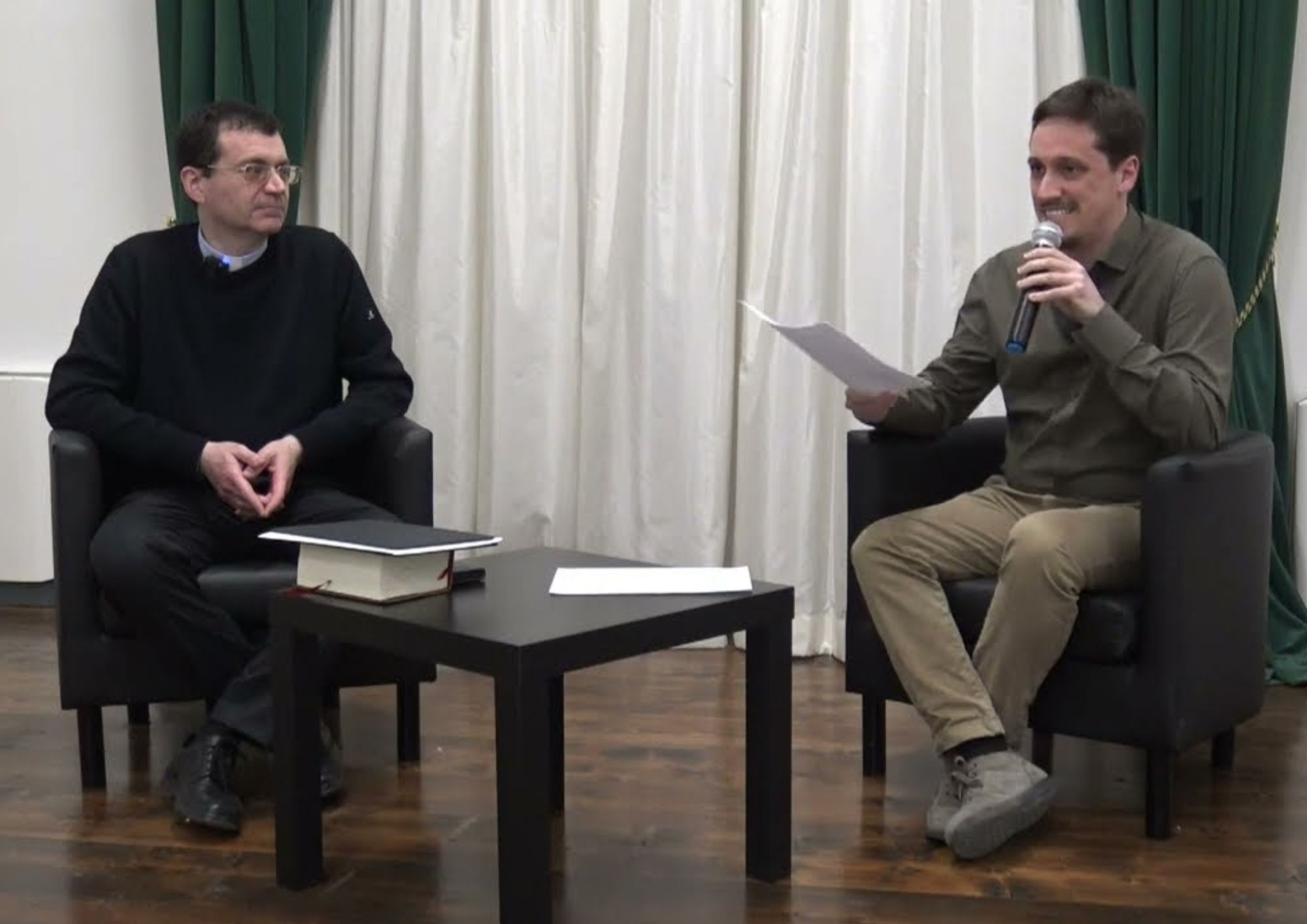
Camaldoli - The Prior General of the Camaldolese Congregation of the Order of Saint Benedict, Dom Matteo Ferrari, has sent a letter to the priors, vice-priors, residence superiors, masters of novices and of those in simple profession.
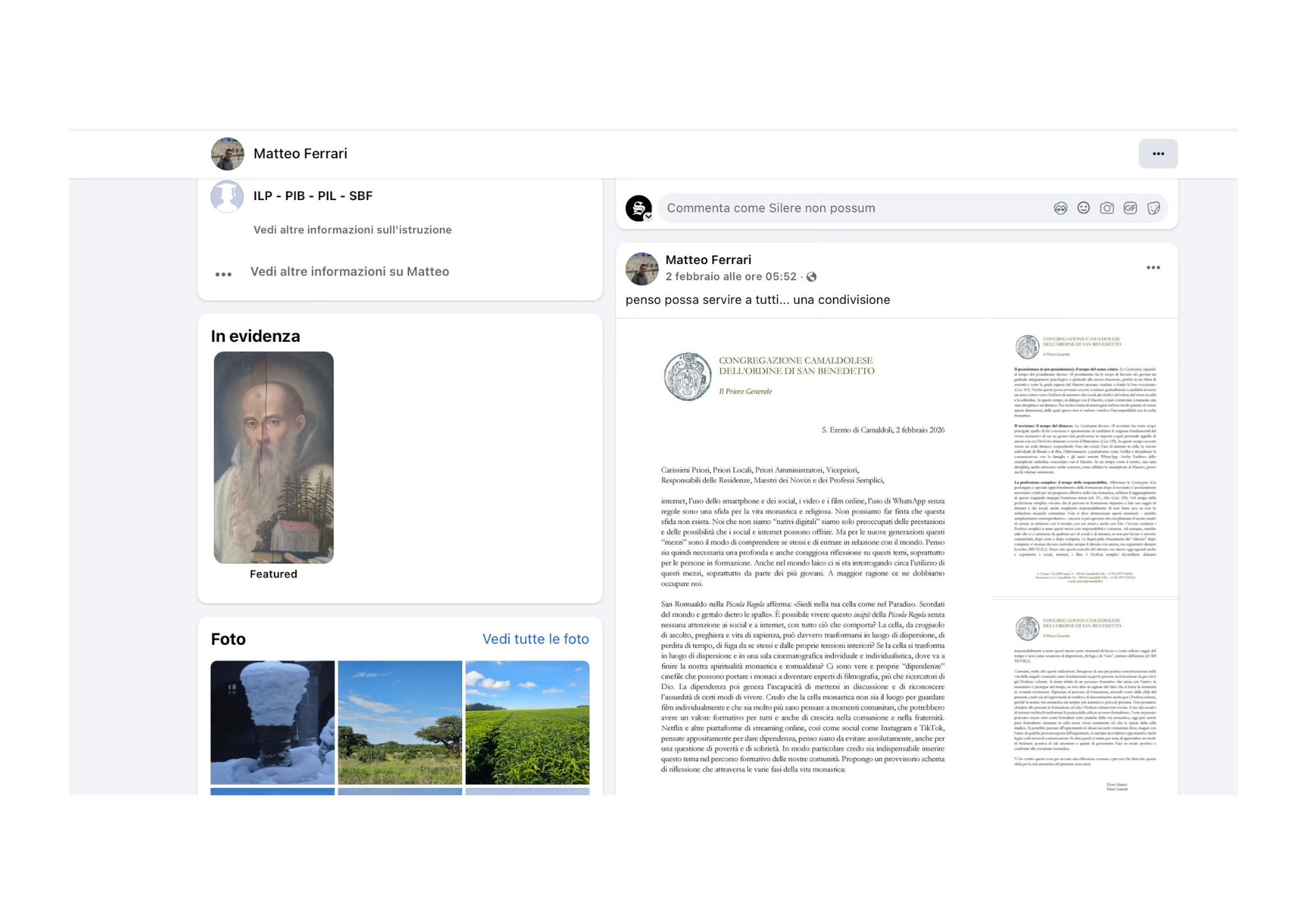
I want to highlight, first of all, one point that I consider gravely inappropriate: the publication on Facebook of a letter that deals precisely with the use of social media in monastic life. The abbot has made it public on his own profile, active for years, using exactly the medium that the text itself identifies as an area requiring vigilance. The short circuit is obvious. For a monk, the issue is even more delicate: we are not speaking of a religious or a diocesan priest. The monastic vocation is built on detachment, the guarding of the cell, silence, stability. Within that horizon, a personal social-media profile risks contradicting the very structure of one’s vocation. If anything, the use of social media pertains to other ministries and other forms of ecclesial life.
The Prior General of the Camaldolese Order also knows perfectly well that certain internal communications, once made public, are immediately instrumentalised from the outside. They do not become an occasion for serious discussion, but material to strike at monastic life, feeding the narrative that “monasteries do not live monastic life well”. The dynamic is predictable: these themes attract polarisation, not debate. Precisely for this reason, the letter should have remained reserved to the intended recipients, within a circuit of responsibility and communal discernment, rather than being turned into content for a digital public square.
That said, and to provide context without getting stuck in preliminaries, the broader frame from which the document emerges also matters. We are speaking of a prior who, at Camaldoli, for years has hosted a self-styled liturgist openly favourable to the ordination of women; who has allowed monks to undertake paths such as yoga courses and meetings devoted to Buddhism; and who, in the monastery shop, has allowed books on yoga and Buddhism to circulate and be sold. These are choices that point to a precise orientation and, for that very reason, make less credible any claim to present oneself as a guardian of sobriety and discipline in the already fragile conversation about media and monasticism. Even so, one could also read the letter as a kind of admission and change of pace, as if Ferrari were saying: “Up to now we have allowed too much; now it is time for conversion and clear rules.” To this one must add a symbolic, and in many respects discordant, episode: the Prior General’s entry into the Synod on Synodality circuit in the role of “master of ceremonies”. A monk moving in that context, already far from the monastic grammar of a withdrawn life, naturally raises questions. And this is not just any monk: it is the Superior General, a figure who represents an entire Congregation. The function entrusted to him places him within a dynamic of visibility and liturgical-protocol management that sits uneasily with the idea of monastic discretion.
How was Ferrari “recruited”? By the usual Vatican system. Cardinal Mario Grech went to Camaldoli, was impressed by the liturgy he saw, and asked him to come to the Synod. This too tells us a great deal about the Maltese cardinal: at Camaldoli the liturgy, for some time, has been only loosely aligned with a properly Benedictine and monastic framework, and the fact that precisely that style was “appreciated” says much about the ecclesial climate in which we are living. In substance, the letter’s content may well touch real problems, but the decision to publish it on Facebook, by someone urging vigilance over social media, weakens the message’s credibility and opens the way to instrumentalisation. And when this happens within a wider pattern of already controversial identity choices, the letter risks becoming yet another element of confusion, rather than a serious help towards reform of monastic life. The content of the letter, however, should not be brushed aside. On the contrary, it offers a concrete opportunity to reflect on an issue that, in different degrees, now runs through almost all monasteries. Dom Matteo addresses the use of the internet, smartphones, social media, online videos and films, and WhatsApp “without rules”, describing them without ambiguity as “a challenge for monastic and religious life” and adding: “We cannot pretend that this challenge does not exist.”
Why the diagnosis holds today more than yesterday
The letter grasps something many communities already know from within: the risk of a parallel life that grows without ever declaring itself. In various abbeys and monasteries the day can remain formally intact, choir, refectory, work, chapter, and yet be hollowed out in substance when “free” time is swallowed by screens and notifications. The consequence is not only a discipline problem; it is a slow erosion of presence, responsibility and communion, the very elements that make monastic life recognisable. There are also certain abbeys, particularly in German-speaking countries, where the stable assignment of pastoral care for external parishes ends up creating, in practice, wider margins for escape. It happens that, once parish activity is finished, one does not return to the monastery, not from real necessity, but because communal life is perceived as burdensome or dysfunctional and so one prefers to remain outside. The problem is facilitated by an arrangement still present in some orders, which allows a very broad management of time and space extra claustra, to the point of making structural what ought to remain exceptional.
The cell between listening and dispersal
Dom Ferrari anchors the theme in the Romualdine tradition. He cites Saint Romuald in the Little Rule: “Sit in your cell as in Paradise. Scordati the world and throw it behind your back.” The Italian scordati implies a deliberate act of the will, removing from the heart what demands possession, whereas dimenticare can remain unintentional. On this threshold the Prior General asks the decisive question: can the cell, “from a crucible of listening, prayer and a life of wisdom”, “turn into a place of dispersal, of wasted time, of flight from oneself and from one’s inner tensions?” He warns of the concrete drift: “an individual and individualistic cinema”, with “real cinematic dependencies”.
Platforms designed to hook
The Prior does not soften his language. He speaks of “Netflix and other online streaming platforms” and of social media such as “Instagram and TikTok”, describing them as realities “designed specifically to create dependence” and which “I think must be avoided absolutely”, also “for reasons of poverty and sobriety”. Here the letter touches a spiritual nerve before a moral one: what trains the heart for immediate gratification weakens the capacity to remain in stability, to endure dryness, to pass through limits without immediately seeking an anaesthetic.
Postulancy: educating critical sense
The Prior General sets out a line of work that embeds this concern within the formation pathway already foreseen, with distinct stages, starting from the postulancy understood as a “time for critical sense”. He recalls the Constitutions: postulancy serves to foster “a gradual psychological and spiritual adaptation to the new situation” so that the young, “in a climate of serenity and under the experienced guidance of the Master”, may “study their vocation in depth” (Cost. 131). The use of the internet and social media is treated, rightly, as material for discernment: risks, the value of the cell and solitude, and the discipline learned “in dialogue with the Master”.
Novitiate: detachment as a concrete test
In the novitiate the letter asks for a further step: to “live a real detachment”, suspending “the use of social media”, “the use of the internet in the cell”, “individual viewing of clips or films”, and “subscriptions to platforms such as Netflix”. Even communication with family and friends “via WhatsApp” is to be “disciplined”. The smartphone is placed under an explicit criterion: “it should be agreed with the Master”, and even the option of “entrusting the smartphone to the Master” is presented as a concrete choice to be seriously evaluated. After all, the monk is not a diocesan priest, nor simply any religious. The monk is called to a wholly particular life, and often people fail to grasp its specificity precisely because there are no real differences from the life of a priest or religious.
Simple profession: responsibility and the guarding of the night
For those in simple profession, Dom Ferrari speaks of a “time of responsibility”: learning “to make wise use” of the internet and social media, including choosing responsibly not to use them unless required by communal tasks. He formulates a practical rule: abstain from any use “after supper or after Compline”. In the Rule of Saint Benedict, the great father of monasticism speaks of silence: “Monks must keep silence at all times with love, but especially during the night” (RB XLII, 1). The point is not an asceticism of prohibition; it is the protection of an inner territory, the one in which fidelity to the following day is decided.
Solemnly professed: coherence as a condition of credibility
In the concluding section the letter focuses attention on those already solemnly professed. The Prior General recalls that formation “continues over time” and sets down a criterion that cannot be sidestepped: “We cannot ask those in formation to live what the solemnly professed do not live.” This is decisive because it concerns the monastery’s credibility. Where life is lived seriously, without double standards, vocations often arise, and not rarely young vocations. Personal fragility is not the scandal: the monk remains a man, falls, rises again, is sanctified within daily conversion. The scandal, rather, is cultural surrender disguised as tolerance, the logic of “anything goes” elevated to an implicit norm. Something else entirely is keeping a common direction firm: indicating a goal, recognising fatigue, walking together, supporting and correcting one another. In this line one also understands the balance of the Rule of Saint Benedict, which asks the Abbot to unite firmness and charity: “he must correct energetically the undisciplined and the restless” and at the same time “lovingly exhort those who obey with docility to make ever greater progress”. In the saint’s words there is no permissiveness, but a realistic pedagogy: the community grows when those who lead do not abdicate, and when those being formed see in the formators a coherent life, not a system of exceptions.
Ferrari speaks plainly: “The use of social media and the internet risks turning the practice of the cell into mere formalism.” It is a line that captures an increasingly widespread pathology: certain outward signs of discipline remain, while the substance is slowly shifted elsewhere, into private spaces not shared. Common life then risks shrinking into a sequence of gestures repeated out of inertia and obligation, a choreography sustained more by habit than inner conviction. “I go to choir because otherwise I’ll be reprimanded”, we may sometimes be tempted to think. Yet in truth I should go to choir gladly, to pray to God with my community. In some places, indeed, I believe things have gone even further. There is no longer even the urgency to save appearances, because the shame of presenting as “normal” what has little to do with monastic life has disappeared. And Camaldoli, in my view, falls among such cases: not only does the substance weaken, but the very weakening ceases to be perceived as a problem.
Cassian’s acedia and the screen as an escape hatch
Tradition helps us read the present without sterile moralism. John Cassian called acedia that fever of the soul which makes one’s place of life unbearable, hardens the gaze towards one’s brothers, empties prayer and reading. Today the escape can be carried out without crossing the cloister: it is enough to open a screen. The body remains in the cell, attention slides elsewhere, and the monastery risks becoming a set of connected solitudes, where community meets but is not inhabited. One tolerates the confrere poorly, avoids the abbot, and attends communal moments unwillingly.
Saint Benedict: primacy of the Opus Dei and common discipline
The Rule of Saint Benedict, surprisingly current and not weakened by time, does not speak of algorithms, but it knows the human heart well. The operative criterion remains the priority of the Opus Dei and common discipline: when the bell rings, one stops whatever one is doing. Transposed to today, this means no device can acquire a private status that diminishes choir, refectory, work and chapter. And when Benedict calls “idleness” the “enemy of the soul”, he is not offering an abstract or outdated remark: he describes a concrete spiritual mechanism that today can be fuelled by hours of scrolling on TikTok or solitary Netflix consumption, precisely because these present as harmless, as mere “rest”, while in reality they fragment presence and weaken the unity of the monastic day.
An implicit proposal: verifiable rules and communal life
Dom Ferrari suggests “community meetings” with the help of experts, to clarify opportunities and risks and to “govern use” positively and in a way consonant with the monastic vocation. It is a concrete direction: set places, times, purposes, and introduce real accountability. Even content consumption, when necessary, can take a communal form, because it reduces isolation and obliges a shared criterion. Without such boundaries, technology risks becoming a zone removed from discernment and capable of redesigning the day around a private agenda. At bottom, Ferrari’s letter names what one is often afraid to name, and which nevertheless runs through many communities, monastic and otherwise: addiction. The solitude of the cell can become favourable ground because it allows habits and compensations to be cultivated far from fraternal gaze and confrontation, with the temptation to avoid judgement and, more deeply still, to avoid the truth about oneself. Addictions can be to substances, appearing in more or less visible forms: alcohol, nicotine, cannabis and other drugs, but also the distorted use of medicines taken as an emotional shortcut, sedatives, anxiolytics, analgesics, until they become a habitual refuge. They can be behavioural, and here the digital world offers an almost infinite repertoire: social networks, compulsive scrolling, short videos, streaming and binge-watching, solitary content consumption, gaming, constant chat and messaging, online shopping, the relentless search for stimuli and novelty. There are also addictions that do not necessarily pass through a screen but work in the same way: pornography, gambling, disordered eating, and even forms of activism or work that, more than service, become anaesthesia and flight from common life. In some cases addiction takes on a “respectable” face and is therefore harder to unmask: compulsive news consumption, a need for control, perfectionism, or even a certain kind of spirituality used as emotional shelter rather than real conversion.
This is why Ferrari’s proposal must not be allowed to drop. It touches the monk’s psychological and spiritual life and, in governance and formation, naming things remains decisive. It would have been preferable not to expose everything in Facebook’s shop window, but the substantive point remains: what stays hidden tends to grow and take root; what is named, placed under discernment and accompanied can be healed, corrected and brought back into the service of monastic life. This too is why naming problems is useful: the monk who recognises himself in a fragility, hearing it finally spoken, can stop living it as an isolated shame and begin to think, “I am not the only one fighting this difficulty, therefore a path of healing exists.”
What is at stake: not pretending, not delegating, not trivialising
The letter closes with a sentence that functions as a charge: “I have written these things to begin a common reflection and not to pretend that this challenge for monastic life today does not exist.” These words oblige a choice: either the Congregation takes the matter in hand with discernment, or it lets it slide and suffers it. In that case monastic life may continue to stand by inertia, but not for long: one need only look at the numbers, communities growing ever older, novices ever rarer, among the Camaldolese and far beyond the Camaldolese sphere. In recent years this has been seen clearly: many crises have not erupted through scandals or dramatic episodes. They have entered silently. Community life has progressively cooled, liturgical life has thinned almost to disappearance, the cell has ceased to be a place of prayer and listening and has become a refuge, and stability has been reduced to mere physical permanence, without that conversion of heart which alone gives meaning to enclosure and perseverance. For this reason Ferrari’s words deserve to be taken seriously and translated into concrete choices. If they remain dead letter, the challenge will continue to work underground; if instead they become an occasion for discernment and reform, they can open a genuine renewal of the Camaldolese Congregation. Its charism has real strength, a spirituality capable of speaking to the human heart, and today it has even more reasons to be proposed in its essence, without ideological additions and without shortcuts. There is a generation that is not looking for religious entertainment, but for God; that does not ask for experiments, but for a credible life; that feels the weariness of a world that wants to anaesthetise and homogenise, often also through social media, where polarisation devours encounter. For this very reason monasticism is an answer. Not because it escapes reality, but because it guards the one thing reality cannot give itself: a place where, in silence, one can listen to God.
Beata solitudo, sola beatitudo
fr.V.B.
Silere non possum