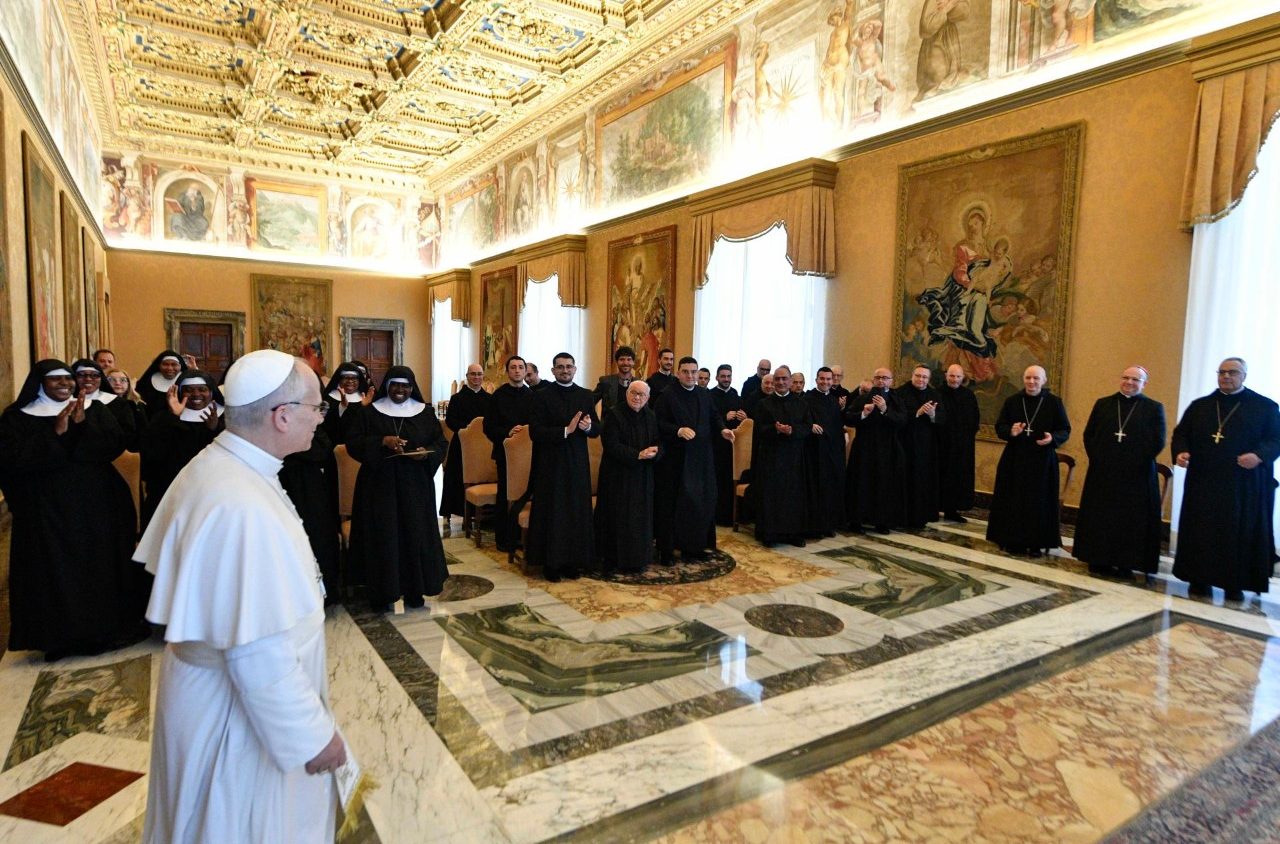
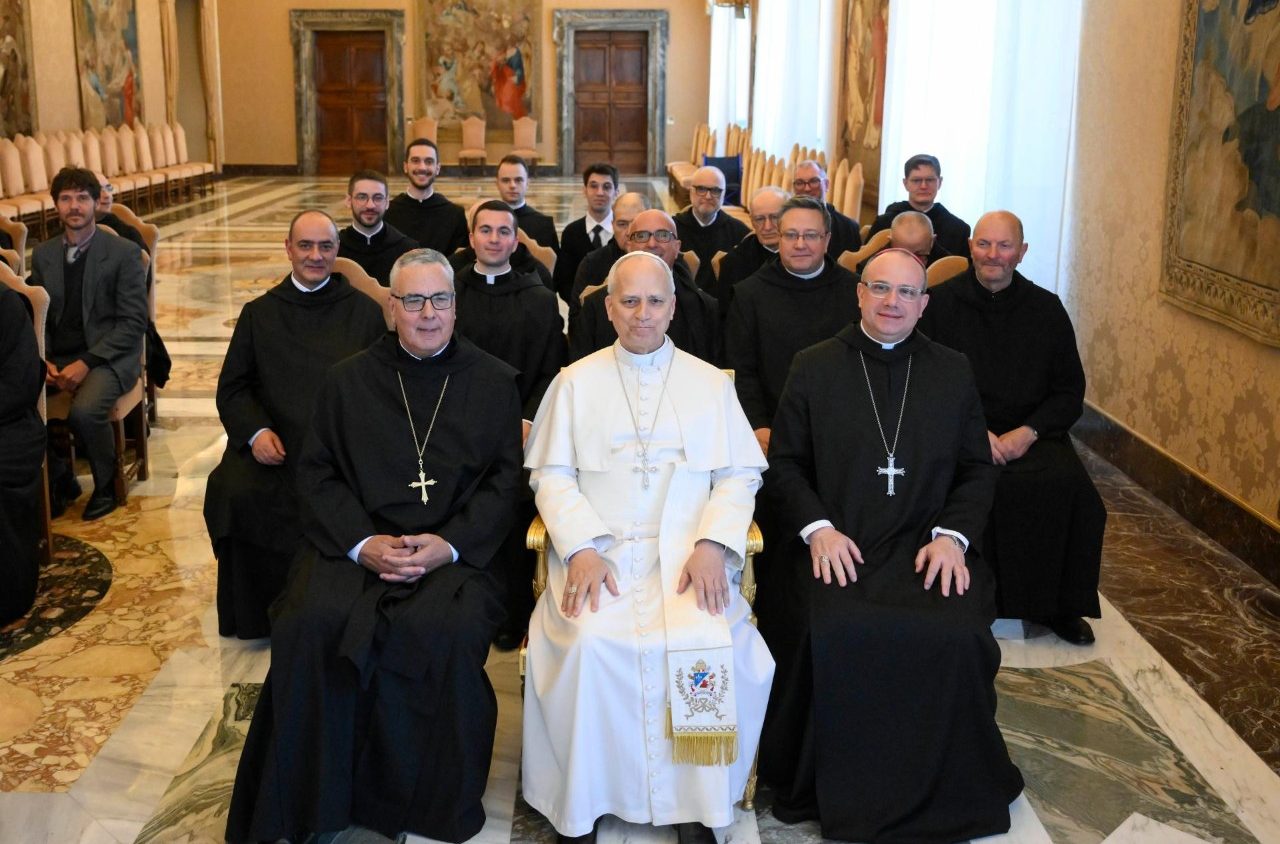
Vatican City - This morning, at the Vatican Apostolic Palace, Pope Leo XIV received in audience three Benedictine monastic communities: the monastic community of the Territorial Abbey of Saint Scholastica in Subiaco, the monastic community of the Abbey of Santa Maria del Monte in Cesena, and the Benedictine nuns of the Abbey of Saint Scholastica in Bari.
In his address, the Pontiff offered a rich reflection on the meaning of the Benedictine charism, dwelling on the relationship between prayer, fraternal life, ecclesial mission and ongoing formation. The Holy Father explained the purpose of the meeting, describing it as an opportunity to “reflect together on the value of the Benedictine charism in your lives, in the life of the Church and in the world”. It was not, therefore, an appeal limited to the internal life of monasteries, but a reflection set within the broader horizon of the Church and contemporary society. The first point addressed by Leo XIV concerned the monk’s interior life as read through the Rule of Saint Benedict. Quoting Chapter IV, the Pope recalled the exhortation to “keep guard over one’s every act”. In this perspective, he pointed to prayer and the prayerful reading of Scripture, “especially in the Lectio divina”, as essential means of this vigilance. According to Prevost, it is precisely daily familiarity with the Word of God that enables the consecrated person to enter into the truth about himself, recognising “their own weaknesses and sins” but also celebrating “the Lord’s graces and blessings”. Leo XIV underlined that contemplative life does not lead to an abstract or idealised view of oneself, but to a truer knowledge of one’s condition before God. From this, he explained, there arises a renewed desire to belong to the Lord and a concrete confirmation of one’s consecration. For this reason, he urged the communities to make Scripture the “nourishment of your contemplation and daily life”.
Fraternal service and community
Alongside the personal dimension, the Pope strongly emphasised the communal one. He stated that the path of sanctification “cannot be reduced to a merely personal journey”, because it has “a necessary community dimension”. It is in this shared life that the proclamation of Easter takes shape in “fraternal service”, presented as a reflection of Christ’s love for the Church and for humanity.
Leo XIV directly links monastic life to one of the most significant themes in ecclesial debate in recent years: synodality. The Pontiff explained that, in the monastery, synodality is translated into the daily practice of “walking together”, reciprocal listening, community discernment under the guidance of the Holy Spirit, and communion with the local Church and with the Benedictine family. In other words, the monastery was presented by the Pope as a place where synodality does not remain a theoretical formula, but takes on the concrete face of the fraternal assembly, common prayer and shared decisions.
Obedience and authority
In this passage, Leo also clarified the relationship between authority and obedience, indicating that they are not a rigid or purely disciplinary mechanism, but a reality in which they “come together in dialogue, to seek God’s will together”. It is a significant emphasis, because it places the monastic tradition within an ecclesial reading in which communion, listening and discernment become structural elements of common life.
Leo XIV then explicitly corrected a possible distortion in the way enclosure and monastic life are understood. “Monastic life cannot be understood simply as withdrawal from the outside world,” he said. On the contrary, it is a means by which a love similar to that of Christ may grow in the hearts of the disciples, “ready to share and to help, even amongst monasteries”. In this way, the Pope removed cloistered life from a reading of isolation, showing instead its ecclesial and relational fruitfulness.
From this also follows a consideration of strong pastoral significance. In “a world often marked by self-absorption and individualism”, monastic life can become “a model for the whole of God’s People”. The Pontiff explained that mission is not measured first and foremost by the activities to be carried out, but by “a way of being and of conducting relationships”. It is a central passage of the address, because it brings missionary fruitfulness back not first of all to doing, but to the evangelical quality of life.
 © Vatican Media
Intercession: a fundamental task
Within this perspective, Leo XIV wished to dwell on a dimension he described as proper to the “missionary life of cloistered communities”: intercession. It is one of the densest centres of his address this morning. The Pope recalled that the Word, made prayer, unites the believer to Christ the Mediator, “who intercedes for us”. To intercede, he added, is “the prerogative of hearts that beat in harmony with God’s mercy”, capable of gathering up and presenting before the Lord “the joys and sorrows, the hopes and anxieties of people today and of every age”. Intercession was described by the Pope not as a marginal or inward-looking practice, but as an essential task entrusted to contemplative communities. Leo XIV said so clearly, defining it as “a primary and fundamental aspect of the work entrusted to you”. In this way, the Pope restored full ecclesial centrality to the hidden life of the monastery, presenting it as a real and necessary service to the Church and to humanity.
To illustrate this vocation, the Pontiff invoked the Gospel figure of the prophetess Anna, who “did not depart from the temple, worshipping with fasting and prayer night and day”. Anna, widowed and advanced in years, had made the house of God her home; it was precisely prayer and asceticism that enabled her to recognise in the child presented by Mary and Joseph the Messiah. Leo XIV read this figure as a model of spiritual discernment and prophetic vision: the life of prayer makes it possible to perceive, “within the fabric of history”, God’s intervention and to turn it into a proclamation of joy and hope.
 © Vatican Media
Ongoing formation
From the theme of prophecy, the Pope moved to that of ongoing formation, which he defined as “particularly necessary in an age like ours”. Here too his address took on a very concrete tone. Formation, he explained, consists first and foremost in “knowing the love of Christ which goes beyond all knowledge” and is indispensable so that consecrated life may serve ever more appropriately “the monastery, the Church and the world”. For Leo XIV, it is not a task delegated to individual specialists or to occasional moments, but a responsibility involving the whole community as “the active agent”. Prayer, the Word, moments of celebration and decision-making, discussion and shared renewal, lived “in the primacy of charity”, are indicated as the concrete places of this formation. The Pope therefore asks the communities for a commitment exercised “with wisdom and prudence”, capable of encouraging every good intention and directing every effort towards common growth in the capacity for self-giving. The goal he indicates is profoundly Benedictine: to make every monastery a “school of the Lord’s service”. With this expression, taken from the Prologue of the Rule, Leo XIV substantially summed up the whole of his address. According to the Pope, monastic life preserves a form of existence that educates people in the truth about themselves, in communion, in fraternal charity, in the mission of intercession and in a continual readiness to be formed by the Gospel.
In the concluding part, the Pontiff addressed words of strong gratitude to the communities present, thanking them for “the immense and hidden good” they do for the Church “through your offering, your unceasing prayer, your service, and the witness of your life”. Here too one of the most significant features of the address emerges: the recognition of the fruitfulness of a life that remains hidden, but is for that very reason not marginal. On the contrary, the Pope openly defines it as “the work of God”.
fr.D.R.
Silere non possum