Fontgombault - It is a Thursday afternoon, and the landscape around Fontgombault seems to preserve an ancient stillness. The Creuse runs along the edge of the monastery, the Brenne enfolds it in its quiet green, and everything helps to create a sense of measure that inwardly disposes one to silence. Even the majesty of the abbey does not break that harmony; it belongs to it naturally. Monks, after all, have always sought out places able to shelter not only their walls, but their lives as well.
That atmosphere is itself an introduction to the climate of prayer, to that lived liturgy which comes before every word. In a place such as this, one begins to understand how the liturgy here is not first of all something to be debated, but a reality that shapes time, orders the days and forms existence itself. We met Dom Jean Pateau O.S.B. while he was in Le Blanc, around eleven minutes from the abbey. The abbot comes there to offer spiritual assistance to the Petites Sœurs Disciples de l’Agneau, a small community of women consecrated to the Lord and made up of sisters with Down’s syndrome. It is a rare reality, perhaps a unique one, in the Catholic Church.
In this atmosphere of calm and fraternity, Dom Jean Pateau gave us some of his time to reflect on monastic life, on what is happening in the Church today, and on the importance the liturgy continues to hold for our lives as Catholics.
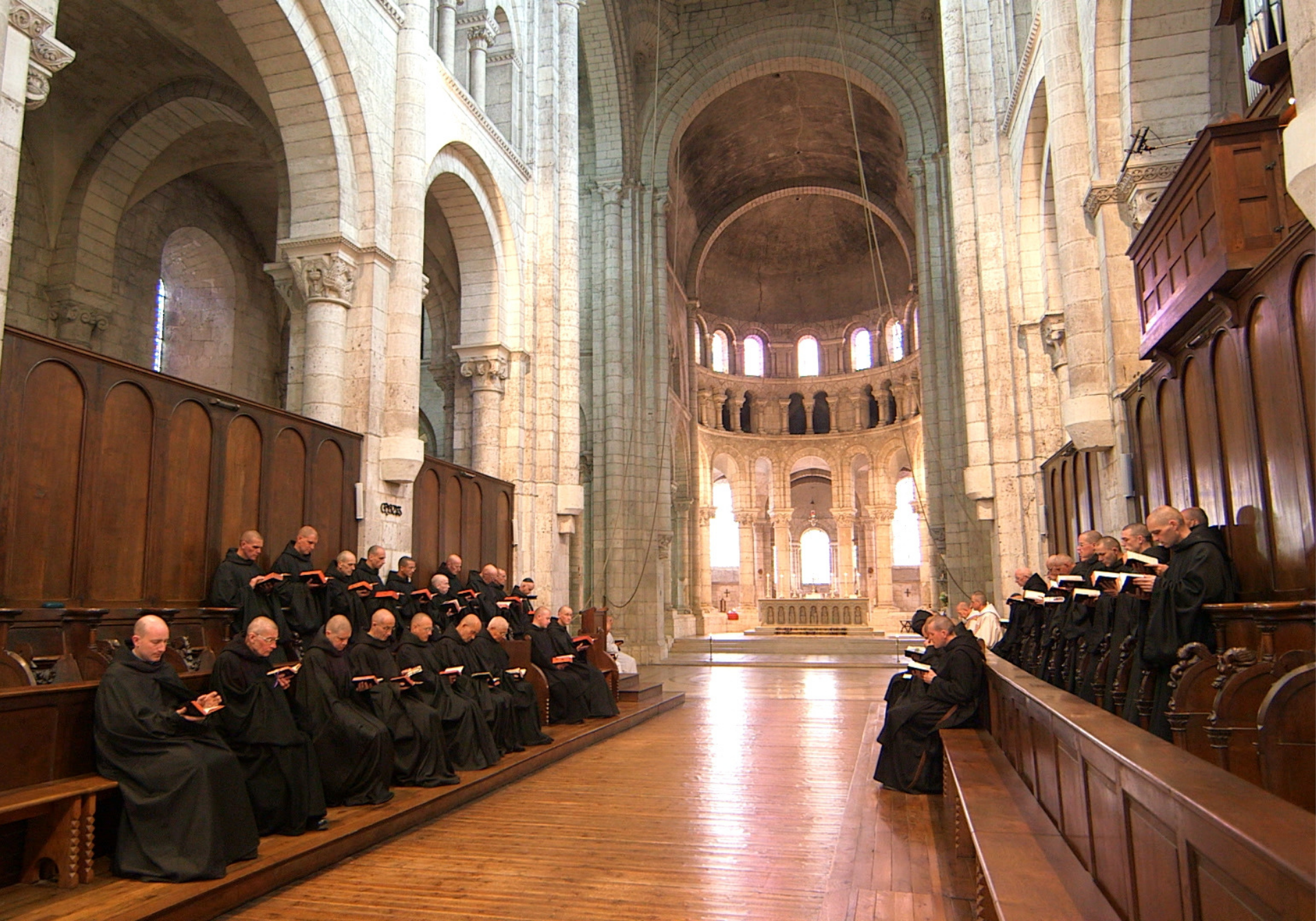
A community that seeks God
Founded in 1091 by Pierre de l’Étoile on the banks of the Creuse, the abbey of Notre-Dame de Fontgombault bears in its very name the memory of its origins, linked to the hermit Gombaud and to the spring that gave the place its name. It is a monastery of the Solesmes Congregation, and one of those French monastic houses that continues to attract attention far beyond its own region. What first strikes one about Fontgombault is what it preserves and makes visible: a form of life in which prayer, silence, work, fraternity and daily faithfulness still form a unity. That, before anything else, is what leaves an impression. Here, prayer is not an abstract idea but a lived experience, and it shapes the community.
Over the centuries, the abbey has endured many trials, passing through periods of prosperity, devastation, decline and renewal. Yet it is precisely this long history that makes Fontgombault all the more significant today: it is not a postcard from a vanished past to be contemplated with nostalgia, but a living tradition, placed each day in the hands of men called to embody it. Benedictine life resumed there in 1948, thanks to a foundation from the abbey of Saint-Pierre de Solesmes. Since then, Fontgombault has once again become a fruitful house. Today the community numbers fifty-seven monks and, as the abbot told us, it also has several novices.
Other foundations have sprung from this monastery as well: Randol in 1971, Triors in 1984, Donezan in 1994, Clear Creek in the United States in 1999; and in 2013 the abbey of Saint-Paul de Wisques was also taken up again. This too says something essential: when monastic life is truly alive, it does not close in on itself, but gives rise to new life. “Monastic life cannot be understood as a simple withdrawal from the outside world. It is a means by which a love like that of the Master may grow in the hearts of the disciples, ready to share and to help, even between monasteries,” Leo XIV recently reminded monks.
It is within this concrete, sober and ordered beauty that our meeting with Abbot Pateau finds its meaning.
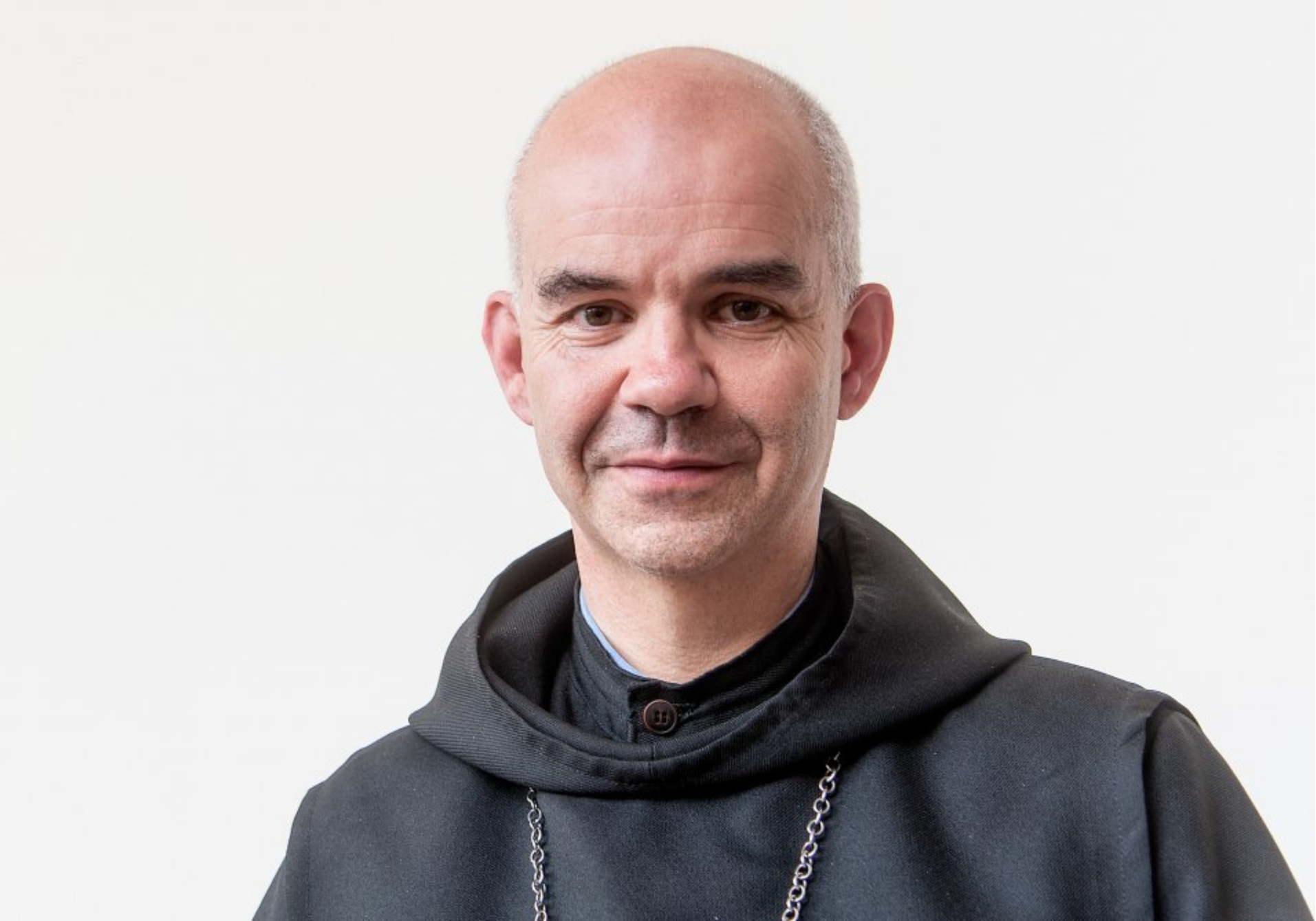
A spiritual conversation
What forms a monk inwardly? What is the relationship between the beauty of worship and the conversion of life? How do Gregorian chant, silence, work, stability and the Divine Office build a community? And again: how can one speak of the ancient rite without turning it into an identity banner for nostalgics seeking refuge in the Church? How can the liturgical question be addressed without deepening divisions?
Dom Pateau answered these questions out of concrete experience. The liturgy holds a central place in the monastic day, and in his words Gregorian chant does not appear as an aesthetic ornament, but as a true school of prayer, a discipline of the soul, a form through which the Church herself sings and prays. The point is a decisive one, because it immediately removes the discussion from the temptation to reduce everything to sensibility, taste, style or belonging. Another aspect also emerges clearly from his words. For the monastic community, the liturgy is never understood apart from life. The solemnity of worship and the simplicity of daily existence are not set against one another. Silence and fraternal communion are not two alternative registers. The search for God runs through the choir, work, recreation, solitary prayer and fraternity. It is this inner unity that makes it possible to understand why, in a monastery such as Fontgombault, the question of the Vetus Ordo does not present itself chiefly as an identity claim, but as something rooted in a form of life.
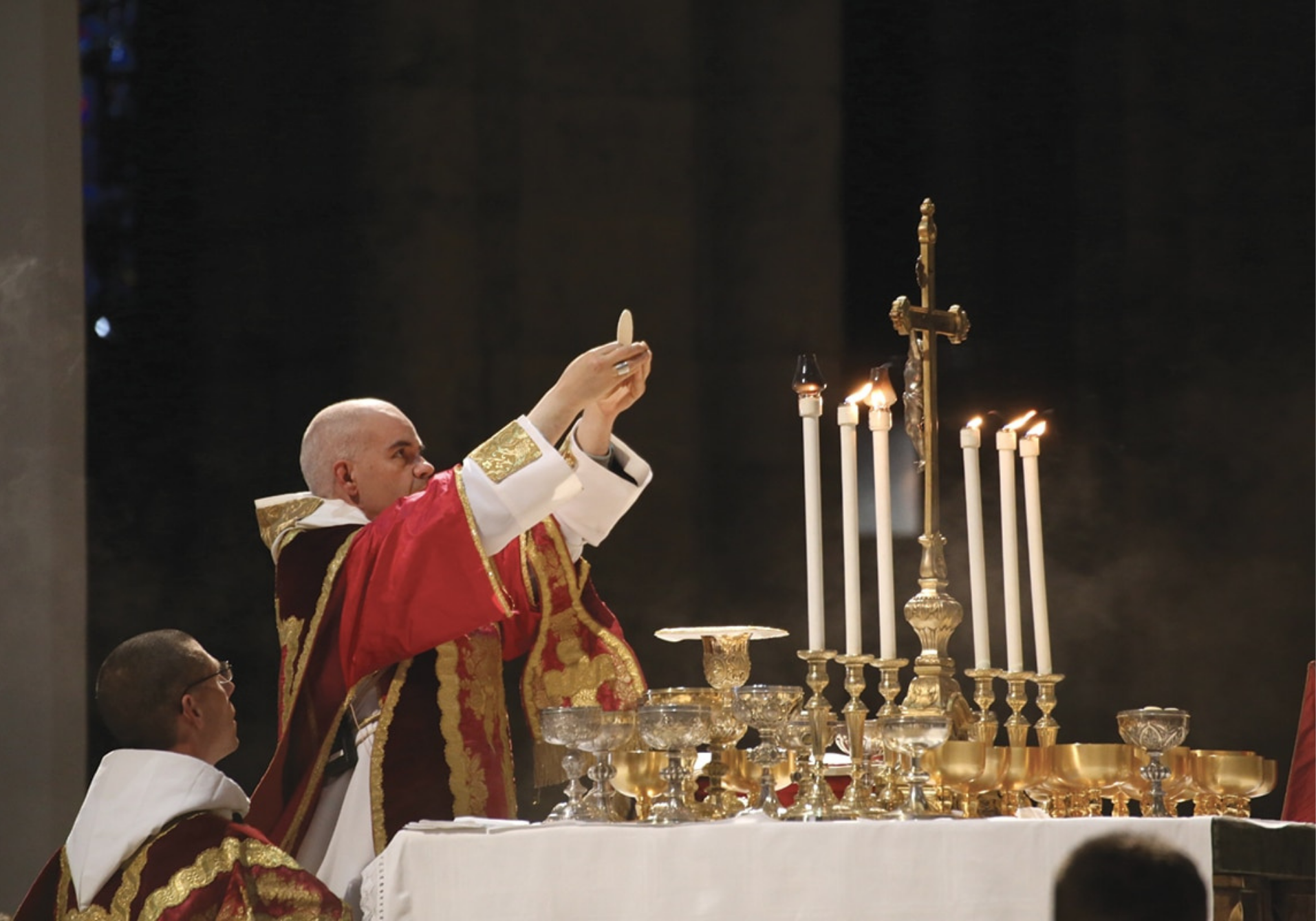
The Church’s liturgy and its richness
Naturally, we also addressed the more difficult and pressing questions: the relationship between the 1962 Missal, the 1965 Missal and the 1969 Missal; the concrete history of liturgical reform within the monastery; the permissions received over time; the conventual celebration and the individual Masses of the priest-monks; the relationship with Rome; and the promulgation of documents such as Traditionis custodes.
The witness of this monk and of his community is precious because it restores the debate to its proper scale, drawing it away from the excesses of certain factions which, over the years, have ended up harming even those realities sincerely attached to the Church’s great and precious tradition. And it is precisely Dom Pateau’s manner - his calm, his composure, the way he approaches every question with seriousness and depth - that gives proper weight to the themes of which he speaks.
When speaking of the Vetus Ordo, the abbot warns against the risk of reducing it to a cultural or sociological banner. When speaking of the Novus Ordo, he acknowledges clearly that a liturgy celebrated with sacrality, silence and a sense of Tradition is capable of deeply attracting the young as well. When he turns to France, he does not conceal the wounds left by liturgical abuses and polarisation, yet he refuses to force all this into a partisan narrative. His remains, to the end, the perspective of a monk - and, one might say, the perspective that ought to belong to every Catholic: to seek God, to safeguard communion, and to serve the Church.
A precious insight for the whole Church
The interview we offer our readers today addresses all these themes. It does so with the calm proper to the monastic world and with the awareness that, in this field, disciplinary solutions alone are not enough. What is needed is a broader ecclesial gaze, capable of recognising wounds, listening to suffering, and distinguishing real problems from caricatures. At Fontgombault, that search takes the concrete form of a life ordered by prayer. And from there Dom Jean Pateau offers a reflection which, far beyond the boundaries of his monastery, speaks today to the whole Church.
Marco Felipe Perfetti
Silere non possum
INTERVIEW WITH DOM JEAN PATEAU, O.S.B.
Reverend Father Abbot, thank you for giving us some of your valuable time. We would like to introduce this precious monastic community to our readers and to hear more about your witness. How many monks live at Fontgombault? Do you have any novices? Is the community fairly homogeneous?
The Benedictine community of Notre-Dame at Fontgombault, in the heart of France, currently has 57 monks living in the abbey. We have 4 novices: 2 in the novitiate for choir monks and 2 in the novitiate for lay brothers. One may speak of a certain homogeneity in the community insofar as all age groups are represented in roughly equal measure. The last significant departure of monks took place in 2013, when the monastery of Wisques in northern France was taken up again. That was 13 years ago now, and today this is felt in the middle age range.
At Fontgombault, the liturgy occupies a fundamental place in the monk’s day. In what way does Gregorian chant shape a monk inwardly? Is it merely an aesthetic form, or a true school of prayer?
If Gregorian chant were nothing more than an aesthetic form of singing, I very much doubt it would have been handed down for more than a thousand years. The history of music shows that, while Gregorian chant gave rise to other forms of musical aesthetics, such as Church polyphony, its original style - simple and stripped back - has always endured, sometimes very discreetly, giving rise to reforms whenever it became necessary to recover it more broadly. The work of restoring Gregorian chant initiated by Dom Guéranger is one example. Saint Benedict recommends: “Ut mens nostra concordet voci nostrae” - “Let our mind be in harmony with our voice” (Rule, chapter 19). The purpose of Gregorian chant is not aesthetics for their own sake, but prayer; indeed, it is the sung prayer of the Church, insofar as Gregorian chant is the proper chant of the Roman Church. The faithful do not sing Gregorian chant for their own pleasure: they lend their voice to the Church, which sings through their mouth. Two ways of approaching the matter then present themselves: the personal point of view, which begins with the individual, and the communal and ecclesial point of view, in which each person is inserted into a body that precedes and surpasses him. An interpretation that sought to charm the heart and the senses, while causing one to lose sight of the relationship with God, would have no place in the Church.
Simone Weil wrote: “Gregorian chant is at once pure technique and pure love, as indeed all great art is.” It is therefore particularly suited to monks because of the simplicity and sobriety of its melody and rhythm. It draws its texts generously from the treasury of Sacred Scripture. Its calming melody introduces one to the mystery of the God of peace. The introit Resurrexi on Easter morning is a striking witness to this. Dom Gajard said: “Melodic curves bring forth, call forth, the curves of souls.”
Divo Barsotti also said that Gregorian chant “expresses in beauty the truth of fraternal communion”. Is that not precisely the communion the monks seek to live, especially when they sing the Divine Office together?
What is the relationship between the solemnity of worship and the simplicity of daily life in the monastery?
One must speak of worship in the same terms in which we have just spoken of Gregorian chant. The monk’s daily life is simple. Worship, even when solemn, must never lose that simplicity. The more natural it is, the more supernatural it becomes. Simplicity within solemnity ensures that worship remains a springboard towards something greater, towards God. Simplicity does not captivate - or, if it does, it directs. The solemnity of worship reminds the monk that his whole life is great insofar as it is offered to God. The simplicity of the life he leads reminds him that the worship he celebrates, however solemn, derives its value not chiefly from its material form, but from the holiness of the one who performs it and, above all, of the One to whom it is addressed. Simplicity and solemnity must not be set against one another, just as one must not oppose the immanence and transcendence of God. The solemnity of worship is there to remind us of the greatness and transcendence of the One to whom it is offered. One does not approach God as one would a mate, with familiarity or, worse still, vulgarity. At the same time, God wishes to be infinitely close to us, and simplicity characterises the immediacy and intimacy of that relationship.
Your community combines times of deep recollection with moments of fraternal recreation. How do you hold together silence and fraternal communion?
The secret of every fully lived human life is to live the present moment. Saint Benedict gives the monk a watchword: “Seek God.” In the silence of solitary prayer, in the singing of the Office, in the fraternal communion of recreation, the monk must pursue one thing only: his search for God. Then his life becomes one. He does not seek himself. He seeks God.
At Fontgombault, the ancient rite is lived within a very firmly established Benedictine monastic framework. You also live a stability that stands in sharp contrast to the contemporary culture of mobility and fragmentation. In what way does the Vetus Ordo concretely shape the monks’ way of praying, working and living? Is it also a school of interior stability?
I believe that the stability we live comes first and foremost from monastic life itself. Peace and stability are not sought in the monastery for their own sake, but as precious helps on the road to God. Madeleine Delbrêl said: “It seems to me that the foundation of silence, for us, might be a phrase that perhaps sounds very secular: ‘You do not interrupt God when He is speaking.’[1]” Whatever harms peace and stability can interrupt the word of God. The ancient rite leaves far less room for the initiative of the celebrant. From that point of view, one may say that it is a school of interior stability, an invitation to let oneself be shaped by the word of God. It is a school of surrender.
Do you also celebrate the rite of Saint Paul VI in the monastery?
Yes. The conventual Mass is celebrated according to a missal akin to that of 1965, very close to the 1962 missal. It is not ordinarily concelebrated. The priest-monks celebrate Low Masses after Matins and Lauds, choosing either the 1962 missal or the 1969 missal. In addition, every morning in the infirmary, a Mass is concelebrated according to the 1969 missal, with the readings in French. We introduced this celebration for elderly or sick monks who can no longer celebrate on their own and who had previously been accustomed to celebrating according to the Novus Ordo. This concelebration is presided over by a volunteer monk who would normally celebrate according to the Vetus Ordo. I am glad that many priest-monks have volunteered for this fraternal service.
In recent hours, France has once again come to the centre of attention because of the words addressed by Leo XIV to the bishops gathered at Lourdes and, in the preceding days, because of the letter your Abbot President, Dom Geoffroy Kemlin, addressed to the Holy Father on the liturgical question. In this context, Fontgombault too carries a significant history, deeply bound up with the liturgy. How did you receive these two interventions?
How could one fail to receive with gratitude, joy and thanksgiving interventions that seek to calm tensions unfortunately accumulated over decades around the altar and the sacrament of love? The Holy Father does not conceal his concern in this regard and invites us to “a new way of each person looking at the other, with greater understanding of the other’s sensibility... a gaze capable of enabling brothers enriched by their diversity to welcome one another mutually, in charity and in the unity of faith.” He implores the light of the Holy Spirit so that “concrete solutions may be found that will generously include those sincerely attached to the Vetus Ordo, in respect of the liturgical orientations desired by the Second Vatican Council.” The 1965 missal is precisely the implementation of the orientations desired by the Second Vatican Council. Saint Paul VI acknowledged this. As for the proposal of Abbot Geoffroy Kemlin, it would allow priests who use the Novus Ordo to benefit from the richness of the signs and gestures of the 1962 Ordo Missae while retaining the readings and certain prayers from the 1969 missal. For communities using the Vetus Ordo, however, it would be difficult to implement. There would no longer be coherence between the readings of the Mass and those of the Divine Office contained in the breviary and antiphonary. In this connection - and this is little known - a lectionary was drawn up in 1966 that enriches the lectionary of the 1962 missal. It preserves all the existing readings and, for weekdays on which the Sunday readings had previously been repeated, proposes proper readings. Its use was left to the discretion of the local Ordinary. It was used in France. This lectionary responds to the Council Fathers’ request for an enrichment of the lectionary and makes it possible to preserve coherence with the Divine Office. In any case, the decision to address the question of enriching the missals in a pragmatic way, whatever solution may be proposed, seems to me very positive and the only fruitful path in the long term. It makes it possible to avoid two pitfalls: rigidity and ideology. Liturgy, after all, is first and foremost a practice.
Could you tell us the story of the reform as it was experienced in your monastery? How did the liturgy evolve over the years? Which missals did you adopt? What was your relationship with Rome? And what particular features do you still preserve today?
From the First Sunday of Advent in 1974, once the French translation of the missal had been approved, the new missal became mandatory in France. The abbey then celebrated the conventual Mass according to the 1969 missal. As for the spoken Masses, at that time only two missals were available, and the first edition had sold out. It was not until the 1976 edition that there was one on every altar. Following the indult Quattuor abhinc annos of 3 October 1984, the Tridentine missal could once again be used. The Archbishop of Bourges, whose task it was to authorise that use, limited the number of days per week on which the faculty was granted. At the beginning of 1989, the Ecclesia Dei Commission granted us full freedom to use the 1962 missal, into which we introduced, with the necessary permissions, a number of elements borrowed from the 1965 Ritus servandus and the 1969 Missal, notably a universal prayer on Sundays and feast days, the sung Per Ipsum, the Pater noster, and so forth. We also use the current calendar for the sanctoral cycle. The feast of Christ the King is celebrated on the last Sunday of the liturgical year. Finally, four times a year - on Maundy Thursday, at Midnight Mass and Mass at Dawn on Christmas, and at the Easter Vigil - the conventual Mass is concelebrated according to the 1964 Order of Concelebration, whose basis is the Vetus Ordo.
In conclusion, I can testify that I have always been very well received in Rome. I remember in particular an audience with Pope Benedict in which he took my hands in his and said to me, in the presence of my predecessor, Abbot Antoine Forgeot: “Remain faithful to the legacy of the dear Father Abbot.” Pope Benedict knew our liturgical usages well.
Today the liturgical question continues, unfortunately, to give rise to tensions and opposition. Leo XIV has also recalled this, urging people to move beyond factional logic in order to foster a climate of peace in the Church, including on the liturgical plane. On the one hand, some groups make the ancient liturgy an identity marker, often loading it with meanings that go beyond the properly ecclesial dimension; on the other, there are those who read liturgical reform in ideological terms, as though it had to assert itself in opposition to what came before. In this context, I would like to ask you: how do you live the liturgy at Fontgombault? In what way does the form you celebrate nourish your personal relationship with the Lord and sustain fraternal communion within monastic life?
That is precisely the question: what is the purpose of the liturgy? Is it a flag to be waved? As monks, we have nothing to prove. We simply have to consume our lives before God. The celebration of the Divine Office and of Mass are privileged places for this encounter. Pope Leo’s motto is rich in meaning for us: In Illo uno, unum - in Him who is one, we are one. Fraternal communion is the fruit of communion with Christ. In other words, the stronger communion with Christ is, the stronger fraternal communion will be. I remain convinced that the celebration of a Low Mass by each priest of the monastery immediately after Matins and Lauds is spiritually essential in the monk-priest’s relationship with God, in his relationship with the universal Church, and also in his relationship with this particular Church which is the monastery. One might object that concelebration too manifests the unity of the community in Christ. That is certainly true. Diversity manifests the richness of a mystery that no single practice can exhaust. It should be noted, however, that some young men choose to enter our community because of this materially solitary celebration in which the whole Church is present. Cardinal Ratzinger, during his visit to Fontgombault in 2001, was deeply struck by it and concluded: “That is the Catholic Church!”
Is there not a risk that the ancient rite may be reduced to a cultural or sociological banner? How, by contrast, can its spiritual and Catholic truth be preserved?
Everything that distinguishes must be viewed with caution. Is it legitimate to distinguish oneself? Saint Benedict, at the eighth degree of humility, invites his monks to do nothing except what is recommended by the common rule of the monastery and the example of the elders. The danger of adopting the posture of one who lectures others is therefore by no means unreal. Pope Francis spoke of those who look at the Church from the balcony. The monk must not be like that. He is fully within the Church, which he loves and serves through his prayer. He lives his life humbly and hidden. His modus vivendi directs his ars celebrandi not towards appearance, but towards being. Far from being a manifesto, the ancient rite, in its more contemplative dimension, is for him a privileged path towards the Eternal.
Many believe that the climate of polemic and ideological confrontation also formed the backdrop to a controversial document such as Traditionis custodes. According to this reading, the text did not fully achieve its aim: on the one hand, it affected faithful who were sincerely attached to the Vetus Ordo and free of any polemical spirit; on the other, it did not really prevent those who were already using the liturgical question as a field of ecclesial conflict from continuing to do so. I would like to ask you: how did you receive this document at Fontgombault?
When faced with a document that raises legitimate questions, the first thing to do is to try to understand the reasons for its publication. The Pope explained them in part. Concretely, the Motu Proprio had no impact on us. The most painful reactions, however, came from diocesan priests who found themselves in a difficult situation. For them, building bridges had become impossible. In fact, I experienced this text as a wound. Sadly, it was not the first. I shall limit myself to mentioning two: the lack of interest in the mutual enrichment nevertheless called for by Pope Benedict, and rigidity or ideology in liturgical matters. Let the liturgy live within the great Tradition of the Church. Let us listen to the Spirit, who never ceases to speak to us.
In your experience, how was this Motu Proprio actually applied throughout the world by bishops? Was there any real uniformity, or were there differing practices?
Reports vary greatly from country to country, and even within the same country. Pope Francis himself very widely dispensed from the application of his Motu Proprio when requests were made to him personally, thus giving rise to differing practices. In some places, bishops applied the Motu Proprio according to the letter of the text, both with regard to Mass and to the other sacraments, provoking reactions among the faithful and leading some of them to join the Society of Saint Pius X. Elsewhere, taking the view, for example, that the Motu Proprio Summorum Pontificum had established genuine peace and real fraternity, and that it was not desirable to call that into question, some bishops opted for the status quo. Be that as it may, one can imagine how uncomfortable the situation was for everyone. Pope Leo XIV’s invitation to the French bishops to show benevolence towards the faithful sincerely attached to the Vetus Ordo ought to be accompanied by greater latitude being left to bishops in regulating the use of the ancient ritual or pontifical, since they are themselves better placed to assess the situation in their dioceses.
Why, in your view, did Leo XIV choose to address this theme precisely by speaking to the bishops of France? The liturgical question today runs through many ecclesial contexts and certainly does not concern one country alone. What is it, in your opinion, that makes the French situation sufficiently significant to prompt an explicit intervention by the Holy Father? Is this sensibility more pronounced in France today than elsewhere?
The question is particularly painful in France. That is true. There is a historical reason linked to the implementation of conciliar reform and the birth of the Society of Saint Pius X. There will no doubt have to be a mea culpa one day regarding the silence of ecclesiastical authorities in the face of liturgical abuses. This is not the place to list them. It is also true that, at the time, episcopal intervention might have been judged badly timed and old-fashioned, since the spirit of the age was one of emancipation from every rule. For a long time, I believed that period was over. Unfortunately, I now know that this is not the case. The silences and abuses that continue foster estrangement and contempt for the Novus Ordo. To the liturgical question must be added that of the teaching of the faith. Many families turn to communities that use the Vetus Ordo because they are disappointed by the catechetical formation offered to their children in their parish. Thus jealousies, deep-seated hatreds and resentments arise within families and dioceses. On a more positive note, there are French bishops who wish to address this question not in order to exclude, but in order to move forward on a path of mutual welcome. The encouragement of the Holy Father is a precious support for them.
In your view, what is the most frequent misunderstanding among those who look at the ancient rite from the outside?
Before there is any misunderstanding, there is often a lack of knowledge. Naturally, that leads to distance, to fear, and fear gives rise to violence, which can take many forms. This mechanism applies on both sides. For several years now, within the Solesmes Congregation, we have had a small commission made up half of superiors from monasteries using the Novus Ordo and half of superiors from houses using the Vetus Ordo. We began by going through the rites of the Mass, sharing our reflections. It has been very fruitful. It dismantles the caricatures that all too often lie at the root of positions taken or decisions that are too radical. If it is not good to look at the Church from the balcony, it is not good either to look at traditionalists from the balcony. So I believe that, before being a question of rite, the traditional question is a question of ecclesiology. Traditionalists are too quickly accused of not “being Church”. That is not always entirely unfounded. But perhaps one should first reflect on what “being Church” actually means. Pope Leo’s motto is a precious witness, a signpost along the road, and probably an invitation to an examination of conscience for all: In Christo uno, unum.
In the Pope’s words one also senses an awareness that many young people are drawing close to communities where the ancient rite is lived. In your experience, does this rite attract them chiefly because of the sense of the sacred, silence and continuity with tradition, or because it opens up a more radical question about God?
The two go together. But first of all, I think one must be careful not to caricature matters. There are communities that celebrate the Novus Ordo with a concern for the sacred, for silence and for continuity with Tradition, and those communities do attract people. So this is not something proper to the Vetus Ordo; it depends rather on the way the liturgy is celebrated. In this regard, I would refer you to the reflections set out in the document Desiderio desideravi. A liturgy celebrated carelessly will truly struggle to lift hearts up and open them to God. A sacred liturgy, distinguished from the profane, devout and recollected, leads readily - precisely by contrast with ordinary life - to the questions “What for?” and “For whom?”, and ultimately to the question of God. Young people thirst to rediscover the radicality of the Gospel.
What would you say to a young person who is drawn to the Vetus Ordo chiefly by aesthetic fascination, without yet having understood the dimension of conversion and sacrifice that liturgy entails?
First of all, I would neither be surprised nor worried. The image and sound carried by the media are the daily bread of our age. Young people are particularly receptive to this mode of communication. The Vetus Ordo, through its signs, the unfolding of the liturgical action it contains, Latin and Gregorian chant, touches young people and leads them to altar service and to choirs. All this fosters vocations. In this connection, one may regret that possibilities for liturgical richness also present in the Novus Ordo - such as the use of incense, celebration facing east, and Gregorian chant - are too easily set aside. If one says that “beauty will save the world” (Dostoevsky), then the question becomes: what sort of beauty? A beauty that imprisons, or a beauty that leads onwards? One can be imprisoned by beauty, even by liturgical beauty, if it becomes an end in itself. Yet its purpose is to lead to the beauty of God, to God. To accompany a young person approaching the Vetus Ordo chiefly through aesthetic fascination means leading him towards the One for whom that beauty is displayed, helping him to understand that the glorious body of the risen Christ on Easter morning bears the marks of the nails and the wound in His side - certainly transfigured, but still the memory of the Cross. “No one has greater love than this: to lay down one’s life for one’s friends.” One goes to God only through Christ, and through Christ dead and risen. One may seek oneself and find satisfaction in liturgical action. If the liturgy does not lead to self-gift to God and neighbour, if it does not pass through sacrifice, then it will have failed in its purpose.
Do you think it would be useful today to re-establish a body which, in forms suited to the present, would carry out the mission once entrusted to the Pontifical Commission Ecclesia Dei, established by Saint John Paul II to preserve ecclesial communion in so delicate a field? And, in your view, what form should such a body take: should it be integrated into the Dicastery for the Doctrine of the Faith, linked to the Dicastery for Divine Worship and the Discipline of the Sacraments, or should it have autonomy of its own?
The question is a delicate one, and I certainly do not have all the elements required to answer it definitively. I shall simply offer a few reflections. It does not seem to me wise to create a new pontifical commission modelled on Ecclesia Dei, with full disciplinary powers either in liturgical matters or in the governance of Institutes. Were that the case, the Dicasteries concerned would feel themselves more or less excluded from areas that properly belong to them. A doctrinal problem should be dealt with by the Dicastery for the Doctrine of the Faith; a liturgical problem by the Dicastery for Divine Worship; and likewise for matters falling under the Dicastery for Institutes of Consecrated Life and Societies of Apostolic Life. So what, then, should be said? I believe there should first of all be a “listening ear” in the Vatican, perhaps linked to the Secretariat of State, able to receive the former Ecclesia Dei institutes, to have an overall view of their situation, to report to the Holy Father, to stimulate reflection and, of course, to direct the Institutes to the competent Dicasteries for the handling of the issues that concern them. Clearly, it would be indispensable for the Dicasteries - especially the Dicastery for Divine Worship and the Discipline of the Sacraments - to include members who know the Vetus Ordo and the ancient rites, and who look upon them and upon the Institutes with a just and benevolent eye, implementing clear directions in accordance with the will of the Holy Father. It is urgent and vital for all the Institutes to restore a relationship of trust with the Holy See. That is the essential point before one can even hope to set out on the way. This dialogue, and the path travelled together afterwards, will have an important effect on the situation in the dioceses and can only contribute to peace.
One could devote oneself to discerning, in the light of the Second Vatican Council, what in the ancient rite ought to be reformed and what may have been abandoned too hastily and deserves to be restored. The point is not to judge one side or the other, but to serve. Once again, such work can only be carried out in mutual trust. Is it too much to ask this of those who call themselves brothers and who, through their priesthood, have devoted their lives to the service of Christ and His Church? Whatever our hesitations, many young people and many priests are waiting and hoping that real work will begin.
We have had the opportunity to encounter a number of Benedictine communities across the world and, looking at Germany, Belgium and Austria, we have noticed forms of monastic life that differ markedly from those found in France. Italian monasticism likewise displays distinctive features when compared with the French and German models. How do you explain these differences? Are there, in your view, historical reasons that help us to understand them?
I share that observation of the great diversity of Benedictine monasteries throughout the world, and I experience it at the Congress of Benedictine Abbots, held every four years in Rome. We all claim the Rule of Saint Benedict, and that Rule truly lies at the root of our lives and our spirituality. Even so, the activities, the proportion of time devoted to the celebration of the Divine Office, to the apostolate, to manual labour and to lectio vary greatly from one house to another. If one considers the history of the Benedictine Order, one sees the reciprocal influence between monasteries and society. The monastery is situated in a particular place. It is inserted into a political context. This way of life surprises and interests people. Contacts are numerous. Unfortunately, those contacts can sometimes harm monastic life. Cluny and Cîteaux suffered from their involvement in the society and Church of their time. Sometimes an outside influence is imposed. Thus the Austrian Emperor Joseph II, in the second half of the eighteenth century, established state control over the Church. Among his reforms, he suppressed religious orders that did not appear useful to the city, that did not teach, care for the sick, or devote themselves to study. In doing so, he pushed monasteries towards a more apostolic form of life. Hence the situation that can still be observed today.
It seems clear that Leo XIV wishes to lead the Church towards a climate of peace that also embraces liturgical life. This can be seen not only in his words, but also in the style of governance he is exercising: a way of proceeding that appears to avoid oppositions, tensions and all that feeds internal division. On the liturgical plane too, one can discern the desire to encourage, without dramatic gestures, a path of ecclesial pacification. In that perspective, what contribution can a community like Fontgombault offer today to the building of liturgical peace in the Church?
At the abbey, liturgical life is lived in a calm and unforced way. Many of our guests notice this and rejoice in it. The same is true of our relations both with the parish clergy and with the diocese. These are many, and we gladly take part in the major moments in the life of our diocese. A Benedictine abbot lives stability in a relative sense because of the travelling required by his office. Nevertheless, he remains stable in that office. Elected abbot in 2011, I am already on my fourth bishop. I can testify that my relations with all of them have been excellent, deeply fraternal. The same is true with many other French bishops with whom I am regularly in contact. I am not the only abbot who could say as much. As for liturgical practice, the problem, as Cardinal Ratzinger pointed out during the liturgical days at Fontgombault in 2001 following a lecture by Professor de Mattei, is the passage from the universal Church to the local Church - in other words, the regulation of the use of two rites. The question is very simple, the Cardinal observed, in an abbey or within an order. It becomes more complicated for fraternities working in dioceses. The monastery is a place where many people stay. I wish and hope that all feel welcome there. So it should be for everyone in the Church. We hear the sufferings of one and of another: of those priests sidelined because they had too much zeal; of those priests wounded by seeing their faithful leave them for the traditionalists, while they are only celebrating the Mass they were taught; of those bishops who exhaust their strength and spend their time managing endless conflicts that seem to have no way out.
What is to be done? First, to contribute to dialogue, to the establishment of a relationship of trust with the Holy See. To encourage it to relax the rules introduced by Traditionis custodes and to restore to bishops - while urging them to show benevolence - greater authority regarding permissions connected with the use of the ancient missal and ritual, since they know the situation in their dioceses, and the people or priests behind the requests.
Secondly, the abbey, through its liturgical life, gives concrete witness to the possibility of living the Vetus Ordo in the spirit of the Second Vatican Council, without losing the specific features of the ancient missal and ritual, which have proved their worth, constitute a real richness, and were not in fact called into question by the Council Fathers. This experience could serve as a basis for dialogue. We have spoken of wounds. There are also joys - and great ones. I keep a memory full of wonder of my abbatial blessing, conferred on 7 October 2011 by Archbishop Armand Maillard of Bourges. On that occasion, he agreed to preside at a concelebrated Mass according to the 1964 Order. Priests from the most varied backgrounds gathered round the altar without difficulty. All bore witness to their thanksgiving. The monk cultivates purity of heart, which makes possible the welcome of the other and respectful listening, free from calculation and free from programme. This grace must be asked for those who are called to reflect on these delicate and important questions, which are not without consequences for man’s relationship with God and for the form of his liturgical prayer.
Today the situation is painful. It seems frozen, with no apparent way forward... a Good Friday. The first duty of abbeys, above all, is to pray that hearts may open to the luminous path of reconciliation and peace. There is a liturgical Passover to be lived, and it will be lived only with Christ and in Christ. In Illo uno, unum. There is no Good Friday without an Easter morning.
[1] Madeleine Delbrel, La joie de croire, 123