Monastic life does not arise as an aesthetic escape from the world, nor as an eccentric form of religiosity. At its truest root, it takes the Christian vocation with full seriousness and carries it into a form of radical concentration. The monk thus appears as the man who orders his entire existence around a single end: to seek God, without secondary aims, without dissipation, without reserve. In this perspective, the monastery is not a refuge for rare souls, but a place where Baptism is embraced with absolute seriousness, to the point of making the whole of life an accelerated journey towards the Kingdom of God.
The primacy of the Word of God
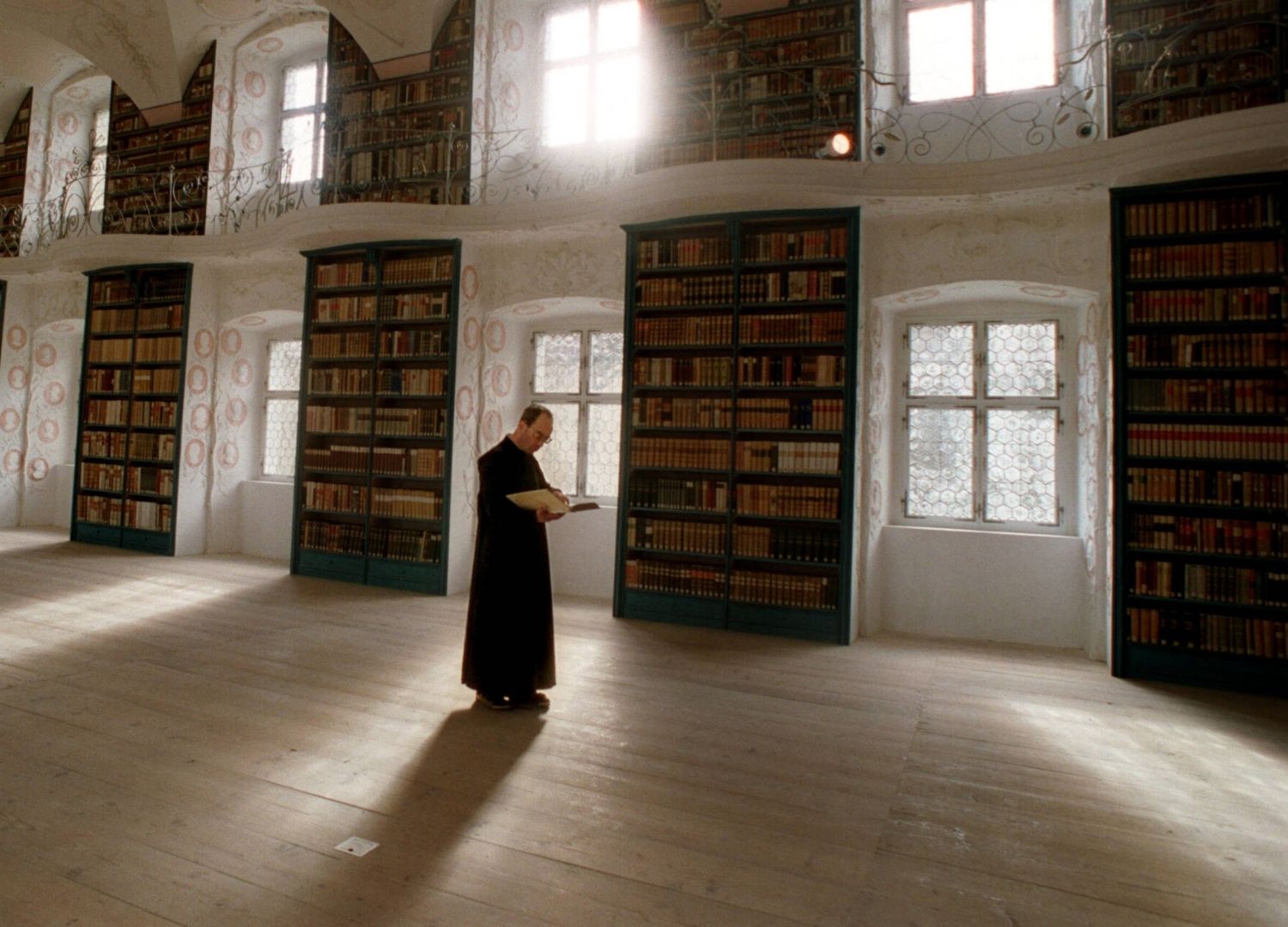
At the heart of this experience remains the primacy of the Word of God, received not as material to be mastered by study, but as the place in which the believer is slowly formed, corrected, purified and led into a real knowledge of self and of God. The monastic tradition has preserved this dynamic with remarkable precision, describing lectio divina as a true inner ascent: reading, meditation, prayer, contemplation. Reading offers the substance, placing the soul before Scripture; meditation digs deeper, searching for the hidden treasure in the revealed word; prayer turns that search into invocation, petition, desire; contemplation comes as gift and introduces the soul, even if only for moments, into the taste of eternal things. In this movement it becomes clear that the Word does not serve to enlarge one’s stock of religious notions, but to open man to an experience that converts and unifies him.
Lectio divina as an inner path
For this reason, the monk’s life is nourished by the Bible, by the Fathers, and by the patient assimilation of the sacred text, almost like bread brought to the mouth, broken, chewed and savoured. Reading offers the nourishment, meditation breaks it open and interiorises it, prayer kindles desire for it, contemplation communicates its sweetness. Along this path, the knowledge of God does not remain external to man, but descends into the heart, tests it, exposes its impurities and directs it towards that purity of heart which makes the vision of God possible. Even when the sweetness of contemplation recedes and the soul experiences weariness, dryness and distance, the journey does not come to a halt: it returns to reading, takes refuge in prayer, and learns the humility of one who knows that he does not possess the mystery and yet continues to seek it.
A witness for the whole Church
Guigo II the Carthusian spoke in precisely these terms, and this remains a decisive lesson for the rest of the Church as well. Theology keeps its centre when it is born from a word that has been heard, meditated upon, prayed and lived; it loses that centre when it closes in upon pure conceptual exercise. Monastic wisdom reminds us that revealed truth certainly requires intelligence, but before that it demands a transformation of existence. Only in this way does the Word of God truly become light for concrete life, fire that kindles desire, discipline of the heart, and a foretaste of that full communion which the monk seeks throughout his life.
Prayer as dialogue and assent
From this follows the central place of prayer. In the monastic world, prayer does not coincide with an accessory practice or with a mere obligation of the timetable. It is the concrete way in which man enters into dialogue with the Word he has received. The liturgy holds a privileged place because it offers the monk the very language of God, a biblical and poetic language that introduces him into the mystery. Yet alongside the liturgy stands personal prayer, born of lectio divina, of slow reading, meditation and inward rumination upon the sacred text. Prayer thus matures as assent to God, profound adherence to his will, and readiness to let oneself be led.
Solitude and the truth of the heart
Solitude therefore holds a decisive place. It is not sterile isolation. The desert is the place where social pretences fall away, where man ceases to hide behind roles, words and self-images. To enter the cell means to confront one’s own poverty, to measure oneself against emptiness, anguish and the truth of the heart. It is precisely there that the monk learns that separation from the world has meaning only when it becomes a purification of sight and a readiness for charity. True solitude does not produce closed individuals; it produces freer men, more capable of bearing within themselves the wounds of others. When it is authentic, the flight into the desert becomes a form of healing for the world as well.
Yet this tension towards the desert does not abolish common life. The monastic tradition insists on a point that remains theologically decisive: one cannot claim to love God without learning to love the brother who is visible. For this reason, the history of monasticism has held together two poles: the impulse towards solitude and the necessity of fraternal communion. There is no contradiction, but rather a discipline of the heart. Silence, obedience, humility, patience, shared work and mutual correction prevent the search for God from turning into individualistic spiritualism. Even the cenobitelives a form of solitude, but he lives it within a fraternity that trains him in a concrete charity.
Asceticism, poverty and manual labour
Within this dynamic, asceticism, poverty and manual labour are better understood as well. Monastic asceticism does not have self-mortification as an end in itself. It aims to free man from what weighs him down, to make him watchful, sober and inwardly available. The struggle against the passions, bodily discipline, custody of the heart, detachment from goods and from every form of possession gradually build an inner freedom. Poverty cannot be reduced to a juridical formula: it calls for real simplicity, sobriety, dispossession, and the renunciation of every comfort that obscures the expectation of God. Work itself enters into this pedagogy as a form of obedience, humility and concreteness, capable of rescuing spiritual life from abstraction.
Peace as the fruit of combat
The result of this long struggle is not hardness, but peace. Monastic literature describes the monk as a man marked by struggle, penance, toil and perseverance, and for that very reason capable of a profound peace. Not a psychological or sentimental peace, but the peace that comes from having ceased to defend one’s own ego and from having entrusted one’s life to God. The cell, lectio, continual prayer, work, silence and fraternal charity all converge towards this outcome: a pacification of the heart that makes the monk a sign of the Jerusalem to come in the midst of history.
A necessary witness even today
For this reason, monastic life still retains a singular force even today. In a time dominated by fragmentation, hyperactivity and the constant search for outward legitimisation, monasticism reminds us that man is saved by recovering a centre. That centre is the Word, it is prayer, it is the truth of a unified existence. The monk does not offer first and foremost an organisational or pastoral model: he offers a witness. He tells the Church and the world that transcendence is not evasion, that silence is not emptiness, that detachment is not contempt for created things, that renunciation can open onto a higher fullness. Above all, he says that a life wholly oriented towards God remains one of the clearest forms in which Christianity continues to manifest its promise.
fr.B.N.
Silere non possum