In the grotesque knot that has for years tightened around the Vatican, populated by impostors forever straining towards circles that continue to keep them at a distance, the tragicomic saga of certain self-styled Vatican experts and headline fabricators goes on unabated. They form part of a well-organised clique which now seems to have lost even the most basic sense of the ridiculous to which it has surrendered itself.
The April Fool’s joke that is not funny
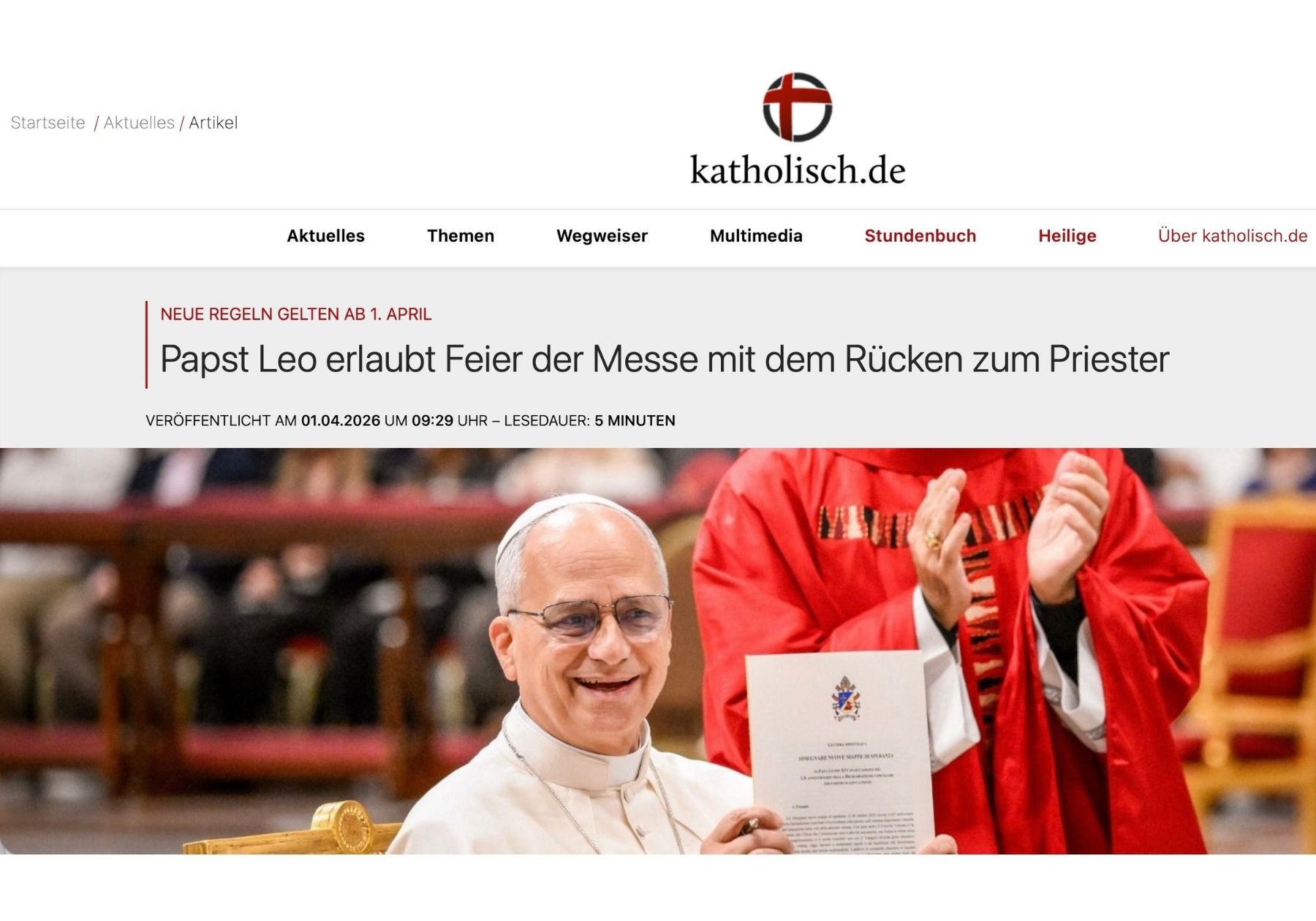
Against this backdrop, at 9.29 a.m. on 1 April, Katholisch.de published an article claiming that Pope Leo XIV was intending, at least provisionally, to settle the dispute over the pre-conciliar liturgy through an unusual compromise. The piece attributed to the Pontiff a non-existent motu proprio, significantly entitled Retrograde semper, under which the faithful would supposedly have been permitted, during Mass, to turn their backs on the priest, regardless of which missal was being used.
The article then tried to give substance to this fabrication by invoking the contrast between celebration ad orientem and versus populum, even going so far as to raise, in a deliberately caricatural tone, the idea of a priest turning round on himself, described as sicut sol. Making the entire construction even more absurd was the reference to alleged solutions supposedly being considered for the future of the 1962 Missal, including the merging of the two forms into a single missal or a fanciful “synchronised concelebration” between the ancient rite and the reformed rite, with references even to well-known figures in the liturgical debate.
A grave act and a revealing expression of Catholic journalism
To publish an April Fool’s joke in an official news outlet which describes itself on its own website as “the internet portal of the Catholic Church in Germany” is an inappropriate and ill-judged decision, one profoundly at odds with any serious understanding of the journalistic profession. Even more serious is the deliberate blending of real elements, such as Cardinal Parolin’s letter, with claims that are entirely invented. In the communicative chaos of our time, a Catholic newspaper cannot afford to play games with the conventions of news reporting on matters this delicate, because today’s reader often stops at the headline, or at most the opening lines, and even that minimal act of attention presupposes a degree of trust that is increasingly rare in an age of compulsive scrolling and distracted content consumption. That is precisely why dressing up a joke as information amounts to an abuse of trust, the very trust a news outlet ought instead to guard with rigour. It is also for this reason that many Catholics have stopped reading newspapers such as Avvenire and L’Osservatore Romano, outlets that over time have squandered their credibility and which continue to survive on funding and networks of influence with little to do with the free trust of readers.
There is, however, a second aspect, even more serious, that this episode brings starkly into view: the ideological outlook of those who run that portal. It is an outlook that has been evident for some time and is often accompanied by questionable practices, at times coming close to breaches of professional ethics, not least because of the casual way in which sources are sometimes handled. It is no coincidence that, within the German landscape, Katholisch.de is regarded with suspicion by professionals who are far more serious and far more conscious of the weight ecclesial reporting ought to carry. In this case, the ideological slant is altogether too obvious: the article amounts to a mockery of the Pope and, at the same time, of the Vetus Ordo, to which many of the faithful remain sincerely attached, with devotion and genuine ecclesial participation. It is precisely this contemptuous frivolity, dressed up as irony, that makes the affair all the more revealing.

Serious journalism is something else
We had already denounced on social media the gravity of the portal’s decision, and Silere non possum’s intervention prompted the site to publish a further article clarifying that it had all been a joke. Of course, anyone still possessing a minimum degree of discernment can see that it is a joke; and if even that is lacking, it becomes clear only to those who have the patience to read to the very end of the article, where, in almost invisible lettering, it is finally stated that this is an April Fool’s joke, as though the clarification ought to come only once the misunderstanding has already done all its damage. And that was precisely what concerned us: the fate of those readers who, whether on social media or in newspapers, do not truly read, do not analyse, do not verify, and end up accepting as true anything presented to them with a plausible headline and an apparently authoritative tone. In the Catholic world, unfortunately, figures of this kind abound, and they find their natural habitat among the Facebook and Instagram profiles of those pathological individuals most morbidly enthralled by social media, almost as though offering, day after day, a living confirmation of Umberto Eco’s famous and razor-sharp words.
For years, moreover, the Vatican scene has been stalked by people trading on false titles, men and women who proclaim themselves “journalists” and “experts in Church history”, and who like to pass themselves off as close to cardinals and bishops, while in reality remaining largely unknown figures, or figures known chiefly for their past record. They spend their time on social media exposing priests and friars to public ridicule, accusing them of faults and miseries which, quite plainly, they are unwilling to acknowledge in themselves, thereby revealing a humanity that is unresolved, murky and deeply fractured. These are names well known even to several public prosecutors’ offices, the recipients of complaints for extortion, threats, defamation, coercion and more besides: case files that pile up on the desks of prosecutors who are all too often “distracted”. And when some cardinal grants them an interview, he not infrequently ends up confronting them with their own hypocrisy, openly mocking them and reminding them, right in front of those very people “married” to men, that same-sex marriage is not accepted by the Catholic Church; something certain traditionalists, forever intent on policing what priests and lay people whom they have classed as enemies do in their underwear, are incapable of doing and which, indeed, leads them to present even their most embarrassing outbursts as “reliable”.
Thus we are left watching scenes that tip over into the ridiculous: “ultra-traditionalist homosexuals” who proclaim themselves “married” to other men, when in reality they are simply civil unions, and who then interview cardinals passed off as “their friends”, while in fact not knowing them at all; prelates who grant the interview solely because these people present themselves in the name of the outlet for which they write, while continuing to boast of a journalist’s title they do not possess. It is the circus that has for years revolved around the Vatican and the Catholic Church: a spectacle that is at once miserable and revealing. A drama which, in Italy, is certainly also attributable to Basaglia (Franco Basaglia was the man who led the way in Italy to the closure of psychiatric hospitals).
The supremely reliable Franca Giansoldati
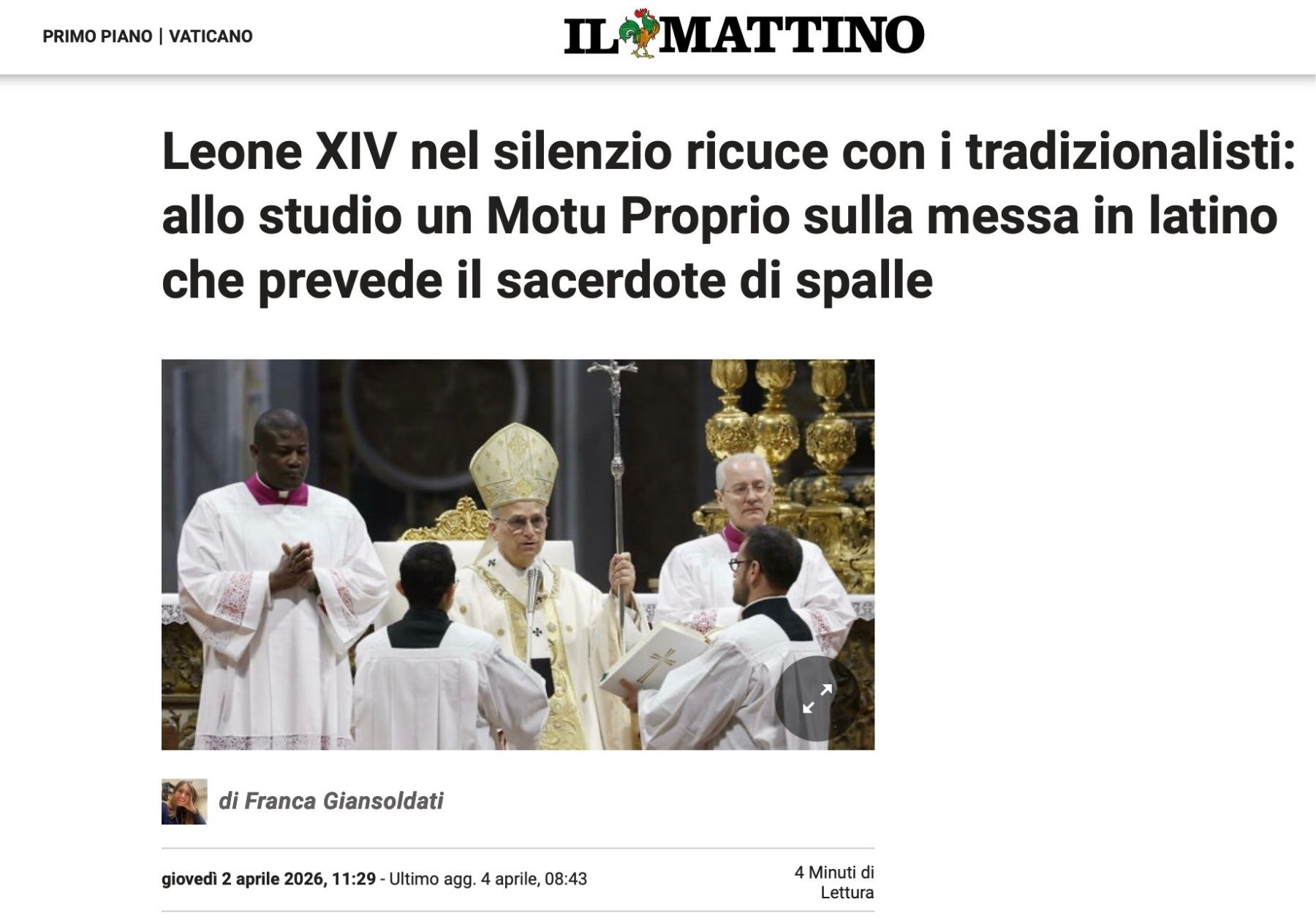
Unfortunately, fantasy was soon overtaken by reality. At 11.29 a.m. on 2 April, the “highly capable and utterly reliable” Vatican correspondent Franca Giansoldati published an article under the headline: “Leo XIV quietly mends ties with traditionalists.” We are speaking of the highly capable Vatican correspondent who for thirty years has rendered “honourable service” in reporting on the Vatican and the Catholic Church, and who is a “friend and colleague” of those boasters who have for years prowled like jackals around Vatican affairs. By completely distorting the meaning of the article, which Giansoldati evidently did not even understand, despite being a know-it-all and, of course, certainly knowing German as well, her piece claims that Leo XIV has for months been engaged in patient, discreet efforts to heal the rupture with the traditionalist world and has identified a compromise solution to defuse the dispute over the pre-conciliar liturgy.
According to the reconstruction offered by the highly capable journalist, the Pope is supposedly even preparing to introduce, by means of a motu proprio, a provision that would allow priests to celebrate with their backs turned to the faithful, regardless of which missal is used. The article then proceeds to cloak in a veneer of journalism details that ought immediately to have revealed their inconsistency. The liturgical controversy is reduced to the mere question of the celebrant’s orientation; the idea of a priest regularly turning round on himself, the famous “sicut sol”, is once again presented as though it were remotely plausible; and the piece finally goes so far as to evoke, in the tone of a seasoned insider columnist, definitive solutions supposedly still under examination, such as the unification of the two forms into a single missal or a fanciful “synchronised concelebration”. At this point the problem ceases to be merely caricatural and becomes deeply revealing. We are not dealing with an occasional oversight, but with an emblematic case of the sort of journalism that Franca Giansoldati has represented for years. The issue lies not only in having failed to understand the German text, but above all in having failed seriously to verify what it said: no cross-checking, no formal request for clarification, no comparison with other sources. And that is precisely the trait many have long recognised in her method, the same one that in the past led her to make false and defamatory remarks even about Canon Michele Basso after his death. In other words, we are faced with the emblem of a journalism that abdicates its duty of verification and allows itself to be seduced by effect, insinuation, the attention-grabbing formula, the hastily assembled backstage narrative that has not been properly scrutinised. To this must be added an even more disconcerting fact: the impression that the article later picked up and used as the basis for a further piece had not even been read to the end. It would be difficult to imagine a more pitiless representation of a certain way of practising ecclesial reporting: solemn in tone, exceedingly fragile in substance.
Nor should it be forgotten that Franca Giansoldati is the very same journalist who, over these years, has repeatedly claimed to have been the target of unjust attacks by Silere non possum, when in reality this newspaper has done nothing more than bring to light things she did entirely on her own initiative. The reality is quite different: Giansoldati has long been associated with an organised clique, indeed with a veritable criminal organisation, with the specific aim of promoting and fuelling a defamation campaign against this newspaper and against its editor. The problem? This daily exposed their incompetence and their harmful determination to shape people’s thinking rather than do journalism. That is what led this clique, together with outside elements seeking approval, to launch a genuine defamation campaign as early as April 2023, one that has never ceased and continues still today amid the culpable silence of authorities called upon to suppress conduct amounting to offences recognised and punished both under national law and under European law.
On this matter
Silere non possum will soon make public
exclusive content concerning every individual involved in that organisation, among whom
Franca Giansoldati also appears. And it is precisely she who, exactly one year ago, while
Pope Francis lay on his deathbed, was insistently asking for a
“photo of the Pope” as he was dying, maintaining that he was
“the most media-savvy Pope in history” and that not having such an image amounted to
“an anomaly”. Words and attitudes that reveal the mentality of a
media scavenger, in open contradiction with any principle of professional ethics, and which showed a willingness to instrumentalise even the Pontiff’s suffering for the sake of journalistic exposure.
Silere non possum