Vatican City - As 5 July 2026 approaches, the date on which Paolo Ruffini will reach eight years as Prefect of the Dicastery for Communication, the atmosphere in the corridors of Piazza Pia is anything but relaxed. In December, Andrea Tornielli and Andrea Monda will reach the same milestone; in July, meanwhile, it will be seven years for Matteo Bruni, Director of the Holy See Press Office. This sequence of expirations effectively reopens the question of governance and the editorial line of the Vatican media, precisely at a time when the new pontificate is demanding clarity, coherence, and adequate tools. Considering that, in 287 days, Pope Leo XIV has not wished to receive these figures in audience – with the exception of Paolo Ruffini, whom he met last June for a lightning audience – concern is growing at Piazza Pia: many fear that the Pontiff does not intend to wait for the completion of the full five-year term before dismissing them. And it would be nothing short of a wise choice.
Everyone tending their own patch
The current command structure consists of a restricted group, riddled with internal friction and competing balances of power, in which everyone protects their own areas of influence. On one point, however, the differing sensibilities converge: the idea that priests should not return to management roles within the Dicastery. Indeed, the mere fact that a cleric might even be inserted into a top role in the Dicastery makes them shudder. Into this picture steps Msgr. Lucio Adrián Ruiz, who has clashed with the Prefect on more than one occasion: the management of social networks and the approach of the "Gospel on social media" project have, over the years, followed different lines, with investments and priorities that have not always converged. For the older brother of the former director of the Italian Revenue Agency, social media is not something to invest in, and the results of this "farsighted" approach of his have borne much fruit for the Holy See; we are seeing only some of it today.
Communication organised to save seats
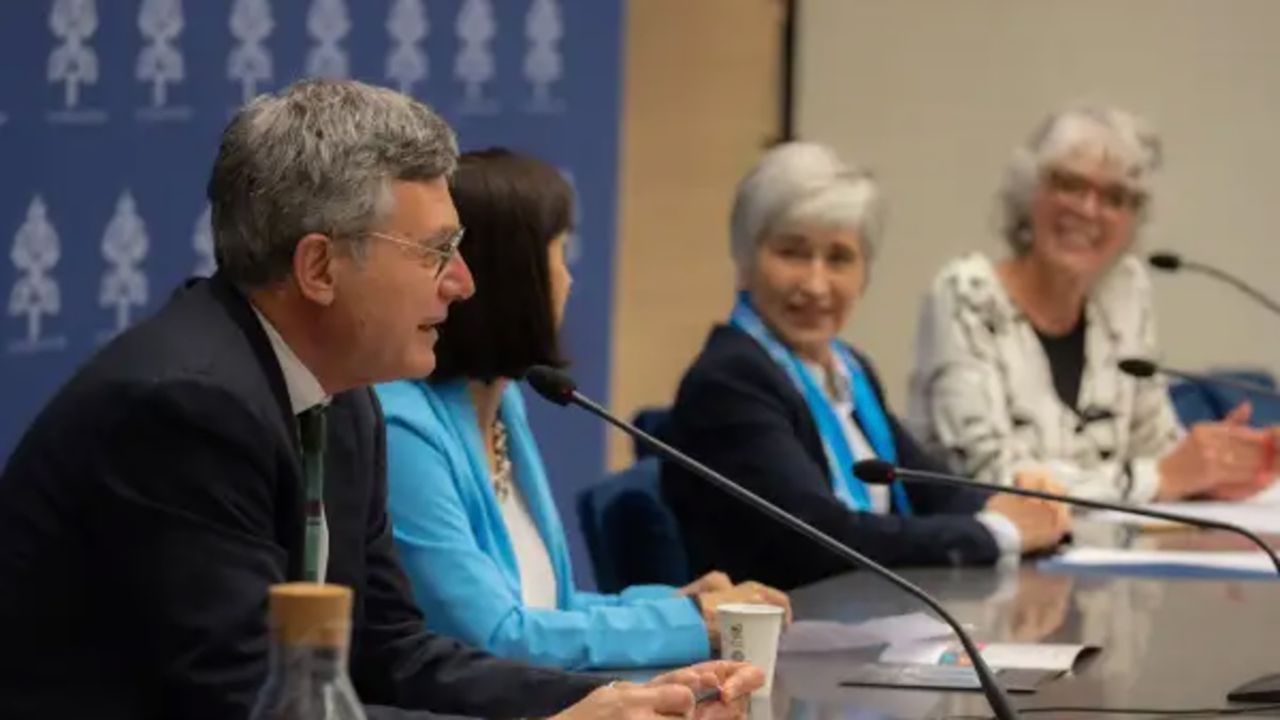
In recent hours, the appointment of a religious sister to replace Christiane Murray has caused alarm for quite a few people. Krapić has a solid Catholic background: she is a jurist and, above all, a Croatian journalist with editorial activity already documented by numerous published articles. However, it must not be forgotten that Sister Nina Benedikta Krapić is a staunch loyalist of Nataša Govekar, who wanted her and brought her into the Dicastery. Govekar, in turn, was appointed in previous years as Director of the Theological-Pastoral Directorate of the Dicastery for Communication by virtue of her belonging to the circle of Marko Ivan Rupnik. Govekar, following the scandal that emerged regarding the Slovenian Jesuit, was among the main supporters of the line that prevented the removal of images of Rupnik’s works from the Vatican News website, causing discomfort to the entire Holy See and inevitably damaging the Pope’s image. We will not deal today with the situation of the Holy See Press Office, which is in a pitiful state and where employees are paying the price, amongst other things, for the excessive power of a woman whom Matteo Bruni seems to allow free rein because she enjoys "his esteem".
Today we want to concentrate on what is happening at Piazza Pia. The fact that Leo XIV chose a religious sister and not a layperson has nevertheless begun to make the seats of some tremble: they moved quickly, running for cover and engaging a "heavyweight" name. They chose one of those cardinals who, in terms of the ability to change the direction of their flag depending on which way the wind is blowing, is second only to Christoph Schönborn. Indeed, under the pontificate of Francis, the Canadian Cardinal Marc Ouellet began to support unsustainable theses that he would never have affirmed during the pontificate of Benedict XVI, of whom he boasted of being a "loyalist"; with Francis, conversely, he endorsed any statement regarding the presence of laypeople in the places of governance of the Roman Curia. Some of his confreres report that all this happened primarily due to the accusations of abuse received in Canada and that Ouellet feared that, without Francis’s protection, he risked meeting the same fate as George Pell: returning to his homeland to face a trial and then, despite being innocent, exposing himself to the danger of a conviction, useful only to give the impression that specific crimes are genuinely pursued in Canada too. Yet, as we know, these laypeople, when they can take advantage of one person or another, do so: they show no favour to anyone. Thus Ruffini, Tornielli, Menichetti and José thought it best to turn to him specifically and have him publish an article on Vatican News which, in order to have "good resonance", they had translated into Italian, French, English and Spanish. The article explains that laypeople are very dear and good and that they can happily occupy roles of governance. From a sacramental and canonical point of view, however, no explanation or solid justification is offered. It is one thing to consider what Canon 129 §2 provides, when it states that "lay members of the Christian faithful can cooperate" in the exercise of the power of governance: the law indeed knows various cases in which laypeople assume tasks precisely by virtue of this cooperation. It is quite another thing to maintain that laypeople are "capable" of the power of governance in the proper sense. Once again, therefore, many slogans and no serious in-depth analysis. The aim, however, is crystal clear: to send a precise message to the Pope. There are cardinals – coincidentally figures who have nothing left to claim and who exercised their service in years when their authority was not questioned – ready to back these laypeople; the laypeople must stay where they are, and priests are not needed. Obviously, the article was "spammed" to all the Vaticanists and some, such as Repubblica, did the "favour" of spreading it.
Aversion to a Pope who "acts like a Pope"
From the beginning of the pontificate, Leo XIV has followed what happens at Piazza Pia with attention, monitoring the work of a leadership that receives disproportionate remuneration but struggles to offer a recognisable and stable guiding line at the service of the Holy See. The knot concerns not only the methods of communication, but the editorial choices: what is decided to be published, with what timing, according to what hierarchy of news and with what criterion of completeness. In theory, the Dicastery for Communication should guarantee an efficient and integrated system, capable of channeling Holy See content and updates into a single platform, also allowing a member of the faithful to orient themselves rapidly. In practice, the fragmentation remains evident: the Secretariat of State and the various Dicasteries continue to move with their own graphic designers, their own web managers and autonomous priorities, without truly unified direction. Emblematic, too, remains the institutional website of the Holy See, which should be the reference channel for the Pope’s magisterium: the system appears dated, the updates made in recent months are primarily aesthetic, and usability remains poor. Information that is already obsolete appears there, consultation paths are non-intuitive, and the overall structure conveys an impression of disorder. In a phase in which it is decisive that the Pope’s voice arrives with clarity, timeliness and through adequate channels, the current setup often ends up achieving the opposite effect, making the circulation of content more laborious and its dissemination less effective. This is also confirmed by the management of official photographs: requests that, in many cases, require weeks before receiving a response. A wait that discourages both the faithful and prelates from asking for them, with repercussions on the economic level as well, because it translates into a loss of revenue that is anything but marginal. For years, in fact, an elementary solution has been lacking: an automated platform capable of uploading materials, allowing payment and permitting the user to download them immediately, with immediate procedures. It is unclear why, in almost a decade, there has been no desire to set up such a system. Is someone afraid of causing job losses for those who respond, quite calmly, to emails manually?
The lack of a coherent editorial line
Despite a significant salary, Andrea Tornielli has for some time employed his energies primarily in the dynamics of taking sides and in the management of relationships that are anything but positive, oriented towards attacking and provoking – to the point of defaming and slandering – those whom the Editorial Director of the Vatican Media has labelled as his enemies, rather than in the editorial work of the Vatican media. The theme resurfaced this summer at the Rimini Meeting and will be the subject of a dedicated in-depth analysis: for the readers of Silere non possum, what happens and what role the Editorial Director of the Vatican Media plays in it will be reconstructed, with documentary evidence and confirmation. The material is ready: only a few "technical issues" remain. In the meantime, the archive continues to grow. "Silere non possummoves calmly, but when it arrives, it is felt," someone dared to say on 1st January last. Since it does not appear that concrete interventions have been adopted to curb this criminal behaviour, we will have no difficulty in explaining to the faithful who is selected – according to logic that, to date, appears to be a veritable masochistic practice – to cover such delicate positions, with direct repercussions on the image of the Catholic Church and the Pope. To return to the merits of this analysis, the incompetence, arbitrariness, and absence of logic and a coherent editorial line also emerge clearly in the management of simple episcopal appointments. On the Vatican News website, not all appointments are accompanied by a dedicated article: some receive great visibility, others remain entrusted to sparser forms of publication. Everything depends on the ties the nominated bishop has with Tornielli or the entourage. A similar dynamic is also found in L’Osservatore Romano, where space is found primarily for writers deemed close to the sympathies of the director, whilst other contributions – sometimes of far superior value – are not even taken into consideration. In this context of terror, there are those who criticise these "executives" in hushed tones, aware of the weight that the lay leadership of communications can exercise over their "careers" and "opportunities". In substance, Vatican News ends up functioning a bit like a showcase for the initiatives of "friends". One need only note that on the portal there is no trace of the critical issues and disasters attributed to Mauro Gambetti. It is not a detail that Paolo Ruffini sits on the Board of Directors of the Fratelli Tutti Foundation. By the same token, in recent months Gabriele Giordano Caccia, Permanent Observer of the Holy See to the United Nations, has obtained ample space on the portal directed by Andrea Tornielli, with punctual coverage of speeches and considerations. A choice explained by the interest of his sponsor, Pietro Parolin, who asked Tornielli to increase his visibility whilst awaiting the United States' approval for Caccia's nomination as Apostolic Nuncio.
Leo XIV visits roman parishes, but Vatican News?
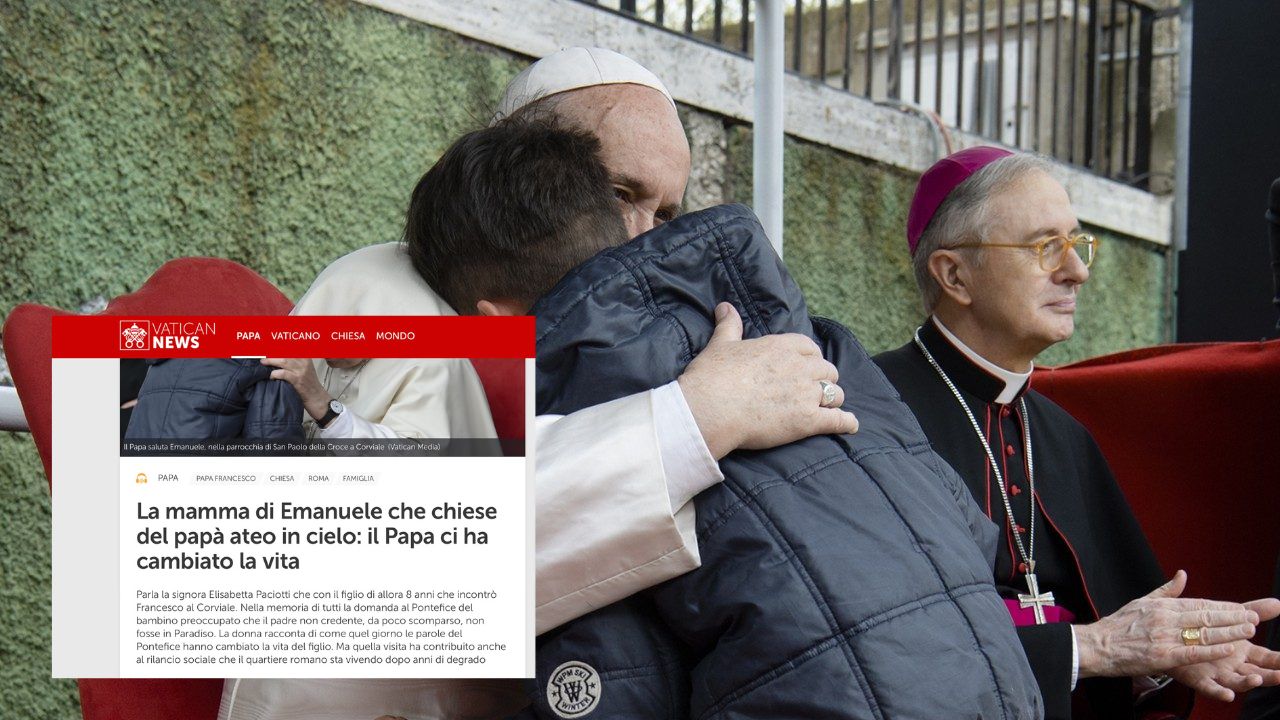
Silere non possum has already highlighted how, with the start of the pontificate of Leo XIV, colossal gaffes have been recorded which have generated embarrassment; and, above all, how a truly ordered and incisive institutional narrative has never taken off. Whereas, in the pontificate of Francis, every choice was relaunched with enthusiastic tones, today the register results more tenuous, sometimes rigid, with an impression of fulfilling a duty rather than a project: a machine that proceeds, but without a clear identity. A concrete example is the Holy Father's first pastoral visit to a parish last Sunday. Cernuzio and Guerra were sent to the site. As is known, Cernuzio is the "protégé of Andrea Tornielli" who brought him to the Vatican from La Stampa where he worked and "wrote so many books" (cit.). The order Cernuzio received was to write only one article at the end of the day. The Vatican News live broadcast covered the Holy Mass, whilst the Pope's meetings with the 400 young people, the elderly, the sick, the poor and the Caritas volunteers were not broadcast at all. The comparison with some public outings of the previous pontificate is inevitable: then the coverage was massive, with more journalists, more content and a constant push for circulation on social media and on the website, often constructed artificially around emotionally strong passages, selected and used as a narrative lever. Suffice it to recall Pope Francis's visit to the parish of San Paolo della Croce in Corviale: the image of the child who had recently lost his father made the rounds of the international press, and that pain was transformed into communication material. On Sunday, however, the images of those meetings were not even broadcast. Communication, for any public authority, remains a decisive sphere; for the Pope, it is so to an even greater measure. Without an intervention on the decision-making chain and on the operational priorities of a structure that seems to move according to its own logic, the risk is that of finding oneself in a spiral of misunderstandings and stumbles already seen in the past, when between 2010 and 2012 the management of crisis and narrative weighed significantly on the pontificate of Benedict XVI.
F.C. and Fr.D.P.
Silere non possum