Vatican City - “After the Jubilee Year… we are beginning a new cycle of catecheses that will be dedicated to the Second Vatican Council and to a rereading of its Documents.” With this decision, Leo XIV today inaugurates his first Wednesday catechesis after the closing of the Holy Door, marking a precise turning point: for as long as the horizon of the Jubilee Year lasted, the Pope remained within a path already set in motion; now he opens a new journey, one he intends to structure as a cycle and which touches on a point particularly close to his heart. It is a decisive choice for reading the pontificate of Leo XIV: it speaks of his desire for unity throughout the Church and confirms that continuity which many observers are noting with increasing clarity between the Augustinian Pope and the pontiff who most loved Augustine, Benedict XVI.
It is often repeated: many speak about Vatican II, while very few have truly read its texts and understood their meaning. For this reason, the Pope’s proposal does not rely on “interpretations” or second-hand formulas, but on a rereading of the Documents, capable of clearly orienting the Church’s path. It is a choice by the Pope that should not go unnoticed even by those who, in these hours, are pressuring the cardinals they finance and are already weighing down the climate surrounding a delicate appointment such as the Extraordinary Consistory. Leo XIV appears determined to be unequivocal on this point: rites are important, all of them; but woe to anyone who imagines they can evade or bypass the Second Vatican Council.
Vatican II as a “hinge” and as a watershed
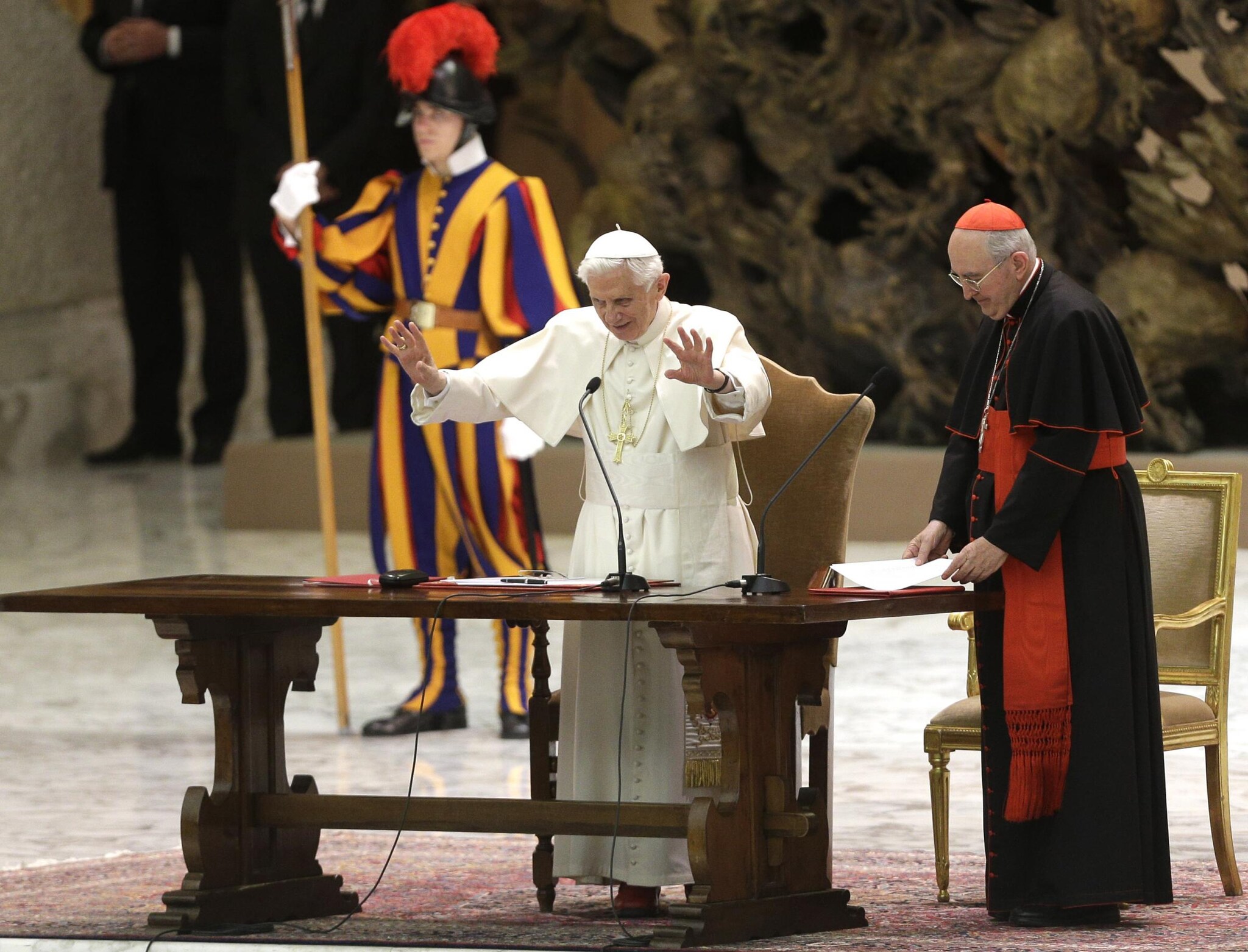
This choice, as we were saying, is a precise hinge, a clear connection with a passage that marked recent ecclesial memory and brings us directly back to the pontificate of Benedict XVI. The reference is to 14 February 2013, when Ratzinger, after announcing his intention to resign, wished to meet the clergy of Rome: not with a prepared text, but speaking extemporaneously about the Second Vatican Council, almost as if to entrust the Church with a decisive interpretative key.
From that meeting emerged a text that remains, even today, to be meditated upon in order to understand the role of the media, the pressures, and the years of internal struggles within the Church. And above all, it was significant that Joseph Ratzinger chose to take leave of his diocesan clergy on this subject and with those words. The opening of his address immediately set the tone: gratitude for a clergy that was “truly catholic, universal”; an awareness of catholicity as the essence of the Church of Rome; the need for vocations and for a faith that is “strong and robust”. Then came the link to the Creed professed before the tomb of Peter and to the fundamental ecclesial logic: together with Peter, to confess Christ, to follow Christ, to grow as Church. It is at this point that Benedict XVI introduces his “little chat” on Vatican II “as I saw it”, placing it within personal memory and within the original atmosphere: the enthusiasm, the expectations, the hope for a “new Pentecost”, the perception of a Church that risked appearing a “reality of the past”, and the desire to renew the relationship between Church and modernity. Leo XIV is the second pontiff, elected after Vatican II, not to have personally lived through this event. And he seems intent on indicating a very concrete path: if we want unity, we must return to understanding what that event truly was and what the Council of the Documents - to use Ratzinger’s expression - actually handed on to the Church, not a Council reduced to an ideological banner, wielded to strike others and, in the end, the Church itself.
The real Council and the Council of the media
Benedict XVI described a “Council unto itself”, perceived by the world through categories external to faith, with a political reading: power struggles, oppositions, the reduction of the Council to partisan dynamics. From this derive, in his analysis, translations and banalizations: the liturgy read as an activity of the community rather than as an act of faith; the idea of participation understood as outward activism; intelligibility transformed into banality; Scripture treated as merely a historical book; a reception in which the “virtual Council” ends up appearing stronger than the real Council. And Benedict lists concrete consequences: seminaries closed, convents closed, a banalised liturgy. Leo, today, seems to want to tell us that the task of the Church is to work so that the real Council, with its spiritual force, may truly be realised.
Leo XIV: rereading, not repeating
It is within this framework that Leo XIV’s choice today is situated. In this Wednesday’s catechesis he states that it is a precious opportunity to rediscover the beauty and importance of this ecclesial event. He recalls the judgement of Saint John Paul II, who defined the Council as a “great grace” received by the Church in the twentieth century; and he recalls Benedict XVI, to reaffirm that the Documents have not lost their relevance and that their teachings remain pertinent to the new demands of the Church and of a globalised society. The Pope describes Vatican II as an event capable of rediscovering the face of God the Father, the Church as a mystery of communion and sacrament of unity, the liturgical reform centred on the mystery of salvation and on the active and conscious participation of the People of God; and, at the same time, as an opening to the world in dialogue and co-responsibility, in the desire to “open its arms to humanity”, to echo hopes and anxieties, to collaborate in building a more just and fraternal society. In this perspective he also cites Saint Paul VI: “the Church becomes word; the Church becomes message; the Church becomes dialogue”, and places Vatican II within the trajectory of ecumenism, interreligious dialogue, and dialogue with people of good will.
A deeper criterion: holiness and the long view
There is another passage that carries weight: the reference to Albino Luciani, the future John Paul I, who wrote prophetically that the need does not so much concern organisations, methods or structures, as a holiness that is “deeper and more widespread”, and that the fruits of a Council can mature over time, passing through contrasts and adverse situations. It is an important note that invites us to shift our gaze: the Council is not an event to be filed away with immediate reforms, but a process that demands conversion and maturation. From here comes the reference to Pope Francis and to the need to “restore primacy to God” and to a Church “mad with love” for the Lord and for men.
Why begin now
The point, then, is that Leo XIV chooses to begin precisely now - after the closing of the Jubilee - a cycle on Vatican II because he considers it decisive for the orientation of the Church. His catechesis is not a commemoration: it is a method. To return to the Documents, to take the Council as a criterion of discernment, to receive tradition and at the same time to question the present, to “run towards the world” carrying the Gospel of the Kingdom of God, a kingdom of love, justice and peace. It is also a call to dismantle misunderstandings that have, over time, become almost automatic reflexes. Leo XIV seems to want to say that the Council did not “close cupboards”, did not renounce a liturgical tradition, did not ask for the abolition of the previous Missal, did not establish that Latin could no longer be used. None of this. Vatican II handed on precise indications, and those indications are to be found in the texts, not in hearsay. Only in this way – by returning to the Council of the Documents – can a real path of communion in the Church be rebuilt: not to make everyone the same, but to place everyone in a position to walk together, with a shared and finally verifiable foundation. In this sense, the first Wednesday catechesis after the closing of the Jubilee is not merely the beginning of a series. It is the choice to reopen an essential worksite: to place the Church once again before the texts, so that from engagement with those texts there may pass a truer understanding of the present and a clearer responsibility towards the future.
fr.M.S.
Silere non possum