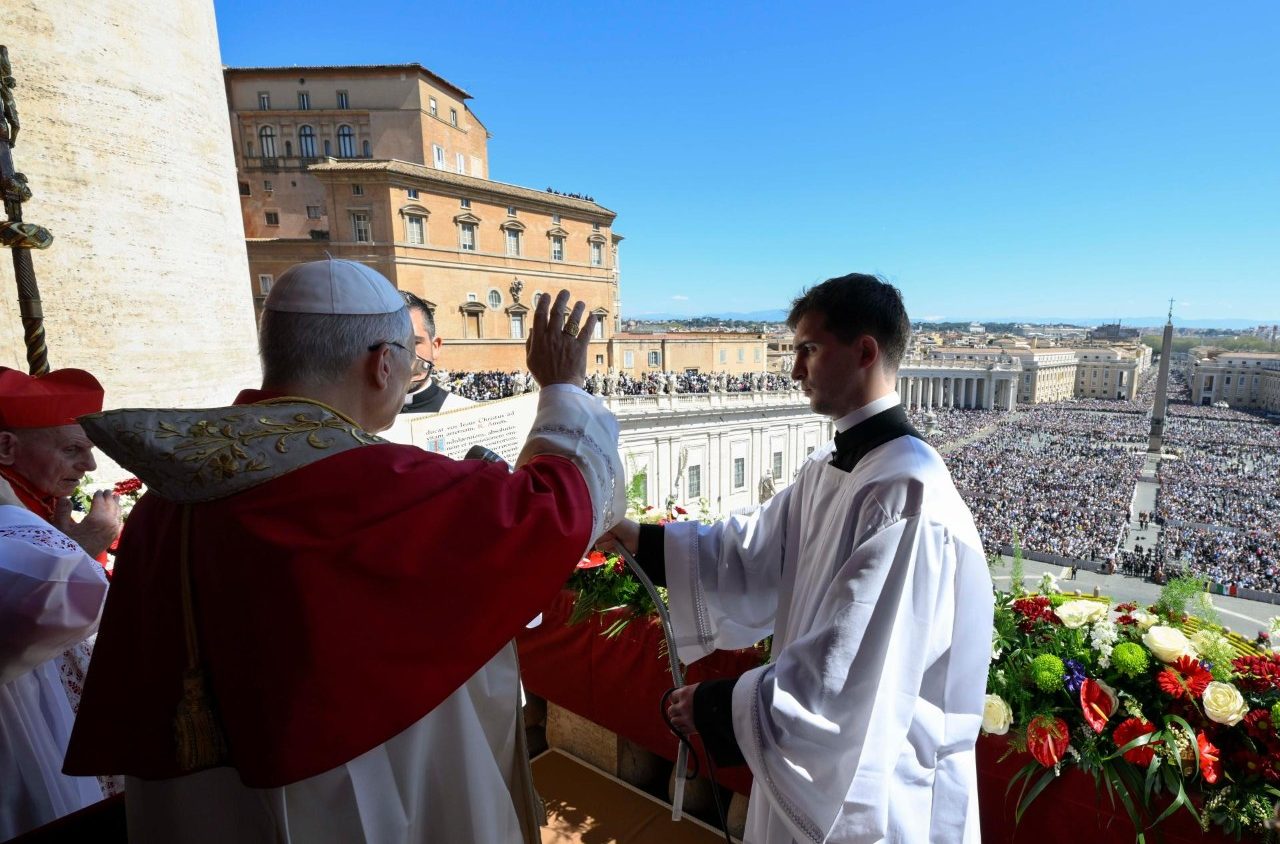
Vatican City - After the solemn Easter Sunday Pontifical Mass, celebrated this morning in St Peter’s Square, Leo XIV appeared at 12 noon on the central loggia of St Peter’s Basilica for the traditional Urbi et Orbi Message and Blessing, addressed to the city of Rome and to the whole world.
From there, the Pope entrusted to the Church and to the international community an address shaped by the theme of peace, read within the Paschal mystery of the death and resurrection of Christ. “Christ is risen! Happy Easter!”, the Pontiff began, before developing his address around a central truth: Easter is the victory of life over death, of light over darkness and of love over hatred, yet this victory does not arise from a logic of power. It comes instead through Christ’s sacrifice, through obedience to the Father, through the total gift of self. The Pope explained that the power of the Resurrection is God himself, his faithful and creative love, capable of forgiving and redeeming. The most significant part of the message concerns precisely the way in which Christ conquers. Leo XIV insisted that the Resurrection does not reveal a worldly force, nor a revenge enacted through violence. He presented it, rather, as an entirely non-violent power, likened to the grain of wheat that dies in the earth and to the wounded heart that renounces revenge. Here lies both the theological and the political heart of the address: for the Pope, peace is not a mere balance between opposing interests, but the fruit of relationships transformed by love, marked by respect among individuals, families, social groups and nations, and directed towards the common good.
 © Vatican Media
From this perspective came the most direct appeal of the address: “Let those who have weapons lay them down!”Immediately afterwards, Leo XIV called on those who have the power to provoke wars to choose peace, and to do so through dialogue and encounter. The Pope also made clear that the peace of Christ does not coincide with an outward truce or with the simple silence of weapons. It touches the human heart, converts it, and frees it from the will to dominate and the pursuit of power. For this reason, his was not merely a diplomatic appeal, but a moral and spiritual summons addressed to rulers and peoples alike.
Another important point in what was Leo XIV’s third Urbi et Orbi Message was his denunciation of the growing habit of violence. Leo XIV observed that people become accustomed to conflict, resign themselves to death, and grow insensitive to division and even to the economic and social consequences of war. In this context he took up the expression “the globalisation of indifference”, also recalling the words spoken a year ago by Pope Francis from this very same loggia. The Pope linked the celebration of Easter to the urgency of not turning away from the suffering of the world. In his words, the Resurrection is not a theme detached from history, but the criterion by which indifference, evil and fear are to be judged.
The message concluded with an invitation to join the prayer vigil for peace which Leo XIV will celebrate in St Peter’s Basilica on Saturday 11 April. Before imparting the blessing, the Pontiff then offered Easter greetings in several languages, from Italian to Latin, bringing to the loggia the universal tone proper to the Urbi et Orbi.
s.G.B.
Silere non possum