Vatican City – Six years after a postponement announced only weeks before the scheduled ceremony, the Holy See has now given its definitive approval: Archbishop Fulton J. Sheen will be beatified on 24 September 2026 in St. Louis, Missouri. The ceremony will be presided over by Cardinal Luis Antonio Tagle, Prefect of the Dicastery for Evangelisation.
The announcement was made by the Bishop of Peoria, Louis Tylka, who stated on 9 February: “The Holy See has informed me that the cause of the Venerable Servant of God, Archbishop Fulton J. Sheen, may proceed to beatification.” The diocese in Illinois, where Sheen grew up and was later buried, worked with the Dicastery for the Causes of Saints to determine the details of the celebration. The decision brings to a close a long and complex process, formally opened in 2002 and marked by progress, suspensions and further examinations.
A central figure in twentieth-century Catholicism
Born in 1895 in El Paso, Illinois, Fulton Sheen – baptised Peter John Sheen – was ordained a priest in 1919 for the Diocese of Peoria. He quickly distinguished himself for his academic formation and for his ability to combine theological rigour with effective communication.
After studies in the United States and Europe, he taught philosophy and theology before being appointed Auxiliary Bishop of New York in 1951 and later Bishop of Rochester in 1966. In 1969, after leaving that office, he was granted the title of archbishop. His significance, however, extends beyond episcopal ministry. Sheen is remembered above all for his remarkable work in evangelisation through the media.
The television face of evangelisation
Even before television, Sheen reached a wide audience through the radio programme The Catholic Hour (1930–1950). The move to television marked a turning point: with Life Is Worth Living (1952–1957) and later The Fulton Sheen Program (1961–1968), he became one of the most recognisable figures in religious communication of his time. His direct style, capable of addressing both believers and non-believers, earned him an Emmy Award and a level of recognition that extended well beyond the United States. As early as 1958, it was noted that he was known “far beyond” his own country for his work as a writer and for his television programmes.
At the same time, Sheen served as National Director of the Pontifical Mission Societies in the United States from 1950 to 1966, contributing significantly to the support of missionary activity and developing the five-colour Mission Rosary as a symbol of the continents.
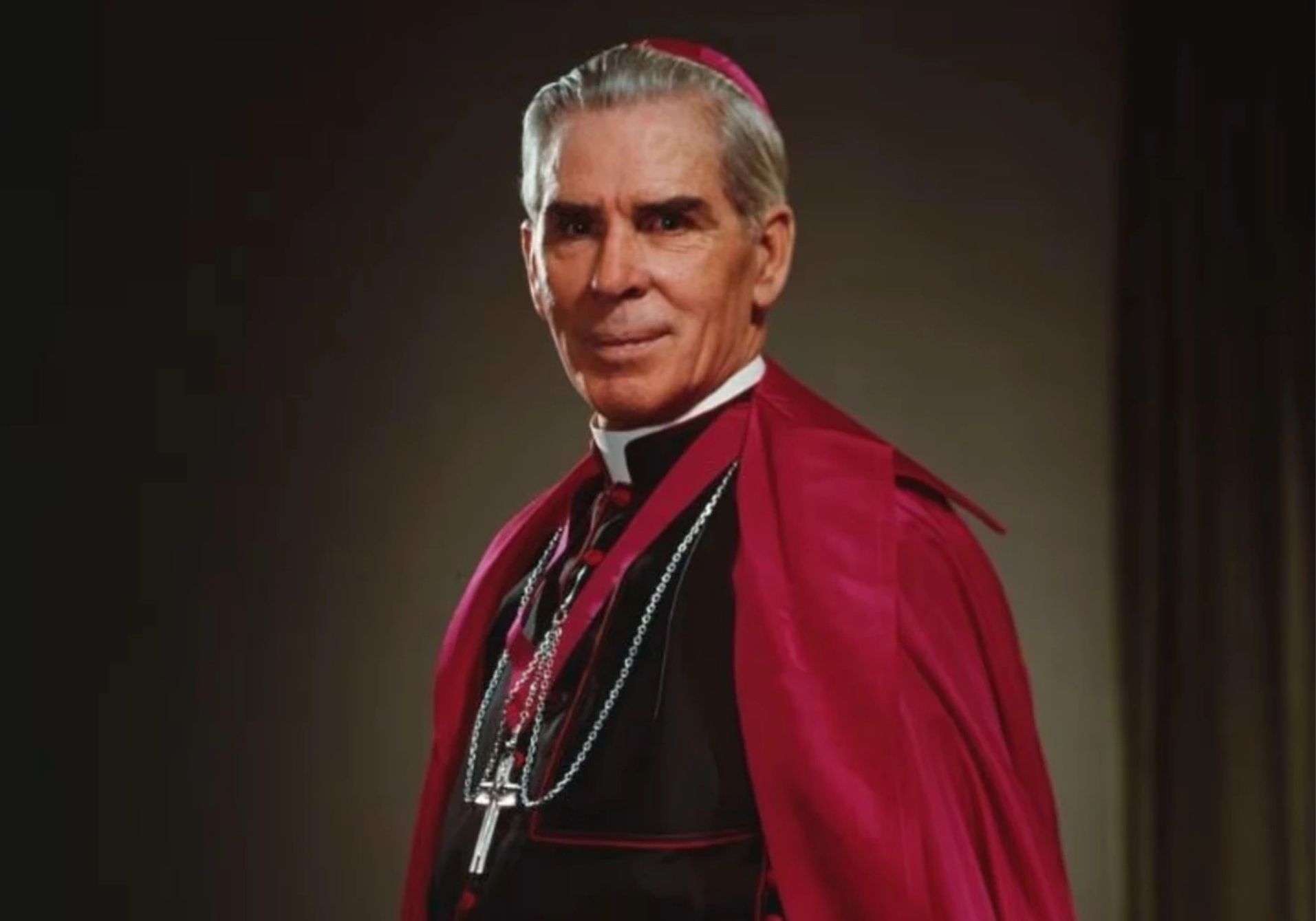
A rooted and communicative spirituality
In outlining the figure of the archbishop, Bishop Tylka stressed that Sheen was “one of the greatest voices of evangelisation in the Church and in the world of the twentieth century”, highlighting the foundation of his pastoral work: devotion to the Eucharist and to the Blessed Virgin Mary. His ability to communicate the Gospel in new forms, without losing theological depth, shaped entire generations. Countless people, the statement notes, were led to an encounter with Christ precisely through his ministry.
A long and complex path towards canonisation
The path to beatification has involved several stages, some decisive, others controversial. The cause for canonisation was opened on 14 September 2002, when Sheen was given the title Servant of God. In 2012, Pope Benedict XVI recognised his heroic virtues, granting him the title Venerable. In 2014, the miracle was approved by medical experts and theologians, but in the same year the cause was suspended due to a dispute between the dioceses of Peoria and New York over the place of burial. The matter was resolved in 2019, when a New York court authorised the transfer of the remains to Peoria. That same year, Pope Francis formally approved the miracle, opening the way to beatification.
Everything appeared ready for the ceremony scheduled for 21 December 2019, but on 3 December the Holy See decided on an indefinite postponement for further examination relating to the period when Sheen was Bishop of Rochester. Only now has the definitive approval arrived: consent to proceed on 9 February, and on 25 March the official confirmation of date and place.
A beatification of strong symbolic value
The beatification takes place at a moment of particular symbolic significance: during the 250th anniversary of the United States Declaration of Independence and within the pontificate of Leo XIV, the first American Pope. In this context, Sheen’s figure emerges with renewed relevance within a Church called to confront increasingly complex cultural and communicative challenges. The beatification also occurs during a pontificate that, from the outset, has emphasised the responsibility of words, the need for serious information, and the duty to seek the truth.
His legacy today is linked to a fundamental question: how can the Gospel be proclaimed in a world shaped by the media, without reducing it to a superficial language and without diminishing its force?
Revisiting the figure of Fulton Sheen helps to understand that the means of communication do not empty the content of the message: everything depends on the seriousness with which they are used and on fidelity to the truth one seeks to convey. For this reason, his witness continues to challenge not only the faithful and the clergy, but also the world of journalism, which is called each day to reckon with the weight of words, the responsibility of narration, and the duty not to betray reality.
fr. L.C.
Silere non possum